Showing posts with label budget. Show all posts

Friday, January 4, 2013

January 4, 2013


NEWSMAX
Gore's $70M Take from Current TV Designed to Avoid Obama Tax Hikes
by Bloomberg News
January 3, 2013

Al Gore, who shared the 2007 Nobel Peace Prize for his fight against global warming, may gross about $70 million from the sale of his Current TV network to Al Jazeera, the cable channel funded in part by oil-rich Qatar.

Al Jazeera will pay about $500 million for Current TV, including the stake held by Gore, 64, according to two people with knowledge of the deal. The network is one of dozens of investments made by the former vice president since he lost the 2000 presidential race by a slim margin, Bloomberg reported.

“It’s reeking with irony,” said Jeff Sonnenfeld, senior associate dean at the Yale School of Management, who studies corporate governance. “It seems to be at least a paradox in terms of his positions on sustainability and geopolitics.”

The deal highlights Gore’s makeover from career politician to successful businessman. His take from the Current TV sale is is many times the maximum net worth of $1.7 million he reported while running for president in 1999. Besides investing in startups, Gore is on the board of Apple Inc. (AAPL), an adviser to Google Inc., according to his website biography, and a partner at Kleiner Perkins Caufield & Byers.

Late Thursday, Fox News and other media reported that the sale seemed to have been rushed to avoid the anticipated fiscal cliff tax increases.

In addition to wanting a buyer who would reflect his political philosophy, Gore was anxious to fulfill his fiduciary responsibility to himself and keep his taxes low, the Washington Times reported.

"A critic of the tax structure that allows the very wealthy, like former Massachusetts Governor Mitt Romney and billionaire tax activist Warren Buffet, to escape the high income tax rates paid by their secretaries, Gore attempted to complete the deal by December 31," the Times reported Thursday. "Because the deal wasn’t signed until today, he and his partners will pay the new 23.8 percent capital gains tax rather than 15 percent, or an extra $8.8 million."

“The green of money knows no political boundaries,” Charles Elson, who is director of the John L. Weinberg Center for Corporate Governance at the University of Delaware, told Bloomberg News. “When you are running investments, your priority needs to be maximizing return.”

Gore’s holdings also include investments in Amazon.com Inc., EBay Inc. and Procter & Gamble Co. through his Generation Investment Management LLP.
2004 Purchase

Gore holds a 20 percent stake in Current TV, according to the people, who asked not to be named because the sale terms aren’t public. His proceeds are difficult to pin down because the company had $41.4 million in debt, as well as preferred stock entitled to $99.5 million in the event of a sale or liquidation, according to a 2008 regulatory filing.

The Current TV price represents a sevenfold increase from the $71 million Gore and his partners paid for the predecessor company in 2004, according to the filing. Gore, chairman, and Joel Hyatt, a co-founder and chief executive officer, announced the sale yesterday in a statement, without providing financial terms.

Kalee Kreider, a spokeswoman for Gore, didn’t respond to a phone call or e-mail request for comment.

“Many Americans are tired of borrowing huge amounts of money from China to buy huge amounts of oil from the Persian Gulf to make huge amounts of pollution that destroys the planet’s climate,” Gore said in September 2006 at the New York University School of Law. “Increasingly, Americans believe that we have to change every part of that pattern.”
Current Investors

The network’s investors included funds controlled by Los Angeles billionaire Ron Burkle and San Francisco money manager Richard Blum, according to the 2008 filing, when the company unsuccessfully sought to sell stock to the public. Blum is married to U.S. Senator Dianne Feinstein, a Democrat from San Francisco.

The Raine Group advised Current TV on the sale.

The owners introduced Current TV in 2005 after purchasing the network from Vivendi SA.

Al Jazeera is closely held and gets some funding from the government of Qatar, a small country on the eastern side of the Arabian Peninsula that gets almost half of its gross domestic product from oil and gas, data compiled by Bloomberg show.

Read more: http://goo.gl/7waHh


TOWNHALL
Mike Lee: Senators Only Had Six Minutes to Read “Fiscal Cliff” Bill Before Voting
by Daniel Doherty
January 3, 2013

What could go wrong, right? According to Utah Republican Senator Mike Lee, members of the upper chamber had -- at most -- six minutes to read the “fiscal cliff” bill before they voted on it. Little wonder, then, that the so-called “compromise” was in many respects a complete and total disaster:

"Everything about this bill was a failure…you need look no further than the fact that we were given a total of six minutes before we voted on it. Not one single Senator who voted for this bill had read it."
 This should trouble every American. I mean, if Senators aren’t reading a bill that will pretty much impact every single working American, what else aren’t they reading? An important question to ponder, it seems. Still, this isn’t the first time members of Congress have passed sweeping legislation without understanding the details of a bill, let alone the consequences of voting “aye.” Nancy Pelosi infamously said in 2010 we need to pass Obamacare to “find out what is in it.” Just look at how that turned out. Is it really surprising, then, that about half the country is not feeling optimistic about the future, and thus probably believes that the American Century has already come and gone? An exceedingly chilling thought, if you ask me.

Above all, we need leadership in Washington, something this Congress -- as well as the last one -- seems incapable of providing.

Read more: http://goo.gl/jfC7C


BREITBART
Inside the Conservative Rebellion Against John Boehner
by Matthew Boyle
January 3, 2012

House Speaker John Boehner barely held onto his job atop Congress’ lower chamber on Thursday. Just how close a call Boehner had is now becoming clear.

Nine House conservatives voted for somebody other than Boehner, two abstained from voting and one voted “present.” That total of 12 Republicans who didn’t support Boehner was a stone’s throw from the required 17 to force a second ballot election – at which point several more Republican members were slated to back a competitor to Boehner’s, who would unite the party behind him or her.

Politico has reported the original list of members possibly considering defection from Boehner was longer and included Reps. Steve King of Iowa, Cynthia Lummis of Wyoming, Paul Gosar of Arizona, Scott Garrett of New Jersey and Steve Fincher and Scott DesJarlais, both of Tennessee.

Politico uncovered this list because Kansas Republican Rep. Tim Huelskamp “sat on the House floor during the speaker vote brandishing an iPad” with a message “displayed on the screen ticking off members of the House Republican Conference he hoped would oppose the sitting speaker.”

The title of the email message was reportedly: “You would be fired if this goes out.”

Breitbart News has confirmed that the following members were considering voting against Boehner retaining his speakership as well: Reps. Jeff Duncan of South Carolina, Mo Brooks of Alabama, Sam Graves of Missouri, Steve Southerland of Florida, Trey Gowdy of South Carolina, David Schweikert of Arizona, Arkansas freshman Tom Cotton and Brett Guthrie of Kentucky.

Breitbart News also learned that outgoing House GOP conference chairman Texas Rep. Jeb Hensarling was considering opposing Boehner. Boehner recently named Hensarling to be the chairman of the House Financial Services Committee in the next Congress.

All in all, there were more than 20 House Republicans who were considering unseat Boehner. Many of these members bailed on the movement at the last minute on the House floor.

There did appear to be at one point a chance Boehner wouldn’t regain his position during the happenings on the House floor. The Clerk of the House had reached the end of her list of names to call when Boehner reached 216 votes – he needed 217 to win re-election. As the National Review’s Washington, D.C., editor Robert Costa noted on Twitter, there were 17 Republican members either not voting, voting present or voting for someone other than Boehner. “So: In short, we were over 17 for a minute, looking at 2nd ballot, when the conservatives come to floor, save Boehner from 2nd ballot,” Costa wrote.

Then, as Costa notes, Bachmann, Tennessee Republican Rep. Marsha Blackburn and New Jersey’s Scott Garrett came back to the floor – after ignoring their names being called the first time during the alphabetical roll call – and voted for Boehner.

“Boehner is fine, people/ He will be reelected. Blackburn, Bachmann, and Garrett saved him,” Costa said of those conservatives saving Boehner. “What a story. What a story.”

Read more: http://goo.gl/0BcTK


Thursday, January 3, 2013

January 3, 2013


NEWSMAX
Bowles, Simpson: 'Washington Missed Magic Moment’ on Budget
by Newsmax Wires
January 2, 2013

Budget-deficit-reduction devotees Erskine Bowles and Alan Simpson rue Congress’ inability to come up with a more comprehensive fiscal-cliff solution than the one it just passed.

While the deal represents a “small step forward” for deficit reduction, “it’s truly a missed opportunity to do something big to reduce our long-term fiscal problems,” the duo say in a statement issued by Fix the Debt, a group they founded.

Bowles was chief of staff for President Bill Clinton, and Simpson is a retired Wyoming Republican senator. They headed a panel on deficit reduction appointed by President Barack Obama in 2010. But their recommendations essentially went nowhere.

As for fiscal cliff negotiations, “Washington missed this magic moment to do something big to reduce the deficit, reform our tax code and fix our entitlement programs,” the two say. “Even after taking the country to the brink of economic disaster, Washington still could not forge a common-sense bipartisan consensus on a plan that stabilizes the debt.”

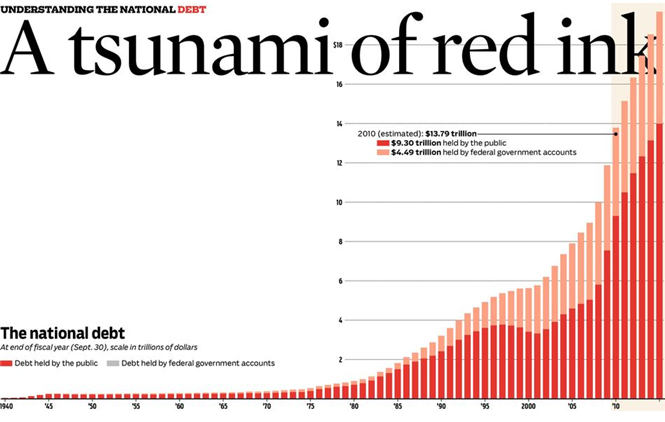
Government leaders now must summon up the courage for real tax and entitlement reform to begin curbing the $16 trillion public debt, Bowles and Simpson say.

They aren’t totally discouraged. “We take some encouragement from the statements by the president and leaders in Congress that they recognize more work needs to be done,” the two say.

But “to reach an agreement, it will be absolutely necessary for both sides to move beyond their comfort zone.”

Read more: http://goo.gl/b6ZOU


WASHINGTON POST
Our decadent democracy
by George Will
January 2, 2012

Connoisseurs of democratic decadence can savor a variety of contemporary dystopias. Because familiarity breeds banality, Greece has become a boring horror. Japan, however, in its second generation of stagnation is fascinating. Once, Japan bestrode the world, jauntily buying Rockefeller Center and Pebble Beach. Now Japanese buy more adult diapers than those for infants.

America has its lowest birth rate since at least 1920 — family formation and workforce participation (which hit a 30-year low last year) have declined in tandem. But it has an energy surplus, the government-produced overhang of housing inventory is shrinking and the average age of Americans’ cars is an astonishing 10.8 years. Such promising economic indicators, however, mask the country’s democratic decadence, as explained by the Hudson Institute’s Christopher DeMuth in the Dec. 24 Weekly Standard:
Deficit spending once was largely for investments — building infrastructure, winning wars — which benefited future generations, so government borrowing appropriately shared the burden with those generations. Now, however, continuous borrowing burdens future generations in order to finance current consumption. Today’s policy, says DeMuth, erases “the distinction between investing for the future and borrowing from the future.”
It is now as clear as it is unsurprising that most Americans will be spared the educational experience of “fiscal cliff”-related tax increases and spending cuts, which would have been a small but instructive taste of the real costs of the entitlement state.

Still, December’s maneuverings taught three lessons.

First, there will be no significant spending restraint. Democrats — you know: the people respectful of evidence and science — even rejected a more accurate measurement of the cost of living that would slightly slow increases in myriad government benefits. Accuracy will be sacrificed to liberalism’s agenda of government growth.

Second, Barack Obama has (as Winston Churchill said of an adversary) “the gift of compressing the largest amount of words into the smallest amount of thought.” His incessant talking swaddles one wee idea — raising taxes on “millionaires and billionaires,” including people earning less than half a million. He has nothing pertinent to say about the steadily worsening fiscal imbalance that will make sluggish growth — less than 3 percent — normal.

Third, one December winner was George W. Bush because a large majority of Democrats favored making permanent a large majority of his tax cuts. December’s rancor disguised bipartisan agreement: Both parties flinch from cliff-related tax increases and spending decreases. But neither the increases nor decreases would have tamed the current $1 trillion-plus budget deficit nor made a discernible dent in the 87-times-larger unfunded liabilities of the entitlement state.

This state cannot be funded by taxing “the rich.” Or even by higher income taxes on the middle class. Income taxes cannot fund the government liberals want, and they dare not seek the consumption and energy taxes their entitlement architecture requires. Hence, although Republicans are complicit, Democrats are ardent in embracing decadent democracy. This consists not just of infantilism — refusing to will the means for the ends one has willed — but also of willing an immoral means: conscripting the wealth of future generations.

As economists Glenn Hubbard and Tim Kane explain in National Affairs quarterly, the U.S. political system “cannot govern the entitlement state” that “exists largely to provide material benefits to individuals.” Piling up unsustainable entitlement promises — particularly, enactment of Medicare in 1965 and the enrichment of Social Security benefits in 1972 — has been improvident for the nation but rational for the political class. The promised expenditures, far in excess of revenue, would come due “beyond the horizon of political consequences.”

“Our politicians,” say Hubbard and Kane, “are acting rationally” but “politically rational behavior is now fiscally perverse.” Both parties are responding to powerful electoral incentives to neither raise taxes nor cut spending. Hence, “the clash over raising the debt limit that gripped Washington during the summer of 2011 was just the beginning, not the end, of our fiscal woes.”

But the perils of the entitlement state are no longer (in Hubbard’s and Kane’s words) “safely beyond the politicians’ career horizons.” Furthermore, a critical mass of Republicans reject the careerists’ understanding of “politically rational” behavior. These Republicans have a different rationale for being in politics.

The media, which often are the last to know things because their wishes father their thoughts, say the tea party impulse is exhausted. Scores of House Republicans and seven first-term Republican senators (Rand Paul, Mike Lee, Pat Toomey, Ted Cruz, Ron Johnson, Marco Rubio and Tim Scott) will soon — hello, debt ceiling — prove otherwise.

Read more: http://goo.gl/LsuW5


BREITBART
Can Boehner Hang onto His Job?
by Matthew Boyle
January 3, 2013

The Speaker of the House will be elected today and some conservatives believe they have the votes necessary to oust John Boehner. In an appearance on CNBC, American Majority Action spokesman Ron Meyer said there are more than 20 House Republicans willing to vote for someone other than Boehner on Thursday when the 113th Congress convenes to elect a Speaker. Another source from a different organization has similarly confirmed that more than 20 have planned to oppose Boehner.

Meyer and AMA correctly predicted Republican opposition to Boehner’s fiscal cliff “Plan B" and the overwhelming House Republican opposition to Vice President Joe Biden’s and Senate Minority Leader Mitch McConnell’s fiscal cliff deal that passed the House on Tuesday evening.

Outgoing Louisiana Republican Rep. Jeff Landry made a similar prediction earlier in the evening, telling Breitbart News that between the required minimum 17 members and 20 were on board at that point.

Despite rumors that he might do so, Boehner did not resign at a Republican conference meeting Wednesday night.

The reason why some, including Landry, thought Boehner would resign Wednesday is because that group of members supposedly approached Boehner and offered him a way to avoid the public fight that will likely take place on Thursday. An emergency Republican conference meeting was called on Wednesday evening and Boehner’s decision not to resign sent a message to those who want to unseat him that he believes he will survive tomorrow's vote.

Freshman Rep. Steve Stockman of Texas is on the record publicly stating he’ll oppose Boehner on Thursday, but the members also need a leader to rally around. Though there has been speculation that House Majority Leader Eric Cantor may emerge, his spokesperson would not respond to Breitbart News’ inquiries about whether he would. House Majority Whip Kevin McCarthy also would not go on the record as supportive of Boehner.

But, as Breitbart News reported weeks ago, the document containing the conservative plan to unseat Boehner notes that those members involved expect a new leader to emerge if Boehner were to lose a first election for Speaker (there are potentially multiple votes).

Meyer said in a statement Wednesday evening that his sources are "very Conservative members” and that they "remain optimistic that Speaker Boehner will lose his job tomorrow.” He also noted that sources behind the rumor that Boehner would resign Wednesday night were "different sources than the ones that helped AMA correctly predict the exact vote counts for Plan B and the Biden-McConnell bill.”

Boehner has made concessions to the conservatives seeking his ouster – a sign he's worried about his job. He caved on the Hurricane Sandy package after originally killing Cantor’s efforts to bring the bill to a vote after the “fiscal cliff” package Tuesday evening. After outrage from Reps. Peter King and Michael Grimm from New York, Boehner now will allow a vote on a Sandy package on Friday.

Boehner also, through a spokesman, renewed an old promise he made – but broke. Boehner said he won’t negotiate with the president on his own anymore, and will let the House follow the regular order. "He is recommitting himself and the House to what we've done, which is working through regular order and letting the House work its will,” a Boehner aide told The Hill.

Boehner made a similar promise during an interview with National Journal’s Major Garrett in October 2010, before the Tea Party wave swept Republicans into the House majority – and Boehner into the Speaker’s office. Boehner promised to follow the three-day rule – meaning legislation wouldn’t come to the floor until it was available for three days for members and the public to read – a promise he broke yet again with the “fiscal cliff” deal.

The Budget Control Act of 2011 – the legislation that carved the so-called “fiscal cliff” into law – was negotiated behind-closed-doors between the president and the Speaker. Boehner has also conducted negotiations on each Continuing Resolution (CR) – the legislation that funds the government in absence of a budget – directly with the White House.

We were each elected to uphold the Constitution and represent 600,000-odd people in our districts. We need to open this place up, let some air in. We have nothing to fear from letting the House work its will–nothing to fear from the battle of ideas. That starts with the committees. The result will be more scrutiny and better legislation.”

But now that he’s in trouble, he’s making the same promises again.

Stockman, for one, is not opposing Boehner because he doesn't like the Speaker as a person, but because he believe he’s failed the conservative cause. “We cannot tolerate betrayal of conservative principle and economic reality,” the Texas Congressman wrote in blog post according to the Dallas Morning News, adding that Boehner is a “decent man” who didn’t get the job done.

Landry made a similar argument in an op-ed for Breitbart News on Wednesday. “Thanks to the leadership of Speaker John Boehner, the House passed a bill which raises taxes by $620 billion while cutting spending by a mere $15 billion over 10 years,” Landry wrote. “Usually, a compromise is an even trade (one-for-one). In this trade, House and Senate Republicans traded $41 dollars in tax hikes for every $1 dollar in spending cuts—not exactly a balanced approach.”

Read more: http://goo.gl/7zDul

Wednesday, January 2, 2013

January 2, 2013


NEWSMAX
Cantor, McCarthy Join 151 Republicans Against Bill
by Stephen Feller
January 2, 2013

Majority House Leader Eric Cantor and GOP Whip Kevin McCarthy were among the 151 Republicans who voted against the fiscal cliff bill in the House Tuesday night.

Speaker John Boehner and Republican Conference chairwoman Cathy McMorris Rodgers, the number four in the party hierarchy in the House, both voted in favor of the bill that was introduced in the House by the GOP's Ways and Means Committee chairman Dave Camp.

The party was split with around two-thirds of House Republicans voting against the bill aimed at keeping a plethora of tax rates from going up this year.

It even divided one married Republican couple. Florida's Connie Mack voted against while his wife Mary Bono Mack of California voted in favor.

The biggest complaint was that the bill — which had earlier passed by an overwhelming 89-8 vote in the Senate — did not include enough spending cuts while increasing taxes on Americans who make more than $450,000 per year.

Chief Deputy Whip Peter Roskam joined the no votes, along with influential oversight committee chairman Darrell Issa.

Budget committee chairman and former vice-presidential candidate Paul Ryan voted for while former presidential candidate Ron Paul was among five GOP members who did not cast a vote.

The bill passed the house 257 to 167 as 85 Republicans and 172 Democrats voted to send the bill to the president to be signed, and 151 Republicans and 16 Democrats voted no.

Cantor "was disappointed with the bill that passed the Senate late last night," the Virginia congressman's deputy chief of staff, told Politico. "That's why you saw him working all day to find an alternative with the leadership. That's why you saw two conference meetings to deal with what all alternatives.”

Republicans also discussed the possibility of amending the bill by adding additional spending cuts to it, however the Senate would have been required to vote to approve the new version of the bill. Senate Democratic leaders already had indicated earlier in the day that they would not vote on the bill again.

Had the bill not passed the House, tax rates on all Americans were set to go up — which gave pause to many Republicans who voted against it.

"I'd like to be speaking for this bill, but I can't," said Californian Issa during the debate. "I would like to vote for this because I do vote for lower taxes. But the other day in conference, one of my colleagues pointed out that in fact you're spending the money, you're taxing our future generation."

Read more: http://goo.gl/NNJR0

National debt

BREITBART
Sources: Enough Republicans Willing to Unseat Speaker Boehner
by Matthew Boyle
January 1, 2013

American Majority Action spokesman Ron Meyer told Breitbart News late Tuesday that enough House Republicans have banded together in an effort to unseat House Speaker John Boehner from his position--they just need a leader to take up the mantle.

“At least 20 House Republican members have gotten together, discussed this and want to unseat Speaker Boehner--and are willing to do what it takes to do it,” Meyer said. “That’s more than enough to get the job done, but the one problem these guys face is they need a leader to coalesce behind.”

Meyer said the conservatives have considered House Majority Leader Eric Cantor (R-VA) to take the helm after Boehner is knocked out. His opposition from the right to the Senate fiscal cliff deal that Vice President Joe Biden cut with Senate Minority Leader Mitch McConnell is a sign Cantor may try for the job.

AMA is hardly the only conservative entity aware of the rekindled effort afoot to unseat Boehner. Another conservative with inside knowledge of the effort told Breitbart News that the movement has "new focus and juice," and if enough members go to Boehner telling him they won’t support his re-election, that Americans should “watch for him to resign gracefully.”

The vote for Boehner’s re-election as Speaker happens on Thursday, two days after Boehner’s decision to support the Senate "fiscal cliff" deal Vice President Joe Biden cut with Senate Minority Leader Mitch McConnell on New Year’s Eve.

Read more: http://goo.gl/Lq3ZD


CVN EDITORIAL
Beware of Rinos Drinking Tea
by Conservative Sue
January 2, 2012

Well, the votes have been counted, and it appears the Democrats and Republicans have now passed a 'fiscal cliff' deal that represents a big tax increase with no significant long term spending cuts.  Outspoken critics of this deal include Senators Mike Lee, Rand Paul, and other Tea Party favorites,

What Speaker John Boehner has managed to accomplish with his adept political deal-making skill is to get the GOP blamed for the biggest tax increase in the last two decades while simultaneously increasing the deficit and kicking the spending cuts down the road for 'another day' that, most agree, will never come.  And, to add insult to injury, the mainstream media is in full propaganda mode blaming the teaparty for obstructionism and a 'bad deal' even though the teaparty has been pretty much united against this proposal from the start.

What does the GOP stand for?  Limited government?  Low taxes? Controlling spending? Balanced budgets? Fiscal responsibility? State sovereignty? Liberty?  From seeing the legislation written and passed by the GOP over the last 20 years, I see very little coming out of the leadership of this Republican Party that bears any resemblance to the current GOP party platform or the Reagan-style conservatism that built conservative majorities in the 80's.

Interestingly, House Majority Leader Eric Cantor voted no on this deal, which initially puzzled me (considering he's been brokering this deal with Speaker John Boehner and Senate Majority Leader Mitch McConnell all along), but I've had an epiphany this morning and believe I may have discovered the motive behind Cantor's vote....

The balance has tipped in the GOP controlled house, and the vote for this particular bill has made that clear. The majority of Republicans in the House voted against this bill, meaning that the establishment-wing of the GOP (led by Boehner and others) is now in the minority. The 'leash' the establishment had placed on the teaparty coalition has been removed, and 'going along' with GOP leadership is no longer a foregone conclusion.  Cantor is very much an establishment Republican .. so why did he join the teaparty coalition in this vote?  

Simple, Boehner is facing a vote on Thursday by GOP House Republicans on whether or not he will remain as Speaker of the House. The establishment needs to have a viable alternative to put forth if it becomes clear they will not have the votes to keep Boehner in the job .. so along comes the mysterious Cantor 'pro-teaparty' vote just in time to give them that establishment alternative to Boehner. Does anyone really believe Cantor is a teaparty Republican?  I certainly don't.

Beware of Rinos drinking tea. These politicians will sell their souls for power. If the House GOP wants to throw out Boehner for being too liberal on taxes and spending, they had better look elsewhere for an alternative. Replacing Boehner with Cantor is like replacing Charlie Sheen with Lindsay Lohan.  Both Boehner and Cantor are bad news for fiscal conservatives, and neither have any desire to get this out-of-control deficit spending under control.

Tuesday, January 1, 2013

January 1, 2013


TOWNHALL
Senate Passes Bill to Avoid Fiscal Cliff
by Leah Barkoukis 
January 1, 2013

The Senate voted early Tuesday morning 89-8 in favor of the scaled-down bipartisan package that would halt historic tax hikes for many Americans and postpone automatic spending cuts for two months. The bill will now go to the House, which is expected to be back in session at noon today.

The outlines of the deal Mr. McConnell and Mr. Biden worked out included raising tax rates for individuals making more than $400,000 and families with incomes more than $450,000, and extended unemployment benefits for the long-term jobless. It also continued a number of programs from Mr. Obama’s 2009 stimulus law, including tax credits for college tuition and for green-energy programs.

The deal included no net spending cuts, however, which left conservative Republicans complaining. Meanwhile, liberal Democrats balked at not holding firm on tax increases for families making more than $250,000 — a stance on which Mr. Obama campaigned.

Regardless of their income, all taxpayers will still see at least some tax increases with the expiration of the payroll tax holiday, which was worth about $1,000 to the average family in 2012. […]

The deal on the table late Monday included a patch to prevent millions of taxpayers from being hit by the Alternative Minimum Tax, and also included an extension of full payments to doctors treating Medicare patients.

The tax rate agreement would see the top marginal rate rise from 35 percent to 39.6 percent — the rate during the Clinton years — for individuals with incomes more than $400,000 and for households with incomes more than $450,000.

The bill is a far cry from ideal. Earlier in the day, Sen. Mike Lee said that what needs to be kept in mind is that even if a deal happens “we will be leaving intact 99 percent of a dysfunctional system – 99 percent of a tax code that’s unstable - that produces an inconsistent revenue stream and that’s gotten us $16 trillion in debt and has been producing trillion dollar annual deficits.” Lee voted against the bill, as did Republican Sens. Rand Paul, Richard Shelby, Chuck Grassley and Marco Rubio.

The question now is whether the bill can pass the House. Breitbart points out that the deal reached “cuts only $15 billion in spending while increasing tax revenues by $620 billion—a 41:1 ratio of tax increases to spending cuts,” according to the CBO. Commenting on the lopsided ratio, one House Republican said, “I can’t imagine a ratio such as that warming our fiscal hearts.”

Remember this?

Photobucket

Read more: http://goo.gl/Varpk

BREITBART
Boehner Can't Get Majority of GOP to Back Deal
by Matthew Boyle
December 31, 2012

American Majority Action, the conservative group that’s leading the charge against House Speaker John Boehner continuing in his current position, said Monday evening that Boehner doesn’t have at least 50 percent of his House GOP members’ support for the fiscal cliff deal that Senate leaders and the White House have reportedly cut.

The deal, between Senate Minority Leader Mitch McConnell and Vice President Joe Biden, reportedly raises spending and hikes taxes on all Americans making more than $450,000. According to AMA, it raises spending by delaying sequester budget cuts.

In an email to reporters late Monday, AMA spokesman Ron Meyer said he’s “heard directly from senior GOP conservative members in the House that Speaker Boehner does not have a majority of support from the GOP caucus--not even close.”

“These sources tell me Boehner has indicated he won't bring up a plan without 50% GOP support,” Meyer said. “The McConnell-Biden compromise does not meet that threshold.”

AMA was out in front in accurately predicting the failure of Boehner’s fiscal cliff “Plan B” before Christmas – even when House GOP leaders like Majority Leader Eric Cantor and Boehner himself claimed they had the votes to pass it. Boehner ultimately cancelled the scheduled floor vote before the plan would have failed because his own caucus didn’t support his effort.

Citing an anonymous “Democratic source,” Politico reports that the Biden-McConnell deal “includes a two-month delay of the sequester, which had been scheduled to begin on Jan. 2.”

“President Barack Obama spoke with Senate Majority Leader Harry Reid and House Minority Leader Nancy Pelosi about the agreement and both leaders have signed off on it, according to the source,” Politico added.

The Senate could vote late Monday on the deal, after--according to the Washington Post--Biden tries to sell it to the Senate Democrats this evening.

If the House is to vote on the deal, it would likely do so on Tuesday--New Year’s Day--meaning the country would technically fly over the fiscal cliff before congressional and White House leaders undid the move before any of the damage set in.

Read more: http://goo.gl/718xm


THE DAILY CALLER
Rand Paul accuses Democrats of raising taxes just to ‘stick it to those rich people’
by Alex Pappas
December 31, 2012

WASHINGTON — In a passionate Monday speech on the Senate floor, Kentucky Sen. Rand Paul railed against the notion of raising taxes on the wealthy, and expressed doubts that doing so in a “fiscal cliff” deal would actually help pay off the debt at all.

“You may not get any more revenue,” the Kentucky Republican said. “You may not get any more economic growth. But you can say, ‘I stuck it to the rich people.’”

In his floor speech, Paul suggested Democrats are insisting on raising taxes on the wealthy because they “campaigned against rich people” in 2012 and “got enough envy whipped up in the country.”

The lawmaker made the comments on Monday — just hours before the country goes off the so-called fiscal cliff at the end of the year and automatic hikes for all taxpayers are implemented.

All eyes are on the U.S. Senate, where talks have broken down between the leaders of both parties. Republican minority leader Mitch McConnell is now negotiating directly with Vice President Joe Biden, who is leading the talks for the Democrats.

It’s assumed any deal between those two would include extending tax cuts for everyone except a certain percentage of the wealthy. On Monday, Paul said he rejects allowing tax rates to rise on some. (MATT LEWIS: Rand Paul has a point about email snooping)

“We the Republican Party, the party of limited government and low taxation, should have no part in this,” he said. “We should have no finger prints on this and we should in no way support anything that raises taxes because it’s bad economic policy.”

Paul argued that not only is it possible the government will get less revenue by taxing the rich, doing so could also hurt middle-class workers.

“Anybody work for rich people?” Paul asked. “Anybody know somebody who works at a car lot selling expensive cars but that person only makes $40,000 a year but he sells cars that are purchased by rich people?”

He went on to give an anecdote about “the yacht tax” where Congress implemented a “special tax on yachts.”

“Guess who lost their jobs?” he asked. “The working guy making $50 and $60,000 a year making the yachts. Because rich people went to the Bahamas to buy their yachts.”

“This isn’t about getting rich people,” he said. “This is about what it’ll do to the economy, what it’s going to do the average middle-class person who works for a rich person.”


Read more: http://goo.gl/a9yNp

Monday, December 31, 2012

December 31. 2012


NEWSMAX
Over the Fiscal Cliff: Soft or Hard Landing?
by the Associated Press
December 30, 2012

Efforts to save the nation from going over a year-end "fiscal cliff" were still in disarray as lawmakers returned to the Capitol to confront the tax-and-spend crisis. A tone-setting quotation was Democratic Sen. Harry Reid's assertion that the House under Republican Speaker John Boehner had been "operating with a dictatorship."

President Barack Obama flew back to Washington from Hawaii after telephoning congressional leaders from his Christmas vacation perch. Once back, he set up a meeting with leaders of both parties at the White House late Friday to make a fresh attempt to find a solution before Monday night's deadline.

A look at why it's so hard for Republicans and Democrats to compromise on urgent matters of taxes and spending, and what happens if they fail to meet their deadline:

Partly by fate, partly by design, some scary fiscal forces come together at the start of 2013 unless Congress and Obama act to stop them. They include:
Some $536 billion in tax increases, touching nearly all Americans, because various federal tax cuts and breaks expire at year's end.

About $110 billion in spending cuts divided equally between the military and most other federal departments. That's about 8 percent of their annual budgets, 9 percent for the Pentagon.
Hitting the national economy with that double whammy of tax increases and spending cuts is what's called going over the "fiscal cliff." If allowed to unfold over 2013, it would lead to recession, a big jump in unemployment and financial market turmoil, economists predict.

If New Year's Day arrives without a deal, the nation shouldn't plunge onto the shoals of recession immediately. There still might be time to engineer a soft landing.

So long as lawmakers and the president appear to be working toward agreement, the tax hikes and spending cuts could mostly be held at bay for a few weeks. Then they could be repealed retroactively once a deal was reached.

The big wild card is the stock market and the nation's financial confidence: Would traders start to panic if Washington appeared unable to reach accord? Would worried consumers and businesses sharply reduce their spending? In what could be a preview, stock prices in the U.S. and Europe dropped Friday on waning hopes that Obama and key lawmakers would reach an 11th-hour compromise.

Federal Reserve Chairman Ben Bernanke has warned lawmakers that the economy is already suffering from the uncertainty and they shouldn't risk making it worse by blowing past their deadline.

If negotiations between Obama and Congress collapse completely, 2013 looks like a rocky year.

Taxes would jump $2,400 on average for families with incomes of $50,000 to $75,000, according to a study by the nonpartisan Tax Policy Center. Because consumers would get less of their paychecks to spend, businesses and jobs would suffer.

At the same time, Americans would feel cuts in government services; some federal workers would be furloughed or laid off and companies would lose government business. The nation would lose up to 3.4 million jobs, the Congressional Budget Office predicts.

"The consequences of that would be felt by everybody," Bernanke says.

Read more: http://goo.gl/C3KRt


U.S. NEWS & WORLD REPORT
Brace For an Avalanche of Unfunded Debt - The fiscal cliff isn't as scary as the looming deficit and debt crisis about to swamp the country
by Mort Zuckerman
December 28, 2012

All eyes have been on the clear and present danger of the fiscal cliff—understandably—but there's a sound in the mountain range that's even scarier than the cliff. It's the sound made by an avalanche, the trillions of dollars of debt that's heading our way, gathering speed and mass. For most people, it's out of earshot now, and that's the way our government prefers to play it in its financial statements. Liabilities are not set out there in accordance with the well-established norms of the private sector, where this overhang of liabilities would set off alarm bells in the markets, with boards of directors in emergency sessions.

We'll come to why that's not happening, but let's consider first why we should regard our predicaments as gravely as any private company does on the path to bankruptcy.

We are on a trajectory of cumulative fiscal deficits that cannot possibly be sustained. We have gone from being the world's largest creditor nation, with no foreign debt at the end of World War II, to the world's largest debtor, with roughly half of our public debt held by foreign lenders. Over the last four years, our national debt has grown by more than $5 trillion to over $16 trillion. We have to service that debt. The Federal Reserve is keeping rates historically low but here's the cost of paying interest on the debt for fiscal 2012: $359,796,008,919.49

What do you get for that? Nothing.

The greatest fiscal challenge to the U.S. government is not just its annual deficit but its total liabilities. Our federal balance sheet does not include the unfunded social insurance obligations of Medicare, Social Security, and the future retirement benefits of federal employees. Only in the small print of the financial statements do you get some idea of the enormous size of the unfunded commitments. Today the estimated unfunded total is more than $87 trillion, or 550 percent of our GDP. And the debt per household is more than 10 times the median family income.

The public doesn't know about these awesome liabilities because the totals appear only in actuarial estimates. As Chris Cox, former chairman of the Securities and Exchange Commission, and Bill Archer, former chairman of the House Ways and Means Committee, recently noted in the Wall Street Journal, the real annual accrued expense of Medicare and Social Security alone is $7 trillion. The government's balance sheet does not include any of these unfunded obligations but focuses on the current year deficits and the accumulated national debt. Cox and Archer reported that the annual budget deficit is only about one fifth of the more accurate figure.

If the American public saw our financial statements in the same way that public companies report their pension liabilities, it would clearly see the magnitude of danger represented by the future borrowings that these liabilities to an aging population imply—borrowing on a scale that would not only bankrupt the programs themselves but the entire federal government. And to a worrying extent, we are locked into continued escalation by the fact that social insurance programs, as well as other mandatory programs, carry payments that are in accordance with automatic formulas written into law and are not subject to an annual spending limit. Today, less than 40 percent of our budget is actually decided by Congress and the president, down from 62 percent 40 years ago.

If we continue in these irresponsible ways, an eventual reckoning cannot be avoided. The liabilities are so huge, and multiplying so fast, that there will be one unavoidable demand as the various bills come to their due date. Show us the money!

How will the bills be honored? Let's remember that 100 percent of the payroll taxes for Social Security and Medicare are spent in the year that they are collected, leaving no leftovers for the unfunded obligations. And this doesn't take into account other risks, hardly minimal, like the fact that the Federal Housing Authority confronts a $16.3 billion net deficit after its latest audit that may force a taxpayer bailout for the first time in its 78-year history. And just four years from now, in 2016, the Disability Insurance trust fund will be fully depleted.

Read more: http://goo.gl/620En


BREITBART
Lawmakers Leave Capitol Without a Deal
by Kerry Picket
December 30, 2012

Washington D.C. lawmakers in both chambers left the capitol on early Sunday night after negotiations to avoid the fiscal cliff fell apart in the Senate.

Senate Majority Leader Harry Reid (D – NV) said there is "still time left to reach an agreement.” In the meantime, Senate Minority Leader Mitch McConnell will continue negotiations on the phone tonight with Vice President Joe Biden.

McConnell told reporters, “There’s no single issue that remains an impossible sticking point. The sticking point appears to be the willingness and interest or frankly the courage to close the deal. I want everyone to know, I’m willing to get this done, but I need a dance partner.”

At least 50 House GOP members elected two years ago during the tea party wave are key votes to satisfy in the fiscal cliff negotiations.

Congressman Robert Andrews (D – NJ) told reporters he believes Speaker of the House John Boehner (R – OH) cannot do his job with fiscal cliff negotiations because the tea party is a “problem” for the Republican leader.

“There’s the tea party. I think it’s an aberrant strain of the Republican Party that knows what it doesn’t like; knows what it’s angry about, but doesn’t know what it wants to do,” said Andrews.

“I think [Boehner will] survive on January 3rd, sure, but on four occasions the country’s been—in these two years—the country’s been brought to the brink of real economic harm, because a small group on their side doesn’t want anything,” Andrews added.

Congressman Pat Tiberi (R – OH) shot back at Andrews remarks saying that the tea party is not giving Boehner “anymore problems than moveon.org or code pink is giving Ms. Pelosi.”

Rep. Tiberi told Breitbart News that the GOP House Conference’s rejection of Speaker Boehner’s Plan B is not hurting the caucus saying, “I think we’re a lot more united than we are divided.”

He added, “A super majority of our members supported that and there were ones that didn’t, because there were differences as to why people didn’t support it. There wasn’t one reason that united the opposition of Plan B.”

Tiberi explained further that the House GOP is putting the onus on Senator Reid:

“Here are the facts. We did our business. We passed a bill. We passed two bills. We passed one on taxes and one on sequestration. The way that School House Rock worked when I was a kid, until the health care bill that is, the House passes a bill; sends it to the Senate; the Senate either accepts it or changes it. It goes back to the House and we have a conference Committee. And the Senate refuses to do that. They’ve not taken up our bill to this minute of today. The bill that they passed is a joke.”

Congressman Tom Price (R – GA) agreed telling Breitbart News, “The Senate’s got to act. If the Senate acts, then we might be able to respond, but the Senate’s got to act.”

Price said that the conference is currently “solid” since the rejection of Plan B. “It appears the Senate can’t do anything. They can’t pass a budget—can’t pass a bill. It’s time for them to work,” he said.

The House will resume legislative business on Monday morning.

Read more: http://goo.gl/sFbJs


Sunday, December 30, 2012

December 30, 2012


BREITBART
Hobby Lobby Defies Obama Administration with Civil Disobedience for Religious Liberty
by Ken Klukowski
December 28, 2012

“We must obey God rather than men!”—Acts 5:29.

Now that Supreme Court Justice Sonia Sotomayor has denied Hobby Lobby’s application for an emergency injunction protecting them from Obamacare’s HHS Mandate on abortion and birth control, Hobby Lobby has decided to defy the federal government to remain true to their religious beliefs, at enormous risk and financial cost.

Hobby Lobby is wholly owned and controlled by the Green family, who are evangelical Christians. The Greens are committed to running their business in accordance with their Christian faith, believing that God wants them to conduct their professional business in accordance with the family’s understanding of the Bible. Hobby Lobby’s mission statement includes, “Honoring the Lord in all we do by operating the company … consistent with Biblical principles.”

The HHS Mandate goes into effect for Hobby Lobby on Jan. 1, 2013. The Greens correctly understand that some of the drugs the HHS Mandate requires them to cover at no cost in their healthcare plans cause abortions.

Today Hobby Lobby announced that they will not comply with this mandate to become complicit in abortion, which the Greens believe ends an innocent human life. Given Hobby Lobby’s size (it has 572 stores employing more than 13,000 people), by violating the HHS Mandate, it will be subject to over $1.3 million in fines per day. That means over $40 million in fines in January alone. If their case takes another ten months to get before the Supreme Court—which would be the earliest it could get there under the normal order of business—the company would incur almost a half-billion dollars in fines. And then of course the Supreme Court would have to write an opinion in what would likely be a split decision with dissenters, which could easily take four or six months and include hundreds of millions of dollars in additional penalties.

This is civil disobedience, consistent with America’s highest traditions when moral issues are at stake. The Greens are a law-abiding family. They have no desire to defy their own government. But as the Founders launched the American Revolution because they believed the British government was violating their rights, the Greens believe that President Barack Obama and Secretary Kathleen Sebelius are commanding the Greens to sin against God, and that no government has the lawful authority to do so.

The Christian tradition of defying government commands to do something wrong goes back to the very birth of Christianity. When the apostles were ordered not to share the gospel of Jesus Christ with anyone, the Book of Acts records: “Peter and the other apostles replied: ‘We must obey God rather than men! The God of our fathers raised Jesus from the dead—whom you had killed by hanging him on a tree.’”

Eleven of the twelve apostles—including Peter—would lose their lives for the sake of spreading the gospel of Jesus Christ; only the apostle John died of old age. They were determined to obey God’s will at all costs.

This issue of civil disobedience is never to be undertaken lightly. The Bible teaches Christians to submit to all legitimate governmental authority (e.g., Romans 13:1), and so a person can only disobey the government when there is no other way to obey God.

But here in America, the Constitution is the Supreme Law of the Land, and in its First Amendment it protects against a government establishment of an official religion and separately protects the free exercise of religion. On top of that, Congress passed the Religious Freedom Restoration Act of 1993 (RFRA) to specifically add an additional layer of protection against government actions that violate a person’s religious beliefs.

The HHS Mandate is a gross violation of the religious beliefs of the Green family. The issue before the courts here is whether the Greens religious-liberty rights include running their secular, for-profit business consistent with their religious beliefs. In other words, is religious liberty just what you do in church on a Sunday morning, or does it include what you do during the week at your job?

The Greens are now putting their fortunes on the line to do what they believe is right. The courts should side with them, affirming a broad scope of religious liberty under the Constitution and RFRA. And the Supreme Court should resolve this matter with dispatch in their favor.

Millions of Christians across the country feel exactly the same way as the Greens. The Obama administration has issued a statist command that is a declaration of war on people of faith who object to abortion, and civil disobedience could break out all over the country unless the courts set this matter right—and quickly.

Read more: http://goo.gl/d86N3


THE BLAZE
‘We Have Passed That Point of No Return’: Ron Paul Explains What’s Missing in The ‘Fiscal Cliff’ Talks
by Becket Adams
December 29, 2012

Even if Congress manages to come up with a solution to avert the “fiscal cliff,” a combination of year-end tax increases and spending cuts, it won’t be worth anything because it’ll probably only deal with tax rates and ignore the problem of runaway government spending, or so say Texas Congressman and former presidential candidate Ron Paul.

“I think we have passed that point of no return where we can actually get our house in order,” Rep. Paul said Friday on CNBC. “I believe there is too much bipartisanship on the spending. Nobody is talking about cutting any spending.”

“Republicans and Democrats,” he continued, “they pretend they’re fighting up there, but they really aren’t. They’re arguing over power, spin, and who looks good, and who looks bad, but they’re all trying to preserve this system where they can spend what they want, take care of their friends, and let the Fed print money when they need it.”

However, that’s not to say Rep. Paul doesn’t believe U.S. lawmakers will come up with temporary solutions to things like the “cliff.”

“[It’ll be] sort of like — how many times have they had a ‘solution’ for the Greece crisis? About ten or 15 times?” the congressman asked, referring to the eurozone’s most unstable and financially broken member.

“There’s no admission that they [U.S. lawmakers] have a crisis. They have no admission that the country is bankrupt. There’s no admission that our government is spending way too much and it’s way beyond our means and there’s not a single bit of effort to cut anything,” the congressman continued.

“They are so they so far removed from admitting the seriousness of this crisis and if they don’t admit it, they can’t solve the problem. They’re like a bunch of drug addicts that just want another fix. That’s what they are looking for,” he concluded:


Read more: http://goo.gl/SNSSP

TOWNHALL
Putting the Spending Genie Back in the Bottle
Bob Beauprez 
December 30, 2012

As the following chart from Investor's Business Daily demonstrates, The Bush Tax Cuts didn't starve the federal treasury – revenue flooded in as the economy expanded from the pro-growth policies implemented in 2003 and continued until the sub-prime mortgage market collapse.

Even with the anemic Obama economic recovery, revenues are again nearly equal to the level required to fund the government had spending over the last fifteen years increased at the rate of population plus inflation growth.  But, that has not been the case.

The pox on Bush and the Republican majorities is that while revenues soared following implementation of the 2003 tax cuts, spending did as well.  To be fair, much of that increased spending was related to the war on terror following the September 11, 2001 attacks.

Also, the rate of GOP spending increases pale in comparison to what happened when Democrats took control of Congress beginning in 2007 and further accelerated when Obama moved into the White House in 2009.


Federal revenue rose from $1.7 trillion to $2.4 trillion from FY 1998 to 2012 as indicated.  "Revenue growth averaged 2.9% annually, despite two recessions, bear markets, - and tax cuts," as David Hogberg explained in the feature article accompanying the IBD graphic.

However, federal spending rose nearly twice as fast – 5.7% per year – surging from $1.6 trillion to $3.5 trillion over the same period, notes Hogberg.

Further, the chart shows that if spending had increased over the period at the same rate as population and inflation, revenue would have trended upward about the same even allowing for the effects of the recessions.  But, current spending levels are nearly $1 trillion beyond what population-plus-inflation growth increases would have dictated.

Hogberg calculates that had spending from FY1998-2012 increased consistent with population-plus-inflation growth, revenues would have exceeded spending by $177 billion – a net budget surplus!  Instead, because of the dramatic increase in spending, the federal government racked up an additional $6.7 trillion of new debt.

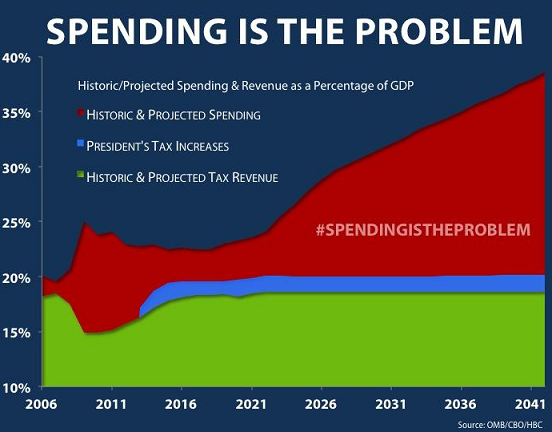
Every objective observer knows that the elephant in the room is the out of control rate of spending increases over the last many years.  True to form, however, Washington – and particularly Barack Obama - is laser focused on who they can raise tax rates on and by how much.  Their efforts would be better directed at putting the Spending Genie back in the bottle.

Read more: http://goo.gl/ALHXq

Saturday, December 29, 2012

December 29, 2012


NEWSMAX
McConnell and Reid Called in to Come up With Fiscal Cliff Deal
by Thomson/Reuters
December 28, 2012

Senate leaders are working to craft legislation by Sunday that averts the year-end "fiscal cliff" of tax hikes and spending cuts, but many details needed to be worked out after a crucial meeting with President Barack Obama on Friday.
Senate Democratic leader Harry Reid and his Republican counterpart Mitch McConnell, termed the meeting "constructive" and "positive" and said they would keep working on trying to find a solution over the weekend.

However shortly afterwards Reid said he would be sending a bill to the Senate calling for an end to the Bush-era tax cuts for households earning more than $250,000, a figure that Republicans have repeatedly said they will not accept.

"At President Obama's request, I am readying a bill for a vote by Monday that will prevent a tax hike on middle-class families making up to $250,000, and that will include the additional, critical provisions outlined by President Obama," Reid said in a statement.

"In the next 24 hours, I look forward to hearing any good-faith proposals Senator McConnell has for altering this bill."

After adjourning on Friday, Reid he would probably not call the Senate back into session until about 1 p.m. on Sunday to give leaders time to hash out a deal.

On the Senate floor, McConnell said, "We are engaged in discussions, the majority leader and myself and the White House, in the hopes that we can come forward as early as Sunday and have a recommendation that I can make to my conference and the majority leader can make to his conference."

"So we'll be working hard to try to see if we can get there in the next 24 hours. So I'm hopeful and optimistic," he added.

An aide to House of Representatives Speaker John Boehner said it was agreed at the White House meeting that the Senate should act first.

"The speaker told the president that if the Senate amends the House-passed legislation and sends back a plan, the House will consider it — either by accepting or amending," the aide said.

However, Reid said it would be difficult to craft a solution that can win passage in both the House and Senate, adding that it involves "big numbers."

"Whatever we come up with is going to be imperfect," Reid said. "Some people aren't going to like it. Some people will like it less. But that's where we are and I feel confident that we have an obligation to do the best we can."

Read more: http://goo.gl/lKKlm


TOWNHALL
Senate Approves $60.4 Billion Sandy Aid Bill
by AP News
December 29, 2012

WASHINGTON (AP) — The Senate on Friday approved a $60.4 billion emergency spending aid package for victims of Hurricane Sandy that had been backed by Senate Democrats.

Democrats had to turn back Republican efforts to cut programs such as $150 million in fisheries aid that Republican lawmakers said was unrelated to the storm that hammered the East Coast late in October. The measure cleared the Senate on a 62-32 vote, with 12 Republicans supporting the bill. Sen. Mark Pryor, D-Ark., was the only Democrat to vote against the bill, but he later switched his vote to support the measure.

The bill faces uncertain prospects in the House, where GOP leaders appear reluctant to move quickly on a big spending bill in the final days of a lame duck session. Congress' attention is focused on talks over the so-called fiscal cliff of tax hikes and automatic spending cuts.

Sandy was blamed for at least 120 deaths and battered coastline areas from North Carolina to Maine. New York, New Jersey and Connecticut were the hardest hit states and suffered high winds, flooding and storm surges. Sandy damaged or destroyed more than 72,000 homes and businesses in New Jersey. In New York, 305,000 housing units were damaged or destroyed and more than 265,000 businesses were affected.

Senate Republicans failed on an amendment for a smaller package of about $24 billion in aid for Sandy, which was the most costly natural disaster since Hurricane Katrina in 2005 and one of the worst storms ever in the Northeast.

House GOP leaders have not said how they plan to proceed. But House Appropriations Committee Chairman Hal Rogers of Kentucky has said Congress should probably begin with a smaller aid package for immediate recovery needs and wait until more data can be collected about storm damage before approving additional money next year.

Rep. Paul Ryan, the 2012 GOP vice presidential nominee and a leading House fiscal conservative, has criticized the Democratic bill as "packed with funding for unrelated items, such as commercial fisheries in American Samoa and roof repair of museums in Washington, D.C."

Sen. Charles Schumer, D-N.Y., urged House leaders to "put this bill on the floor quickly and allow a vote." If the House balks, Schumer said, the Senate bill provides "very good groundwork" for seeking Sandy aid next year.

The measure includes $11.5 billion for the Federal Emergency Management Agency's chief disaster relief fund and $17 billion for community development block grants, much of which would help homeowners repair or replace their homes. Another $11.7 billion would help repair New York City's subways and other mass transit damage and protect them from future storms. Some $9.7 billion would go toward the government's flood insurance program. The Army Corps of Engineers would receive $5.3 billion to mitigate flood future risks and rebuild damaged projects.

Senate Republicans said much of the spending in the Democratic bill was for projects unrelated to Sandy, such as $150 million for fisheries disasters that could go to Alaska as well as Gulf Coast and New England states. Sen. Tom Coburn, R-Okla., sought to strip the fisheries funding, but his amendment failed.

To court votes, Democrats last week broadened some of their bill's provisions to cover damage from Hurricane Isaac, which struck the Gulf Coast earlier this year. A provision was added to the $2.9 billion allotted to Army Corps of Engineers projects to reduce future flooding risks; the coverage area for that program will now include areas hit by Isaac in addition to Sandy. Democrats also shifted $400 million into a community development program for regions suffering disasters, beyond areas struck by Sandy.

A Coburn amendment to reduce the federal share of costs for the Army Corps of Engineer projects to reduce future flooding risks also failed.

Read more: http://goo.gl/dQevo


WASHINGTON TIMES
Washington spenders flunk basic math - Raising taxes won’t avoid ‘fiscal cliff’
by Rep. Darrell E. Issa
December 28, 2012

Politicians in Washington have spent the better part of the past two months advancing a myth that is undermining one of the most important public policy debates in recent memory. It’s a myth that is coming at the expense of solutions based on common sense that could return us to balance and fiscal stability.

Twenty-six years ago, President Reagan implemented significant tax reforms that lowered the individual income tax rate, limited deductions and brought equality to tax rates across all levels. Before that reform, there had been 15 different marginal tax rates reaching levels as high as 50 percent for top brackets. By the time Reagan left office, the number of brackets had been reduced to two: 15 percent and 28 percent.

In 1993, President Clinton raised the top two income rates to 36 percent and 39.6 percent while also raising the corporate tax rate, increasing the taxable portion of Social Security benefits and increasing income taxable for Medicare. This is what has become known as the “Clinton tax rates.”

In 2001, President George W. Bush changed the rate from 39.6 percent to 35 percent, lowered the capital gains and dividend income rates, and expanded credits and deductions such as the Child Tax Credit and the Earned Income Tax Credit.

So much time and energy is being spent advancing the myth that raising taxes is the best way to avoid falling off the so-called “fiscal cliff.”

If you raised taxes on the top income bracket, you would generate around $1 trillion over 10 years. The past four years under President Obama have resulted in trillion-dollar deficits each year. At this rate, in 10 years we’re looking at $10 trillion in new debt. At best, the “tax-the-rich” proposal is just a 10 percent solution.

Let’s take this tax-more, spend-more approach to the extreme. If you return everyone to the Clinton-era tax rates, you’re still left with a 10-year, $2.3 trillion deficit, and that’s assuming everything stays as it is right now, and Washington breaks its trend of spending more every year. (Even if we go over the fiscal cliff and return to Clinton-era tax rates, we’re still left with at least a $2.3 trillion deficit over the next 10 years.) The bottom line is this: Under no proposed scenario does raising taxes eliminate the deficit and return us to a balanced budget. The problem is government spending.

This fixation with tax increases is doing a huge disservice to the American people because it ignores the real crisis: government spending. By now, you know all too well that government spends more than it takes in. The federal government is spending more per household than ever before. Since 1965, spending per household has grown by 152 percent.

Conveniently omitted from the current fiscal-cliff discussions is the reality that for individuals earning more than $200,000 a year, their taxes already are going up in 2013, courtesy of Obamacare, which includes a new 1 percent tax on persons making more than $200,000 a year as well as an additional 3.8 percent tax on capital gains, investment income and certain home sales. These two new taxes will generate $317.7 billion over a 10-year period, or $31 billion a year — covering just a fraction of the current $1.1 trillion deficit for fiscal 2012 alone.

Do you know what some in Washington will say 10 years from now, when the problem hasn’t gone away? They’ll say, “We need to tax more.” Why isn’t the solution ever about spending less?

Some in Washington aren’t interested in the truth. They aren’t interested in facts. They aren’t interested in solving the problem. For them, that’s bad for business. It’s much easier for them to keep kicking the can down the road and using our fiscal decline to essentially “cry wolf” and raise your taxes. When will it ever stop?

I can guarantee you this: It won’t stop here, it won’t stop with just the “1 percent” or the “2 percent.” There will never be enough to satisfy this insatiable appetite to spend more.

That’s what’s really at stake right now.

The other side tries to boil this down into a seven-second sound bite about taxing the rich and people paying their fair share. In 2009, the top 10 percent of earners in the United States already paid more than 70 percent of federal income taxes.

This isn’t about fairness and unfairness. It’s about taxing and spending, and the federal government has spent enough.

Read more: http://goo.gl/Zi0b6


Friday, December 28, 2012

December 28, 2012


MONEYNEWS
Wilbur Ross Sees Recession, Warns of 'Greek' Situation
by Forrest Jones and Kathleen Walter
December 27, 2012

The U.S. economy faces a recession if the nation goes off the fiscal cliff and key tax cuts fully expire at the end of this year, said Wilbur Ross, chairman and CEO of WL Ross and Co.

And, in the wake of news the U.S. will hit its debt limit earlier than expected, the billionaire financier warned that the United States could soon face its own “Greek” style debt situation.

Failure to stop automatic tax increases set for Jan. 1 “would obviously have a big negative effect on disposable income and consequently, I believe would put us back into the recession when coupled with the spending cuts that are also part of it," Ross told Newsmax TV in an exclusive interview Thursday.


Ross says that even a compromise deal that stops tax increases for many still may not save the U.S. economy.

"I think that if we don't go over the full fiscal cliff, because we will go over some sort of a cliff even if you only raise the rates on the high-bracket people, and even if you cut back on the sequester, there still will be jolts to the economy," Ross said.

"So the question isn't whether or not we go over a cliff, it's just how steep is the cliff."


Ross scoffed at the idea that a deal that includes tax increases on the wealthy could avert disaster.

"It's less damaging than if everybody goes over the cliff, but it still is damaging," Ross said of keeping tax breaks in play for everyone except top earners.

"Worse than that is that it really doesn't solve the problem. The problem we have is not so much too little tax, the problem is too much spending," Ross said.

Republicans have proposed a compromise plan that calls for income tax increases for top U.S. earners coupled with spending cuts.

Republicans in the U.S. House of Representatives canceled recent plans to vote on a proposal put forth by House Speaker John Boehner — widely known as Plan B — that called for tax hikes on incomes over $1 million, well above a White House plan that would hike taxes on incomes topping $400,000. Plan B also included future spending cuts on entitlement programs like Medicare and Social Security.

But Ross believes such proposed spending cuts are not real.

"The other thing that I think people don't focus on is, nobody is talking about, cutting the actual, total amount of spending. All they are really talking about is reducing the rate of increase in spending. And that's what makes it so dangerous," Ross said.

Read more: http://goo.gl/QVsq4


THE BLAZE
Rampage Rick: You Have to Watch CNBC’s Santelli’s Epic Anti-Fed, Anti-Washington, Anti-Easy Money Rant
by Becket Adams
December 27, 2012

CNBC’s Rick Santelli (i.e. the original “Tea Partier”) has long been a critic of the Federal Reserve’s monetary policy and is a staunch opponent of runaway government spending. So it shouldn’t come as a surprise that he gets really, awfully, terribly upset when people talk about the U.S.’ economic future and fail to factor in Fed policy.

“Why do we look at the Dow Jones industrial average to handicap if this country’s going to go down the sewer in a couple of days?” Santelli shouted at trader Jim Iuorio during a discussion on the impending “fiscal cliff.” “We can’t afford our bills anymore!”

“The stock market is an immediate gratification for investors to make money. I don’t have a problem with it, but it doesn’t give you a glimpse into our future, or our kids’ future,” he added.

Santelli continued, turning his attention to the Fed’s inability to spend within its means.

“The fact that we have $100 trillion dollars of underfunded liability, it isn’t a question whether that’s going to work!” Santelli said.

“If you can tease out the fact that the Fed has by throwing in all of this money over the last several of years and that’s a difficult thing to do,” Iuorio said.

“The Fed doesn’t have a clue! Neither does the president and neither does Congress!” Santelli shot back.

“The stock market takes all the news stories and filters them for us,” Iuorio added.

Santelli went on to accuse U.S. Treasury Secretary Timothy Geithner of being less-than-honest with the American people about the current state of the nation’s finances.

“[Geithner] gives a speech about hitting the debt ceiling? I’d like to see if he can even count to a million much less $16.4 trillion!” the fiery analyst shouted, referring to the national debt.


Read more: http://goo.gl/ZVYmH

BREITBART
Stormin' Norman, Warrior at Peace
by Joel B. Pollak
December 27, 2012

Not since General Douglas MacArthur had Americans celebrated a general as we did "Stormin' Norman" Schwarzkopf, who cut a figure of strength on the world stage as he decimated Saddam Hussein's military--which was then thought to be the world's fourth most powerful--and restored our confidence in our armed forces.

In the Gulf War of 1991, Gen. Schwarzkopf not only liberated a small nation, Kuwait, from an aggressive invader, but also liberated the U.S. from the timidity and apprehension that had hovered over our military since the end of the Vietnam War. What President Ronald Reagan made possible with his investment in military technology and hardware in the 1980s, Gen. Schwarzkopf brought to fruition in Iraq, shocking even our European allies with the degree to which our military had leapt generations ahead of friend and foe alike.

It is almost difficult to imagine today, but Schwarzkopf led a broad coalition of armies that included every significant Arab military power, with the exception of Jordan. The coalition's crushing victory set the stage for American military, economic, and cultural dominance in the post-Cold War era, enabling President George H. W. Bush to embark on building both the "kinder, gentler" nation and the "new world order" he had promised.

In that victory, there were seeds of future conflict. Coalition forces--obeying United Nations Security Council mandates--left Saddam Hussein in power, enabling him to quash an uprising with appalling brutality. And the presence of foreign forces in Saudi Arabia inspired Osama bin Laden to embark on his terrorist war against America. The recession that followed the war caused Americans to turn inward, replacing Bush with President Bill Clinton, who oversaw military reductions and arguably neglected to stop the rising Islamist threat.

But none of that was Schwarzkopf's fault. He left policy to the diplomats and politicians, and focused on victory, which he secured with honor. He left the national spotlight as a hero, and departs this world beloved by the men and women who fought under his command, well remembered by the people for whom he fought.

Read more: http://goo.gl/iZbr7

In this April 22, 1991, file photo, Gen. H. Norman Schwarzkopf waves to the crowd after a military band played a song in his honour at welcome home ceremonies at MacDill Air Force Base in Tampa, Fla.
"Leadership is a combination of character and strategy. 
If you must be without one, be without the strategy" 
- Norman Schwarzkopf