Showing posts with label poverty. Show all posts

Tuesday, January 15, 2013

January 15, 2013


REAL CLEAR POLITICS
Liberalism Versus Blacks
by Thomas Sowell
January 15, 2013

There is no question that liberals do an impressive job of expressing concern for blacks. But do the intentions expressed in their words match the actual consequences of their deeds?

San Francisco is a classic example of a city unexcelled in its liberalism. But the black population of San Francisco today is less than half of what it was back in 1970, even though the city's total population has grown.

Severe restrictions on building housing in San Francisco have driven rents and home prices so high that blacks and other people with low or moderate incomes have been driven out of the city. The same thing has happened in a number of other California communities dominated by liberals.

Liberals try to show their concern for the poor by raising the level of minimum wage laws. Yet they show no interest in hard evidence that minimum wage laws create disastrous levels of unemployment among young blacks in this country, as such laws created high unemployment rates among young people in general in European countries.

The black family survived centuries of slavery and generations of Jim Crow, but it has disintegrated in the wake of the liberals' expansion of the welfare state. Most black children grew up in homes with two parents during all that time but most grow up with only one parent today.

Liberals have pushed affirmative action, supposedly for the benefit of blacks and other minorities. But two recent factual studies show that affirmative action in college admissions has led to black students with every qualification for success being artificially turned into failures by being mismatched with colleges for the sake of racial body count.

The two most recent books that show this with hard facts are "Mismatch" by Richard Sander and Stuart Taylor, Jr., and "Wounds That Will Not Heal" by Russell K. Nieli. My own book "Affirmative Action Around the World" shows the same thing with different evidence.

In all these cases, and many others, liberals take positions that make them look good and feel good -- and show very little interest in the actual consequences for others, even when liberal policies are leaving havoc in their wake.

The current liberal crusade for more so-called "gun control" laws is more of the same. Factual studies over the years, both in the United States and in other countries, repeatedly show that "gun control" laws do not in fact reduce crimes committed with guns.

Cities with some of the tightest gun control laws in the nation have murder rates far above the national average. In the middle of the 20th century, New York had far more restrictive gun control laws than London, but London had far less gun crime. Yet gun crimes in London skyrocketed after severe gun control laws were imposed over the next several decades.

Although gun control is not usually considered a racial issue, a wholly disproportionate number of Americans killed by guns are black. But here, as elsewhere, liberals' devotion to their ideology greatly exceeds their concern about what actually happens to flesh and blood human beings as a result of their ideology.

One of the most polarizing and counterproductive liberal crusades of the 20th century has been the decades-long busing crusade to send black children to predominantly white schools. The idea behind this goes back to the pronouncement by Chief Justice Earl Warren that "separate educational facilities are inherently unequal."

Yet within walking distance of the Supreme Court where this pronouncement was made was an all-black high school that had scored higher than two-thirds of the city's white high schools taking the same test -- way back in 1899! But who cares about facts, when you are on a liberal crusade that makes you feel morally superior?

To challenge government-imposed racial segregation and discrimination is one thing. But to claim that blacks get a better education if they sit next to whites in school is something very different. And it is something that goes counter to the facts.

Many liberal ideas about race sound plausible, and it is understandable that these ideas might have been attractive 50 years ago. What is not understandable is how so many liberals can blindly ignore 50 years of evidence to the contrary since then.

Read more: http://goo.gl/U05xn


AMERICAN THINKER
Liberals: The Necessary Delusion
by Christopher Chantrill
January 15, 2013

Normally, I can't get interested in the daily liberal partisan output, but when I saw RealClearPolitics' link to Andy Kroll of Mother Jones on "Revealed: The Massive New Liberal Plan to Remake American Politics" I decided to make an exception.

Nancy Pelosi has been promising to take back the House in 2014: maybe the lefties at Mother Jones knew something I didn't know.

The "massive new liberal plan" turned out to be a meeting of all the usual suspects to commit resources and staff to a three-point plan. The plan calls for:
  1. getting big money out of politics,
  2. expanding the voting rolls while fighting voter ID laws, and
  3. rewriting Senate rules to curb the use of the filibuster to block legislation.
Nothing new, in other words, just the usual liberal push to marginalize and demonize anyone and anything that isn't liberal.

Kroll is full of the usual rubbish about "wringing our hands over the Koch brothers" and the "40-plus-year strategy by the Scaifes, Exxons, Coors, and Kochs of the world...to take over the country."

Now I like to say that there are only five things wrong with liberal thought and politics: its cruelty, its corruption, its injustice, its waste, and its delusion. The delusion bit begins with the need for lefty-liberals like Kroll to insist that those awful Kochs and Scaifes and Exxons are trying to take over the world, so they can demonize them.

Let's stipulate that Karl Marx had a point when he worried about capitalists replacing the landed warrior class as the overlords and oppressors of the modern era. Way back then, who could tell how the power contest of the industrial era would turn out?

But the answer eventually became clear, at the very latest when the US government broke up Standard Oil a century ago. If the capitalists were really running things, why would they let the politicians smash up their capitalist corporations?

In our own time we have the recent evidence of the Deepwater Horizon oil spill disaster. When President Obama told BP to fork out $20 billion -- before any regulatory finding or legislative action, just on his say-so -- BP merely asked whether to pay with their usual eftps.gov account. If you are not living a delusion that act has to tell you something.

This week we have the Boeing Dreamliner problem. Does Boeing tell the FAA and the flying public to go take a hike? They wouldn't dare.

The left needs the idea of vast corporate power to populate its tableau of oppression. It needs oppression to justify its lust for government power. And it needs to divide employers and employees to maintain its power.

However, advanced lefties realize that the old tableau of capitalists vs. proletarians needs freshening up. So Michael Hardt and Antonio Negri in their Empire-Multitude-Commonwealth trilogy declare that the capitalists are now merely surplus. In the new economy of "biopolitical production" the capitalists just get in the way of the spontaneous exchanges of the multitude, the "labor of the head and heart, including forms of service work, affective labor, and cognitive labor." Hardt and Negri call for an end of the power of both capitalists and the welfare state in favor of the spontaneity and self-governance of the multitude. But first we need a "global initiative to provide the basic means of life to all:" income, health care, and education.

Isn't it odd that a book advertising the wonders of spontaneous order among millions of "singularities" in the multitude wouldn't have one, not even one index entry for F.A. Hayek, who wrote the book on the subject.

Hardt and Negri call for revolution (of course!) to purge the "common" of its "corrupt form." They mean "the family, the corporation, and the nation."

One is reminded of Winston Churchill line that democracy was the worst form of government "except all the others that have been tried."

One day in the glorious future the history of the last century will be written as the repeated and delusional attempt by people like Andy Kroll and Hardt and Negri to force on us a society stripped of the most stunning and most beneficial forms of social cooperation ever established by settled science: the nuclear family to organize generation, the limited liability corporation to organize production and service, and the nation state to create a society based on the tie of common language rather than common blood.

It's this combination of the common in its corrupt form that got us from $1-3 to $120 per person per day in 200 years.

There will come a day when people will ask of us, as we wonder about the Romans, how could we end up so stupid, so deluded?

Read more: http://goo.gl/8ECvt


HUMAN EVENTS
Obama: GOP 'holding a gun at the head of the American people'
by David Harsanyi
January 14, 2013

President Barack Obama held the final press conference of his first term by demanding that House Republicans raise the $16.4 trillion debt ceiling. Republicans, alleged the president, were “holding a gun at the head of the American people” by demanding Democrats cut deficit spending.

Obama reminded everyone that “the American people” agree with his take on the debate.  (To the surprise of many Americans who hold alternative opinions, no doubt.)

President Obama, who twice said that the United States is “not a deadbeat nation,” reiterated that raising the debt ceiling was about paying the bills that Congress has already amassed and not a debate about deficit spending. In one long, tortured analogy, the president maintained: “You don’t go out to dinner and eat all you want, then leave without paying the check. And if you do, you’re breaking the law.”

Then again, if your credit card has a trillion-dollar outstanding balance on it, you may have no choice.

Obama has consistently claimed he will not negotiate the debt ceiling, claiming that House Republicans were “absolutists.” Yet, of course, he voted against raising the debt ceiling in 2006 as a senator. When challenged on his vote by Major Garrett of CBS News, Obama claimed that historically speaking, the debt ceiling was not held up over negotiations over spending, despite the fact that that’s exactly – as the National Review’s Ramesh Ponnuru lays out — what happened in 1985, 1990, 1993, 1997, 2010 and 2011.

Read more: http://goo.gl/YZgrX


Tuesday, December 11, 2012

December 11, 2012


NEWSMAX 

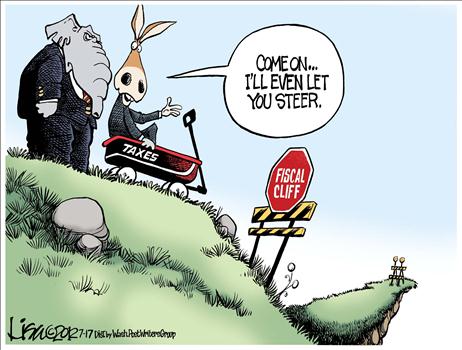
Fiscal Cliff Deadline May Come Sooner Than Expected
by Stephen Feller 
December 10, 2012 

While the tax increases and spending cuts of the fiscal cliff don’t kick in until Jan. 1, if Congress wants to do something to stop the country from going over the cliff they’ll need to make a deal and get it passed much sooner than that.

Congress will recess for the holidays on Dec. 21, so President Barack Obama and Speaker of the House John Boehner have until Dec. 15 to reach a deal, so that legislation can be written and printed with enough time for it to be read and voted on before the break, reported NBC News.

On Jan. 1, the Bush-era tax cuts are set to automatically expire for all income levels and about $110 billion in cuts to the Pentagon budget will begin to be phased in unless Congress passes legislation to override them.

Congress has made a habit during the last few years of waiting until the last possible second to make deals when faced with the threat of extreme calamity. Debates and resulting legislation on tax cut extensions, the debt ceiling debate, and the payroll tax holiday are clear examples of this since 2010.

"The Congress doesn't work on the clock; it works on the calendar," Republican Sen. Roy Blunt of Missouri told Reuters. "There is just that required moment when something has to happen because you've run out of time. [In the meantime] there is a desire to maximize your negotiating position until you realize you don't have any room any more to negotiate. It almost invariably works that way."

Obama and Boehner met Sunday at the White House in a private meeting that both agreed not to discuss. The meeting comes days after reports that the two leaders had failed to discuss the cliff last week or speak at all to one another at the White House Christmas party they both attended on Oct. 5.

The money-saving and revenue-generating provisions were put in place by Congress with approval of the Budget Control Act of 2011. The act provided for a super-committee to find areas of the budget that could be slashed with Congressional approval or risk having the automatic cuts kick in. 

After much discussion of the fiscal cliff in the presidential and congressional races, Congress did not start working on a solution until Obama was re-elected.

Negotiations have stalled on Democratic demands that taxes be increased back to Clinton-era levels for the top 2 percent of earners, while Republicans would prefer to reduce spending and keep tax rates unchanged.

In the last week or two, however, some Republicans have walked back their position that nobody’s taxes should go up. 

"There is a growing group of folks looking at this and realizing that we don't have a lot of cards as it relates to the tax issue before year end," Sen. Bob Corker, R-Tenn., said on "Fox News Sunday."

If Republicans decide to go with Democratic efforts to raise taxes, Corker added, "the focus then shifts to entitlements and maybe it puts us in a place where we actually can do something that really saves the nation."

Read more: http://goo.gl/Hv7n9


REAL CLEAR POLITICS
Taxing the Poor
by Thomas Sowell
December 11, 2012

With all the talk about taxing the rich, we hear very little talk about taxing the poor. Yet the marginal tax rate on someone living in poverty can sometimes be higher than the marginal tax rate on millionaires.

While it is true that nearly half the households in the country pay no income tax at all, the apparently simple word "tax" has many complications that can be a challenge for even professional economists to untangle.

If you define a tax as only those things that the government chooses to call a tax, you get a radically different picture from what you get when you say, "If it looks like a tax, acts like a tax and takes away your resources like a tax, then it's a tax."

One of the biggest, and one of the oldest, taxes in this latter sense is inflation. Governments have stolen their people's resources this way, not just for centuries, but for thousands of years.

Hyperinflation can take virtually your entire life's savings, without the government having to bother raising the official tax rate at all. The Weimar Republic in Germany in the 1920s had thousands of printing presses turning out vast amounts of money, which the government could then spend to pay for whatever it wanted to pay for.

Of course, prices skyrocketed with vastly more money in circulation. Many people's life savings would not buy a loaf of bread. For all practical purposes, they had been robbed, big time.

A rising demagogue coined the phrase "starving billionaires," because even a billion Deutschmarks was not enough to feed your family. That demagogue was Adolf Hitler, and the public's loss of faith in their irresponsible government may well have contributed toward his Nazi movement's growth.

Most inflation does not reach that level, but the government can quietly steal a lot of your wealth with much lower rates of inflation. For example a $100 bill at the end of the 20th century would buy less than a $20 bill would buy in 1960.

If you put $1,000 in your piggy bank in 1960 and took it out to spend in 2000, you would discover that your money had, over time, lost 80 percent of its value.

Despite all the political rhetoric today about how nobody's taxes will be raised, except for "the rich," inflation transfers a percentage of everybody's wealth to a government that expands the money supply. Moreover, inflation takes the same percentage from the poorest person in the country as it does from the richest.

That's not all. Income taxes only transfer money from your current income to the government, but it does not touch whatever money you may have saved over the years. With inflation, the government takes the same cut out of both.

It is bad enough when the poorest have to turn over the same share of their assets to the government as the richest do, but it is grotesque when the government puts a bigger bite on the poorest. This can happen because the rich can more easily convert their assets from money into things like real estate, gold or other assets whose value rises with inflation. But a welfare mother is unlikely to be able to buy real estate or gold. She can put a few dollars aside in a jar somewhere. But wherever she may hide it, inflation can steal value from it without having to lay a hand on it.

No wonder the Federal Reserve uses fancy words like "quantitative easing," instead of saying in plain English that they are essentially just printing more money.

The biggest and most deadly "tax" rate on the poor comes from a loss of various welfare state benefits-- food stamps, housing subsidies and the like-- if their income goes up.

Someone who is trying to climb out of poverty by working their way up can easily reach a point where a $10,000 increase in pay can cost them $15,000 in lost benefits that they no longer qualify for. That amounts to a marginal tax rate of 150 percent-- far more than millionaires pay. Some government policies help some people at the expense of other people. But some policies can hurt welfare recipients, the taxpayers and others, all at the same time, even though in different ways.

Why? Because we are too easily impressed by lofty political rhetoric and too little interested in the reality behind the words. 

Read more: http://goo.gl/7mwuP


Wednesday, November 21, 2012

November 21, 2012


NEWSMAX
Franklin Graham: Pray for America and Obama
by Todd Beamon
November 20, 2012

The Rev. Franklin Graham, the president and CEO of the Billy Graham Evangelistic Association, is calling for prayer for the nation and for President Barack Obama this Thanksgiving week:

"Our country finds itself in perilous times, facing uncertainty and anxiety stemming from economic challenges, global instability, and threats to our freedom and security as a people. Having just come through a divisive national election, I am urging pastors across this country to lead their congregations in praying daily for our president, Barack Obama, and all of our elected leaders – for wisdom, Divine guidance, and that God would accomplish His will and purposes.

“While politics is noticeably partisan, prayer must never be partisan. Americans need to come together, and people of faith should lead the way, by praying diligently for our leaders whether or not they agree with them or their policies. God's Word commands us to pray for 'kings and all who are in high positions' (I Timothy 2:2).

“When we look at the moral and economic decline of our nation and the international threats before us, it should be clear that we cannot solve these monumental problems without the help of Almighty God.

“As Americans this Thanksgiving, may we be reminded to thank God for His blessings; and may we also remember to pray for our nation and the protection of our freedoms. Our future may very well depend on our prayers.”

Read more: http://goo.gl/Y7Ziw


TOWNHALL
Sad: More Americans Than Ever Use Food Stamps for Thanksgiving
by Kate Hicks
November 20, 2012

Just another one of the myriad blessings many of us can be grateful for this Thursday: a Thanksgiving turkey. A new study from the Sunlight Foundation indicates that, thanks to economic hardship, more Americans than ever will be forced to set their Thanksgiving tables using food stamps -- hardly a budget that allows for an opulant feast on a day centered around dinner.

The Food Stamp Challenge, which challenges higher-income families to live as if they are on food stamps, estimates that a person on food stamps has a budget of about $1.25 per meal. In other words, a family on food stamps must buy an entire meal per person for less than the cost of an average cup of coffee.

This Thanksgiving, 42.2 million Americans will be on food stamps, according to the Economic Policy Institute. This is roughly the size of the populations of California and Connecticut combined.

Not surprisingly, feeding millions of Americans isn't cheap. The cost of the SNAP program last year reached $72 billion, the highest to date, according to the Congressional Budget Office.

Although the election -- and subsequently, the rhetorical reminders of economic hardship -- are both over, these figures remind us that the reality is, many of our fellow Americans are still hurting. It's worth saying a prayer for those who are struggling, and certainly a reminder not to take a single bite for granted.

Read more: http://goo.gl/VcZOJ


THE BLAZE
‘Capitalism Doesn’t Work for Everyone’: This Is the Limbaugh Monologue GOP Consultants Will Hate
by Becket Adams
November 20, 2012

Washington Post columnist Michael Gerson in an article published on Monday proposed a solution to the GOP’s “demographic problem”: Create and champion a new form of capitalism that “work[s] for everyone.”

And by “work[s] for everyone,” Mr. Gerson means a system where economic growth ensures prosperity for all.

While this might sound like a nice idea, talk radio host Rush Limbaugh was not impressed. Indeed, during a monologue that’s sure to agitate GOP consultants eager to give the party a facelift, the radio host stated in no uncertain terms that “capitalism doesn’t work for everyone.”

“Stop and think, now. Is that even possible? Is there a system, is there a person, is there a government, is there a place where whatever is going on works for everyone?” Limbaugh asked.

“It used to be opportunity. Opportunity is what people wanted. Opportunity is all they wanted. Just give me a shot. Just let me prove myself. Just let me have at it. Let me try to be the best I can be. Let me use whatever talents and ambition I’ve got. Let me employ excellence as it applies to me, as I know it,” he added.

“That’s out the window, and now people are demanding outcomes. And of course we have some messiahs coming along guaranteeing or promising outcomes.”


“Making capitalism work for everybody is not capitalism. That is a ‘Command Economy,”’ Limbaugh explained. “Capitalism working for everybody is not capitalism, and by the way it’s not possible. There’s not one bit of proof that it can be done.”

Now before consultants and “analysts” start piling on Limbaugh for admitting the reality of failure, it’s important to note that much of conservative host’s monologue is identical to the philosophy of Milton Friedman, the Nobel Prize-winning economist responsible for rescuing the U.S. economy from the Carter administration.

For instance, when Limbaugh says capitalism can’t guarantee prosperity, but that it offers the best opportunity for prosperity, he is walking directly in the shadow of Friedman. Indeed, as far as economic systems are concerned, capitalism has been the most successful in bringing prosperity and wealth to the common man.

“The record of history is absolutely crystal clear,” Milton Friedman once said during an interview on the The Phil Donahue Show.

“[T]there is no alternative way so far discovered of improving the lot of the ordinary people that can hold a candle to the productive activities that are unleashed by a free enterprise system,” he added.


Furthermore, Limbaugh, like Friedman, argues that people — not governments — are responsible for people.

Limbaugh’s monologue centers around the idea that success can be achieved through hard work and personal responsibility. This was the entire basis of Friedman’s economic philosophy:


Final Thought: Now we’re not saying Limbaugh is the next Milton Friedman. What we’re saying is that his monologue sounds like many of the speeches given by Friedman, one of the most successful and effective economists of the 20th century.

And maybe Limbaugh has a point. Rather than transforming the free enterprise system into something that it’s not, perhaps the GOP should fight to defend it and promote it as Friedman did.

Who knows? Maybe they’ll win a few elections.

Read more: http://goo.gl/1kj8s