Showing posts with label economy. Show all posts

Thursday, December 27, 2012

December 27, 2012


WALL STREET JOURNAL
The Biggest Cliff of All
by Daniel Henninger 
December 26, 2012

If you're looking for optimism as the world turns toward 2013, stay up late watching paid-for television explaining how to turn wrinkles into miracles. Past that, my own reservoir of uplift is a bit dry this year.

A famous and successful American optimist, Ronald Reagan, put his finger closer to the problem when he suggested there was little limit to what people could accomplish if government would get out of the way. As Barack Obama flies from Hawaii's beaches to Washington's cliff, there may be four or five liberals who've come to agree with the Gipper.

Indeed, a reality has become too obvious for the world's dazed inhabitants not to notice: The greatest threat to the upward arc of human progress is the collapse of public policy making. That is the biggest cliff of all.

Governments are giving government a bad name.

Japan's once-thriving economy has been in the dumpster for years. California, said to be the world's sixth-largest economy, is joining Japan in decline. The euro crisis, now in its third year, is less a crisis than a chronic condition of policy failure across Western Europe. As to America's fiscal cliff, no comment.

Then came the Newtown massacre. A few days after this event, a familiar American policy-making consensus called for federal gun-control laws. More precisely, they want Congress to re-pass the ban on big, dramatic-looking assault-type weapons that existed from 1994 until the law sun-setted in 2004.

Government, for the past 80 years or so, has seen its purpose as mainly to "respond" to society's failures the moment they occur or whenever they are imagined. Adam Lanza killed with guns, so modern policy-making logic posits that government must pass a law. Whether that law will accomplish its goal is . . . irrelevant.

Policy making has become an activity that supports the genetic and financial needs of policy makers and their follower tribes. The community's role, we've lately learned, is to provide revenue. Medicaid, for example, is medical care for the poor. As administered by the policy professionals, it has been allowed to become awful.

The experience with guns is hardly better. In November 2011, the National Institute of Justice convened its Firearms and Violence Research Working Group to examine what the best research reveals about reducing gun-related violence. In 2005 the National Research Council produced a 250-page study of this subject. Both concluded that the quality of data about gun violence and prevention programs is poor, and that it is possible to reach very few policy conclusions about what works or not.

Programs and laws abound already. For years the U.S. Bureau of Alcohol, Tobacco, Firearms and Explosives has run the National Tracing Center that operates the firearms eTrace system. Every new U.S. firearm goes into the eTrace system from point of manufacture to first retail sale. But past first sale, tracing guns or bullets has proved impossible.

A real-world look at where killers and other career criminals get guns emerged in October when the New York Police Department put on display 154 guns—most of them bizarre-looking handguns—that it obtained in a high-risk sting operation in Brooklyn. Incidentally, these police antigun efforts are about the only program that research has identified as effective.

Buying or possessing a gun legally in New York City is so difficult that it is a non-subject for most New Yorkers. So where did the NYPD get these guns? A Mr. Kerwin "Trini" Gobin allegedly sold undercover cops 87 of the weapons, including a Sten machine gun able to fire 550 rounds per minute. Machine guns have been illegal since the 1930s. But not in Trini Gobin's world. The illicit firearms market is global. Canada, Australia and New Zealand are all wrestling with how to control black-market gun traffic after recent outbreaks of firearm violence, much of it gang-related.

A consensus has formed around the unacceptability of young people being killed by guns—as bystanders in the inner cities or as mass-murder victims in the suburbs and on campuses. Policy making today ordains that we pass laws no matter how little we know and ignore what we've already learned.

After Newtown happened, mental-health experts pointed out the hardly disputed linkage between violent behavior and some untreated or poorly medicated patients who have a severe mental illness. But legislation to monitor or mandate effective treatment for individuals already identified as dangerous is frequently voted down by various civil libertarians. Public programs that exist are often poorly administered.

Government's problem for a great many people around the world today is that its advocates are enacting policies that do damage or don't work. The public record of national governments—America's and others'—as we approach the new year calls to mind the minimalist optimism of a prescient book title from the 1960s: "Been Down So Long It Looks Like Up to Me."

Read more: http://goo.gl/ejRqA


HUMAN EVENTS
Geithner: Treasury runs out of cash Monday
by Neil W. McCabe
December 26, 2012

The 75th man to hold the office of Treasury Secretary informed congressional leaders from both parties by a letter dated today that the U. S. Treasury would hit its debt limit Dec. 31.

As of Dec. 24, the national debt stood at $16,337,556,561,533.65.

The current debt ceiling is: $16,394 trillion.

“Under normal circumstances, that amount of headroom would last approximately two months.  However, given the significant uncertainty that now exists with regard to unresolved tax and spending policies for 2013, it is not possible to predict the effective duration of these measures,” wrote Timothy F. Geithner, who served as the president of the Federal Reserve Bank of New York prior to his current posting.

Geithner said the reason for the short notice and the short leeway is the confusion caused by the failure of President Barack Obama and the Congress to resolve tax and spending issues regarding what has become known as the “fiscal cliff,” the mandatory spending cuts and tax increases written into the Budget Control Act passed in August 2011.

800px-US_Public_Debt_Ceiling_1981-2010

“If left unresolved, the expiring tax provisions and automatic spending cuts, as well as the attendant delays in filing of tax returns, would have the effect of adding some additional time to the duration of the extraordinary measures,” Geithner said.

Speaker John A. Boehner (R.-Ohio) released a joint statement today, before the Geithner debt ceiling letter was released, with the other members of the GOP House leadership team: Rep. Eric I. Cantor (R.-Va), the House Majority Leader, Rep. Kevin O. McCarthy (R.-Calif.), the House Majority Whip and Rep. Catherine McMorris Rogers (R.-Wash.) stating his case for resolving the fiscal cliff.

The House Republicans have already acted to meet the crisis, he said.

“The House has acted on two bills which collectively would avert the entire fiscal cliff if enacted.  Those bills await action by the Senate,” he said.

“If the Senate will not approve and send them to the president to be signed into law in their current form, they must be amended and returned to the House,” he said.

The House will act, but the Senate, controlled by Democrats, must act first, the Speaker said.

Boehner said he and the House GOP will continue to communicate, but they are convinced the problem that the governement spends too much, not that the people are taxed too little.

Geithner sent his letter to all Capitol Hill leaders,  including Boehner, House Minoity Leader Nancy P. Pelosi (D.-Calif.), Senate Minority Leader A. Mitchell McConnell Jr. (R.-Ky.), Rep. Sander M. Levin (D.-Mich.), the ranking member on the House Ways and Means committee; Sen. Max S.Baucus (D.-Mont.), the chairman of the Senate Finance Committee and Sen. Orrin G. Hatch (R.-Utah), the ranking member on the Senate Finance Committee, recieved the same letter as well as individual members of the outgoing 112th Congress. The 112th Congress expires Jan. 3.

The text of the letter sent to Sen. Harry Reid (D.-Nev.), the senate majority leader is below:

December 26, 2012
The Honorable Harry Reid
Majority Leader
United States Senate
Washington, DC 20510
 
Dear Mr. Leader:
I am writing to inform you that the statutory debt limit will be reached on December 31, 2012, and to notify you that the Treasury Department will shortly begin taking certain extraordinary measures authorized by law to temporarily postpone the date that the United States would otherwise default on its legal obligations.
These extraordinary measures, which are explained in detail in an appendix​ to this letter, can create approximately $200 billion in headroom under the debt limit. Under normal circumstances, that amount of headroom would last approximately two months. However, given the significant uncertainty that now exists with regard to unresolved tax and spending policies for 2013, it is not possible to predict the effective duration of these measures. At this time, the extent to which the upcoming tax filing season will be delayed as a result of these unresolved policy questions is also uncertain. If left unresolved, the expiring tax provisions and automatic spending cuts, as well as the attendant delays in filing of tax returns, would have the effect of adding some additional time to the duration of the extraordinary measures. Treasury will provide more guidance regarding the expected duration of these measures when the policy outlook becomes clearer.
Sincerely, 
Timothy F. Geithner
Read more:  http://goo.gl/Aoz67

Friday, December 14, 2012

December 14, 2012


NEWSMAX
Bernanke: Fiscal Cliff Already Hurting Economy
by the Associated Press
December 13. 2012

The U.S. economy is already being hurt by the "fiscal cliff" standoff in Washington, Federal Reserve Chairman Ben Bernanke said Wednesday. But Bernanke said the Fed believes the crisis will be resolved without significant long-term damage.

The steep tax increases and spending cuts can be avoided with a successful budget deal, Bernanke said during a news conference after the Fed's final meeting of the year. The Fed's latest forecasts for stronger economic growth next year and slightly lower unemployment assume that happens.

Still, Bernanke said the uncertainty surrounding the resolution is already affecting consumer and business confidence. And it has led businesses to cut back on investment.

"Clearly the fiscal cliff is having effects on the economy," Bernanke said.

Bernanke said the most helpful thing that Congress and the Obama administration can do is resolve the issue quickly.

"I'm hoping that Congress will do the right thing on the fiscal cliff," Bernanke said. "There is a problem with kicking the can down the road."

Bernanke repeated his belief that if the scheduled tax hikes and spending cuts do take effect in January, they will have a significantly adverse effect on the economy, regardless of what the Fed might do.

"We cannot offset the full impact of the fiscal cliff. It's just too big," Bernanke said.

Still, the Fed took more steps Wednesday to try and help boost economic growth and lower unemployment.

After the meeting, the Fed said it would keep its key short-term interest rate near zero as long as unemployment remains above 6.5 percent and inflation stays tame. It was the first time the Fed had linked future rate increases to specific economic markers.

And in an effort to drive unemployment lower, the Fed said it will spend a total of $85 billion a month to sustain an aggressive drive to keep long-term interest rates low.

Keeping rates low encourages more borrowing and spending, which drives economic growth.

At the news conference, Bernanke said changes in the purchases will be determined by how the economy performs.

He said the Fed expects to keep purchasing bonds to support economic growth "until we see substantial improvement in the labor market."

But if the committee determines that the risks of increasing the Fed's balance sheet begin to outweigh the benefits, the purchase program will be modified, he said.

Read more: http://goo.gl/UhGdb


BREITBART
Exclusive-DeMint: Heritage to Audit Campaign, Republicans 'Amateurish'
by Mike Flynn
December 13, 2012

This afternoon, Breitbart News sat down with Sen. Jim DeMint, in advance of his exit from the Senate to take the reigns at the Heritage Foundation. Our conversation primarily focused on the future of the conservative movement and the immediate talks surrounding the "fiscal cliff." But, one particular exchange was unexpected. Breitbart News asked Sen. DeMint about the newly announced 5-member panel to examine or "audit" the recent campaign and the Republican Party's outreach and messaging. His answer was a surprise:

I'll see what they do, but we're going to do that [auditing the campaign] at Heritage and we're not just going to do an analysis of other pols. We're going to go out and do our own research. I know you can't just ask people what they think, unless you give them cues. Like, what do you think of the word conservative. You can ask them if they call themselves conservative or not. 40% call themselves conservative, but you don't know what the other 60% think about it. They may not like the word, but they may be conservatives.

I just see, looking at the political handling from the Republican side is so amateurish compared to even what I was doing in marketing fifteen years ago, before I came to Congress. And the ability is there to be so much more sophisticated in targeting markets, segmenting and communicating with them individually.

The Republican Party used to be very good at targeting voters. We asked the Senator what he thinks happened to the party's ability to do this well:

Well, I think we tend to put political people into positions where we should have CEOs who know how to run things. When you're running a big organization its not the time for red meat for the grass roots. Its the time to make good people around you with good data. And, there are some groups out there beginning to do that...the expertise is out there.

Yes, it is out there. The work that the Republican Party used to do well is now being done by outside conservative groups like Americans for Prosperity, American Majority and Heritage Action. With just a fraction of the budget the Party commands, groups like these are building an energized infrastructure of grass roots activists.

Talking to DeMint, its clear he wants to aggressively build out this infrastructure, building an almost alternative structure to the GOP. If he succeeds, the question of whether or not the RNC can re-energize itself may be irrelevant.

Read more: http://goo.gl/GSFUP


THE NATIONAL REVIEW
Return to Federalism - Conservatives need to stop playing a game rigged against them.
by Jonah Goldberg
December 14, 2012

To understand why Republicans have a “branding problem,” you first need to understand how the system is rigged against conservatives.

Such is the schizophrenic dysfunction of our politics: We constantly demand “conviction” politicians who will “do what’s right” and then condemn them, often in the same breath, for being unwilling to put aside their conviction and their sense of what’s right.

But such condemnation does not fall equally on conservatives and progressives alike. For the progressive’s principle is, at its core, more. Do more. Spend more. Spend more doing more. Any compromise of progressive principle in this regard is seen as “pragmatic.” Hence, the progressive’s heart is always in the right place.

The conservative, however, who says the federal government is not the right tool to fix the problem at hand, or that it is not Washington’s job to fix said problem, or that such a problem is itself not fixable and taking money from taxpayers to try is despotic folly: This conservative’s heart is never in the right place.

In other words, the progressive wins entirely on the principled question of direction. The conservative (or libertarian) loses entirely on principle but gets concessions on how fast we’ll go in the wrong direction. The progressive says, “Let’s move to Mars.” The conservative says, “Earth is fine.” They compromise by moving to the moon. And, before the first lunar dawn, the progressives start agitating about how Mars would be so much better.

When the classical-liberal philosopher Friedrich Hayek famously said that he couldn’t call himself a conservative because “It has . . . invariably been the fate of conservatism to be dragged along a path not of its own choosing,” he had this dynamic in mind, and you can see it on full display as progressives respond to the unfolding disaster of Obamacare by arguing for a single-payer system.

This gets to the heart of why the Republican “brand” is in such terrible shape. Over the 20th century, progressives erected a system and culture where the government in Washington is the agency of first and last resort for all of our problems. When government is expected to say yes to everything, electing the Party of No makes as much sense as hiring a priest to run a brothel.

So what is the answer? Many conservatives argue that what the GOP needs to do is start saying “yes” to things. This was the idea behind George W. Bush’s compassionate conservatism. Americans want an activist government, so conservatives should find things they can be activist about, too. If the government is going to meddle, it might as well meddle in conservative ways.

While individual policies may be advisable, as a general proposition I think this is the wrong way to go. Not only does this do violence to the constitutional order conservatives are supposed to conserve, it forever puts the Right in a bidding war with the Left about what government can and should do. Conservatives will lose that fight — and possibly their souls in the process.

What’s the alternative? Well, if the game is rigged against you, continuing to play the game is the very definition of idiocy. You have to change the rules.

My own view is that conservatives should recommit themselves to federalism and states’ rights. The party of Lincoln should protect core civil rights, but beyond that, states and localities should be given as much freedom as they can handle. If California wants to become Sweden with better weather, let it. If Texas wants to become Singapore on the Rio Grande, great, go for it. And the same principle goes for cities and towns within those states.

Of course, conservatives already say they believe in federalism, but they rarely demonstrate it save when convenient. Which brings me back to the question of fidelity to principle. In principle, Republicans should look at the monumental clutter in Washington like a boat with too much ballast to stay afloat: When in doubt, throw it overboard.

In practice, Republicans should be more strategic and discriminating. That means taking positions that are right on policy, but also, when possible, highlighting issues that run counter to the (unfair) caricature of Republicans as prudish moneybags. Personally, I’d start with federal marijuana laws. The tide has turned on pot, and states are going to keep legalizing it. Why should Washington stand in their way? The beauty of federalism is that you don’t have to condone legalization in one state or prohibition in another. It’s just not Washington’s fight.

This can’t happen overnight, but the system didn’t get rigged overnight either.

Read more: http://goo.gl/qI4qf

Tuesday, December 11, 2012

December 11, 2012


NEWSMAX 

Fiscal Cliff Deadline May Come Sooner Than Expected
by Stephen Feller 
December 10, 2012 

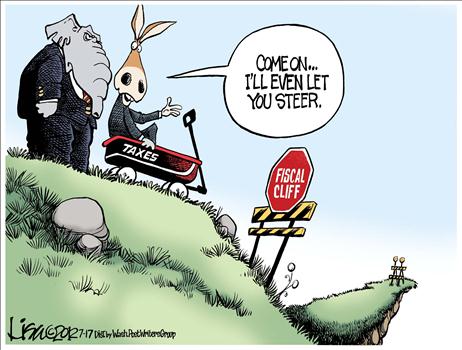
While the tax increases and spending cuts of the fiscal cliff don’t kick in until Jan. 1, if Congress wants to do something to stop the country from going over the cliff they’ll need to make a deal and get it passed much sooner than that.

Congress will recess for the holidays on Dec. 21, so President Barack Obama and Speaker of the House John Boehner have until Dec. 15 to reach a deal, so that legislation can be written and printed with enough time for it to be read and voted on before the break, reported NBC News.

On Jan. 1, the Bush-era tax cuts are set to automatically expire for all income levels and about $110 billion in cuts to the Pentagon budget will begin to be phased in unless Congress passes legislation to override them.

Congress has made a habit during the last few years of waiting until the last possible second to make deals when faced with the threat of extreme calamity. Debates and resulting legislation on tax cut extensions, the debt ceiling debate, and the payroll tax holiday are clear examples of this since 2010.

"The Congress doesn't work on the clock; it works on the calendar," Republican Sen. Roy Blunt of Missouri told Reuters. "There is just that required moment when something has to happen because you've run out of time. [In the meantime] there is a desire to maximize your negotiating position until you realize you don't have any room any more to negotiate. It almost invariably works that way."

Obama and Boehner met Sunday at the White House in a private meeting that both agreed not to discuss. The meeting comes days after reports that the two leaders had failed to discuss the cliff last week or speak at all to one another at the White House Christmas party they both attended on Oct. 5.

The money-saving and revenue-generating provisions were put in place by Congress with approval of the Budget Control Act of 2011. The act provided for a super-committee to find areas of the budget that could be slashed with Congressional approval or risk having the automatic cuts kick in. 

After much discussion of the fiscal cliff in the presidential and congressional races, Congress did not start working on a solution until Obama was re-elected.

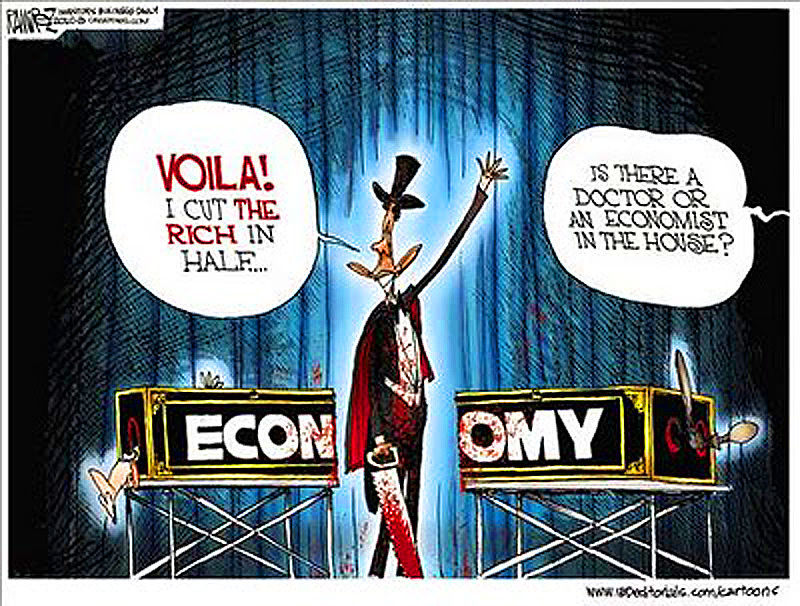
Negotiations have stalled on Democratic demands that taxes be increased back to Clinton-era levels for the top 2 percent of earners, while Republicans would prefer to reduce spending and keep tax rates unchanged.

In the last week or two, however, some Republicans have walked back their position that nobody’s taxes should go up. 

"There is a growing group of folks looking at this and realizing that we don't have a lot of cards as it relates to the tax issue before year end," Sen. Bob Corker, R-Tenn., said on "Fox News Sunday."

If Republicans decide to go with Democratic efforts to raise taxes, Corker added, "the focus then shifts to entitlements and maybe it puts us in a place where we actually can do something that really saves the nation."

Read more: http://goo.gl/Hv7n9


REAL CLEAR POLITICS
Taxing the Poor
by Thomas Sowell
December 11, 2012

With all the talk about taxing the rich, we hear very little talk about taxing the poor. Yet the marginal tax rate on someone living in poverty can sometimes be higher than the marginal tax rate on millionaires.

While it is true that nearly half the households in the country pay no income tax at all, the apparently simple word "tax" has many complications that can be a challenge for even professional economists to untangle.

If you define a tax as only those things that the government chooses to call a tax, you get a radically different picture from what you get when you say, "If it looks like a tax, acts like a tax and takes away your resources like a tax, then it's a tax."

One of the biggest, and one of the oldest, taxes in this latter sense is inflation. Governments have stolen their people's resources this way, not just for centuries, but for thousands of years.

Hyperinflation can take virtually your entire life's savings, without the government having to bother raising the official tax rate at all. The Weimar Republic in Germany in the 1920s had thousands of printing presses turning out vast amounts of money, which the government could then spend to pay for whatever it wanted to pay for.

Of course, prices skyrocketed with vastly more money in circulation. Many people's life savings would not buy a loaf of bread. For all practical purposes, they had been robbed, big time.

A rising demagogue coined the phrase "starving billionaires," because even a billion Deutschmarks was not enough to feed your family. That demagogue was Adolf Hitler, and the public's loss of faith in their irresponsible government may well have contributed toward his Nazi movement's growth.

Most inflation does not reach that level, but the government can quietly steal a lot of your wealth with much lower rates of inflation. For example a $100 bill at the end of the 20th century would buy less than a $20 bill would buy in 1960.

If you put $1,000 in your piggy bank in 1960 and took it out to spend in 2000, you would discover that your money had, over time, lost 80 percent of its value.

Despite all the political rhetoric today about how nobody's taxes will be raised, except for "the rich," inflation transfers a percentage of everybody's wealth to a government that expands the money supply. Moreover, inflation takes the same percentage from the poorest person in the country as it does from the richest.

That's not all. Income taxes only transfer money from your current income to the government, but it does not touch whatever money you may have saved over the years. With inflation, the government takes the same cut out of both.

It is bad enough when the poorest have to turn over the same share of their assets to the government as the richest do, but it is grotesque when the government puts a bigger bite on the poorest. This can happen because the rich can more easily convert their assets from money into things like real estate, gold or other assets whose value rises with inflation. But a welfare mother is unlikely to be able to buy real estate or gold. She can put a few dollars aside in a jar somewhere. But wherever she may hide it, inflation can steal value from it without having to lay a hand on it.

No wonder the Federal Reserve uses fancy words like "quantitative easing," instead of saying in plain English that they are essentially just printing more money.

The biggest and most deadly "tax" rate on the poor comes from a loss of various welfare state benefits-- food stamps, housing subsidies and the like-- if their income goes up.

Someone who is trying to climb out of poverty by working their way up can easily reach a point where a $10,000 increase in pay can cost them $15,000 in lost benefits that they no longer qualify for. That amounts to a marginal tax rate of 150 percent-- far more than millionaires pay. Some government policies help some people at the expense of other people. But some policies can hurt welfare recipients, the taxpayers and others, all at the same time, even though in different ways.

Why? Because we are too easily impressed by lofty political rhetoric and too little interested in the reality behind the words. 

Read more: http://goo.gl/7mwuP


Wednesday, November 28, 2012

November 28, 2012


REAL CLEAR POLITICS
An Overdue Book - The Facts about Spending & Taxes
by Thomas Sowell
November 27, 2012

If everyone in America had read Stephen Moore's new book, "Who's The Fairest of Them All?", Barack Obama would have lost the election in a landslide.

The point here is not to say, "Where was Stephen Moore when we needed him?" A more apt question might be, "Where was the whole economics profession when we needed them?" Where were the media? For that matter, where were the Republicans?

Since "Who's The Fairest of Them All?" was published in October, there was little chance that it would affect this year's election. But this little gem of a book exposes, in plain language and with easily understood facts, the whole house of cards of assumptions, fallacies and falsehoods which constitute the liberal vision of the economy.

Yet that vision triumphed on election day, thanks to misinformation that was artfully presented and seldom challenged. The title "Who's The Fairest of Them All?" is an obvious response to liberals' claim that their policies are aimed at creating "fairness" by, among other things, making sure that "the rich" pay their "fair share" of taxes. If you want a brief but thorough education on that, just read chapter 4, which by itself is well worth the price of the book.

A couple of graphs on pages 104 and 108 are enough to annihilate the argument about "tax cuts for the rich." These graphs show that, under both Republican President Calvin Coolidge and Democratic President John F. Kennedy, high-income people paid more tax revenues into the federal treasury after tax rates went down than they did before.

There is nothing mysterious about this. At high tax rates, vast sums of money disappear into tax shelters at home or is shipped overseas. At lower tax rates, that money comes out of hiding and goes into the American economy, creating jobs, rising output and rising incomes. Under these conditions, higher tax revenues can be collected by the government, even though tax rates are lower. Indeed, high income people not only end up paying more taxes, but a higher share of all taxes, under these conditions.

This is not just a theory. It is what hard evidence shows happened under both Democratic and Republican administrations, from the days of Calvin Coolidge to John F. Kennedy to Ronald Reagan and George W. Bush. That hard evidence is presented in clear and unmistakable terms in "Who's The Fairest of Us All?"

Another surprising fact brought out in this book is that the Democrats and Republicans both took positions during the Kennedy administration that were the direct opposite of the positions they take today. As Stephen Moore points out, "the Republicans almost universally opposed and the Democrats almost universally favored" the cuts in tax rates that President Kennedy proposed.

Such Republican Senate stalwarts as Barry Goldwater and Bob Dole voted against reducing the top tax rate from 91% to 70%. Democratic Congressman Wilbur Mills led the charge for lower tax rates.

Unlike the Republicans today, John F. Kennedy had an answer when critics tried to portray his tax cut proposal as just a "tax cut for the rich." President Kennedy argued that it was a tax cut for the economy, that changed incentives meant a faster growing economy and that "A rising tide lifts all boats."

If Republicans today cannot seem to come up with their own answer when critics cry out "tax cuts for the rich," maybe they can just go back and read John F. Kennedy's answer.

A truly optimistic person might even hope that media pundits would go back and check out the facts before arguing as if the only way to reduce the deficit is to raise tax rates on "the rich."

If they are afraid that they would be stigmatized as conservatives if they favored cuts in tax rates, they might take heart from the fact that not only John F. Kennedy, but even John Maynard Keynes as well, argued that cutting tax rates could increase tax revenues and thereby help reduce the deficit.

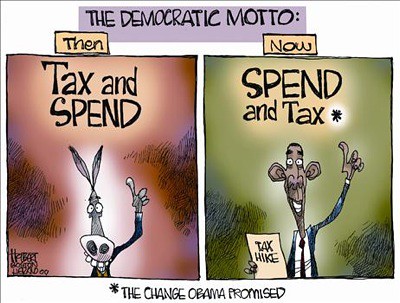
Because so few people bother to check the facts, Barack Obama can get away with statements about how "tax cuts for the rich" have "cost" the government money that now needs to be recouped. Such statements not only promote class warfare, to Obama's benefit on election day, they also distract attention from his own runaway spending behind unprecedented trillion dollar deficits.

Read more: http://goo.gl/hufEO


AMERICAN THINKER
Obama's Next Move: The Global Warming Tax
by Brian Sussman
November 28, 2012

This week the United Nations begins two weeks of climate talks in Doha, Qatar. The primary goal of these meetings is to draw President Obama into accepting a redistribution plan designed extract money from the U.S. economy in the form of a global warming tax and doling out the cash to Third World nations.

"There will be expectations from countries to hear a new voice from the United States," said Jennifer Morgan, director of the climate and energy program at the World Resources Institute in Washington.

The meeting in Qatar's capital will focus on ramping up what is described as "climate financing for poor nations." American leadership is considered crucial to these plans.

"We need the U.S. to engage even more," said European Union Climate Commissioner
Connie Hedegaard. "Because that can change the dynamic of the talks."

And carrying the water in support of this global scheme are the media, selecting their talking points from a recent World Bank report claiming global temperatures are likely to increase by more than 6 degrees, leading to "extreme heat waves, declining global food stocks, loss of ecosystems and biodiversity, and life-threatening sea level rise."

Given that since 1850 the earth's temperature has only warmed 1.2 degrees (with 88 percent of that warming occurring before 1940), and that the global average temperature has not risen since 1998, a six-degree hike flies in the face scientific sanity.

The lame duck Obama administration will likely be all over this UN plan. As a U.S. senator in 2008, Obama sponsored a bill known as the "Global Poverty Act." The bill would have made levels of U.S. foreign aid spending subservient to the dictates of the United Nations.

Joe Biden, then chairman of the Senate Foreign Relations Committee, was a vocal supporter of the legislation which would commit the U.S. to spending 0.7 percent of gross national product on foreign aid, which amounts to a phenomenal 13-year total of $845 billion over and above what the U.S. already spends.

A release from the Obama Senate office about the bill declared, "In 2000, the U.S. joined more than 180 countries at the United Nations Millennium Summit and vowed to reduce global poverty by 2015... it is time the United States makes it a priority of our foreign policy to meet this goal and help those who are struggling day to day."

Obama's bill would have required the president "to develop and implement a comprehensive strategy to further the United States foreign policy objective of promoting the reduction of global poverty, [and] the elimination of extreme global poverty..."

The primary vehicle for such a redistribution plan would be a tax or fee on businesses that produce carbon dioxide as a byproduct of their activities. This could include power plants, refineries, cement manufacturers, and dairy farmers. Those increased costs of production would be passed along to the consumer in the form of higher prices.

A tax on carbon dioxide would also be seen by politicians as a way to offset our severe budget deficit and staggering national debt. It would be sold to the American public in the name of saving the planet.

Obama may be another step closer to realizing his 2008 dream of massive global wealth redistribution.

Read more: http://goo.gl/9WDxU


HUMAN EVENTS
Fiscal cliff a tale of two tax headaches: Small business vs big business
by Tim Cavanaugh
November 28, 2012

Fiscal cliff negotiations and the fight over individual tax increases have exposed a deep division in business tax policy. The controversy pits large and small U.S. companies against each other while reversing many expected distinctions between the political left and right. According to one tax activist, the struggle “will be larger than the tea party.”

At issue is President Barack Obama’s proposal to let temporary 2002-era individual income tax rates, popularly known as the “Bush tax cuts,” expire for households earning more than $250,000 a year. Although lower tax rates for high earners have been renewed several times, the president is determined to raise taxes in the lame-duck budget negotiations.

But while the president and Democrats depict the tax hike as being limited to high net-worth individuals, the higher individual rate could impact millions of small businesses.

According to a 2011 Ernst & Young study conducted for the S Corporation Association (SCA), about 26 million businesses in the United States are organized as “flow-through” entities—Subchapter S corporations, partnerships and sole proprietorships in which profits pass through to owners. These entities employ about 70 million people and, according to the SCA, account for the majority of business activity in the United States.

That’s a very different class of businesses from the large Subchapter C corporations who were represented in a recent White House meeting regarding the fiscal cliff. There, Obama met with the leaders of General Electric, Honeywell, IBM, Xerox, American Express, Wal-Mart, Procter & Gamble, Ford, PepsiCo and Chevron.

These companies are seeking a particular favor from the White House—a cut in the corporate tax rate, which, at 35 percent, is the highest among developed nations that are members of the Organization for Economic Co-operation and Development. Obama has indicated he favors a drop in the corporate rate. The Business Roundtable, a group representing large companies, advocates a 25 percent corporate rate but has for the most part not engaged the issue of the Bush tax cuts. Many advocates say this signals indifference to the way a tax hike will hit small businesses.

“I have sat in a room with the small guys and the big guys and the senators working on this,” Grover Norquist, president of Americans for Tax Reform, said in an interview. “It’s very clear the Subchapter S guys were worried. But the president doesn’t see them as businesses.”

Because Roosevelt Room meetings with the president are widely viewed as providing public relations cover for administration policy, and because the president’s invitation list included only large, powerfully connected corporations, advocates for small business worry that this could signal a rift in business unity on taxes.

“Small businesses … are especially worried because they are facing the prospect of higher personal tax, which is how many of them pay their taxes, and in addition they soon will be dealing with all the costs and mandates of Obamacare and other regulations,” the U.S. Chamber of Commerce said in a statement. The Chamber, which has had a volatile history with Obama, urged politicians to “extend all of the current tax rates and other expiring tax incentives and then in 2013 negotiate a Big Deal to control the debt and put our economy on a path to robust growth.”

Read more: http://goo.gl/7RlJd

Tuesday, November 27, 2012

November 27, 2012


NEWSMAX
Fiscal Cliff in U.S. Raises Risk of Global Recession, OECD Says
by Bloomberg News
November 27, 2012

Failure to prevent the so-called fiscal cliff in the U.S. would increase the risk of a global recession, the Organization for Economic Cooperation and Development said, while adding that the “greatest threats” to the world economy lie in the euro area.

“If the fiscal cliff is not avoided, a large negative shock could bring the U.S. and the global economy into recession,” the Paris-based OECD said in its Economic Outlook report released today.

As the administration of President Barack Obama prepares to negotiate a budget agreement with Republicans in Congress, the OECD urged “smooth” implementation of tax increases, spending curbs and a higher debt ceiling in the medium term.

“Reducing the large federal budget deficit is necessary to restore fiscal sustainability, but this should be done gradually and in the context of a well-identified medium-term consolidation plan,” today’s report said.

The fiscal cliff refers to the $607 billion in federal spending cuts and tax increases scheduled to take effect early next year unless Congress acts. Treasury Secretary Timothy F. Geithner said Nov. 16 the deadlock can be resolved “within several weeks” while the uncertainty it has created “already is having an effect on consumer confidence and the economy.”

Absent the automatic spending cuts and most of the tax increases currently set to take effect next year, the U.S. federal deficit would come to $1.04 trillion in fiscal year 2013, the fifth consecutive year of budget gaps exceeding $1 trillion, according to the non-partisan Congressional Budget Office.

Europe Crisis

The OECD report also said it is “urgent” to solve Europe’s debt crisis.

“In the euro area, where the greatest threats to the world economy remain, progress in adjustment and in strengthening institutions has been significant over the recent past,” the OECD said. “However, challenging fiscal sustainability conditions in some countries risk sparking a chain of events that could considerably harm activity in the monetary union and push the global economy into recession.”

A “major financial event” in the euro zone “would spill over into the rest of the global economy, including the United States,” Pier Carlo Padoan, OECD chief economist, said during a conference call with reporters yesterday.

Federal Reserve

The Federal Reserve should stand ready to enlarge its third round of quantitative easing program if the U.S. economy deteriorates, the OECD said.

“If the economic situation were to turn out significantly worse than expected, the Federal Reserve should further expand the size of its purchases of government and mortgage-backed securities and start purchasing other types of assets if necessary to ease financial conditions,” according to today’s report.

Read more: http://goo.gl/5D57A


THE WALL STREET JOURNAL
$16 Trillion Only Hints at the True U.S. Debt
Hiding the government's liabilities from the public makes it seem that we can tax our way out of mounting deficits. We can't.
by Chris Cox and Bill Archer
November 26, 2012

A decade and a half ago, both of us served on President Clinton's Bipartisan Commission on Entitlement and Tax Reform, the forerunner to President Obama's recent National Commission on Fiscal Responsibility and Reform. In 1994 we predicted that, unless something was done to control runaway entitlement spending, Medicare and Social Security would eventually go bankrupt or confront severe benefit cuts.

Eighteen years later, nothing has been done. Why? The usual reason is that entitlement reform is the third rail of American politics. That explanation presupposes voter demand for entitlements at any cost, even if it means bankrupting the nation.

A better explanation is that the full extent of the problem has remained hidden from policy makers and the public because of less than transparent government financial statements. How else could responsible officials claim that Medicare and Social Security have the resources they need to fulfill their commitments for years to come?

As Washington wrestles with the roughly $600 billion "fiscal cliff" and the 2013 budget, the far greater fiscal challenge of the U.S. government's unfunded pension and health-care liabilities remains offstage. The truly important figures would appear on the federal balance sheet—if the government prepared an accurate one.

But it hasn't. For years, the government has gotten by without having to produce the kind of financial statements that are required of most significant for-profit and nonprofit enterprises. The U.S. Treasury "balance sheet" does list liabilities such as Treasury debt issued to the public, federal employee pensions, and post-retirement health benefits. But it does not include the unfunded liabilities of Medicare, Social Security and other outsized and very real obligations.

As a result, fiscal policy discussions generally focus on current-year budget deficits, the accumulated national debt, and the relationships between these two items and gross domestic product. We most often hear about the alarming $15.96 trillion national debt (more than 100% of GDP), and the 2012 budget deficit of $1.1 trillion (6.97% of GDP). As dangerous as those numbers are, they do not begin to tell the story of the federal government's true liabilities.

The actual liabilities of the federal government—including Social Security, Medicare, and federal employees' future retirement benefits—already exceed $86.8 trillion, or 550% of GDP. For the year ending Dec. 31, 2011, the annual accrued expense of Medicare and Social Security was $7 trillion. Nothing like that figure is used in calculating the deficit. In reality, the reported budget deficit is less than one-fifth of the more accurate figure.

Why haven't Americans heard about the titanic $86.8 trillion liability from these programs? One reason: The actual figures do not appear in black and white on any balance sheet. But it is possible to discover them. Included in the annual Medicare Trustees' report are separate actuarial estimates of the unfunded liability for Medicare Part A (the hospital portion), Part B (medical insurance) and Part D (prescription drug coverage).

As of the most recent Trustees' report in April, the net present value of the unfunded liability of Medicare was $42.8 trillion. The comparable balance sheet liability for Social Security is $20.5 trillion.

Were American policy makers to have the benefit of transparent financial statements prepared the way public companies must report their pension liabilities, they would see clearly the magnitude of the future borrowing that these liabilities imply. Borrowing on this scale could eclipse the capacity of global capital markets—and bankrupt not only the programs themselves but the entire federal government.

These real-world impacts will be felt when currently unfunded liabilities need to be paid. In theory, the Medicare and Social Security trust funds have at least some money to pay a portion of the bills that are coming due. In actuality, the cupboard is bare: 100% of the payroll taxes for these programs were spent in the same year they were collected.

In exchange for the payroll taxes that aren't paid out in benefits to current retirees in any given year, the trust funds got nonmarketable Treasury debt. Now, as the baby boomers' promised benefits swamp the payroll-tax collections from today's workers, the government has to swap the trust funds' nonmarketable securities for marketable Treasury debt. The Treasury will then have to sell not only this debt, but far more, in order to pay the benefits as they come due.

When combined with funding the general cash deficits, these multitrillion-dollar Treasury operations will dominate the capital markets in the years ahead, particularly given China's de-emphasis of new investment in U.S. Treasurys in favor of increasing foreign direct investment, and Japan's and Europe's own sovereign-debt challenges.

When the accrued expenses of the government's entitlement programs are counted, it becomes clear that to collect enough tax revenue just to avoid going deeper into debt would require over $8 trillion in tax collections annually. That is the total of the average annual accrued liabilities of just the two largest entitlement programs, plus the annual cash deficit.

Nothing like that $8 trillion amount is available for the IRS to target. According to the most recent tax data, all individuals filing tax returns in America and earning more than $66,193 per year have a total adjusted gross income of $5.1 trillion. In 2006, when corporate taxable income peaked before the recession, all corporations in the U.S. had total income for tax purposes of $1.6 trillion. That comes to $6.7 trillion available to tax from these individuals and corporations under existing tax laws.

In short, if the government confiscated the entire adjusted gross income of these American taxpayers, plus all of the corporate taxable income in the year before the recession, it wouldn't be nearly enough to fund the over $8 trillion per year in the growth of U.S. liabilities. Some public officials and pundits claim we can dig our way out through tax increases on upper-income earners, or even all taxpayers. In reality, that would amount to bailing out the Pacific Ocean with a teaspoon. Only by addressing these unsustainable spending commitments can the nation's debt and deficit problems be solved.

Neither the public nor policy makers will be able to fully understand and deal with these issues unless the government publishes financial statements that present the government's largest financial liabilities in accordance with well-established norms in the private sector. When the new Congress convenes in January, making the numbers clear—and establishing policies that finally address them before it is too late—should be a top order of business.

Read more: http://goo.gl/thbZY