Showing posts with label Boehner. Show all posts

Friday, January 4, 2013

January 4, 2013


NEWSMAX
Gore's $70M Take from Current TV Designed to Avoid Obama Tax Hikes
by Bloomberg News
January 3, 2013

Al Gore, who shared the 2007 Nobel Peace Prize for his fight against global warming, may gross about $70 million from the sale of his Current TV network to Al Jazeera, the cable channel funded in part by oil-rich Qatar.

Al Jazeera will pay about $500 million for Current TV, including the stake held by Gore, 64, according to two people with knowledge of the deal. The network is one of dozens of investments made by the former vice president since he lost the 2000 presidential race by a slim margin, Bloomberg reported.

“It’s reeking with irony,” said Jeff Sonnenfeld, senior associate dean at the Yale School of Management, who studies corporate governance. “It seems to be at least a paradox in terms of his positions on sustainability and geopolitics.”

The deal highlights Gore’s makeover from career politician to successful businessman. His take from the Current TV sale is is many times the maximum net worth of $1.7 million he reported while running for president in 1999. Besides investing in startups, Gore is on the board of Apple Inc. (AAPL), an adviser to Google Inc., according to his website biography, and a partner at Kleiner Perkins Caufield & Byers.

Late Thursday, Fox News and other media reported that the sale seemed to have been rushed to avoid the anticipated fiscal cliff tax increases.

In addition to wanting a buyer who would reflect his political philosophy, Gore was anxious to fulfill his fiduciary responsibility to himself and keep his taxes low, the Washington Times reported.

"A critic of the tax structure that allows the very wealthy, like former Massachusetts Governor Mitt Romney and billionaire tax activist Warren Buffet, to escape the high income tax rates paid by their secretaries, Gore attempted to complete the deal by December 31," the Times reported Thursday. "Because the deal wasn’t signed until today, he and his partners will pay the new 23.8 percent capital gains tax rather than 15 percent, or an extra $8.8 million."

“The green of money knows no political boundaries,” Charles Elson, who is director of the John L. Weinberg Center for Corporate Governance at the University of Delaware, told Bloomberg News. “When you are running investments, your priority needs to be maximizing return.”

Gore’s holdings also include investments in Amazon.com Inc., EBay Inc. and Procter & Gamble Co. through his Generation Investment Management LLP.
2004 Purchase

Gore holds a 20 percent stake in Current TV, according to the people, who asked not to be named because the sale terms aren’t public. His proceeds are difficult to pin down because the company had $41.4 million in debt, as well as preferred stock entitled to $99.5 million in the event of a sale or liquidation, according to a 2008 regulatory filing.

The Current TV price represents a sevenfold increase from the $71 million Gore and his partners paid for the predecessor company in 2004, according to the filing. Gore, chairman, and Joel Hyatt, a co-founder and chief executive officer, announced the sale yesterday in a statement, without providing financial terms.

Kalee Kreider, a spokeswoman for Gore, didn’t respond to a phone call or e-mail request for comment.

“Many Americans are tired of borrowing huge amounts of money from China to buy huge amounts of oil from the Persian Gulf to make huge amounts of pollution that destroys the planet’s climate,” Gore said in September 2006 at the New York University School of Law. “Increasingly, Americans believe that we have to change every part of that pattern.”
Current Investors

The network’s investors included funds controlled by Los Angeles billionaire Ron Burkle and San Francisco money manager Richard Blum, according to the 2008 filing, when the company unsuccessfully sought to sell stock to the public. Blum is married to U.S. Senator Dianne Feinstein, a Democrat from San Francisco.

The Raine Group advised Current TV on the sale.

The owners introduced Current TV in 2005 after purchasing the network from Vivendi SA.

Al Jazeera is closely held and gets some funding from the government of Qatar, a small country on the eastern side of the Arabian Peninsula that gets almost half of its gross domestic product from oil and gas, data compiled by Bloomberg show.

Read more: http://goo.gl/7waHh


TOWNHALL
Mike Lee: Senators Only Had Six Minutes to Read “Fiscal Cliff” Bill Before Voting
by Daniel Doherty
January 3, 2013

What could go wrong, right? According to Utah Republican Senator Mike Lee, members of the upper chamber had -- at most -- six minutes to read the “fiscal cliff” bill before they voted on it. Little wonder, then, that the so-called “compromise” was in many respects a complete and total disaster:

"Everything about this bill was a failure…you need look no further than the fact that we were given a total of six minutes before we voted on it. Not one single Senator who voted for this bill had read it."
 This should trouble every American. I mean, if Senators aren’t reading a bill that will pretty much impact every single working American, what else aren’t they reading? An important question to ponder, it seems. Still, this isn’t the first time members of Congress have passed sweeping legislation without understanding the details of a bill, let alone the consequences of voting “aye.” Nancy Pelosi infamously said in 2010 we need to pass Obamacare to “find out what is in it.” Just look at how that turned out. Is it really surprising, then, that about half the country is not feeling optimistic about the future, and thus probably believes that the American Century has already come and gone? An exceedingly chilling thought, if you ask me.

Above all, we need leadership in Washington, something this Congress -- as well as the last one -- seems incapable of providing.

Read more: http://goo.gl/jfC7C


BREITBART
Inside the Conservative Rebellion Against John Boehner
by Matthew Boyle
January 3, 2012

House Speaker John Boehner barely held onto his job atop Congress’ lower chamber on Thursday. Just how close a call Boehner had is now becoming clear.

Nine House conservatives voted for somebody other than Boehner, two abstained from voting and one voted “present.” That total of 12 Republicans who didn’t support Boehner was a stone’s throw from the required 17 to force a second ballot election – at which point several more Republican members were slated to back a competitor to Boehner’s, who would unite the party behind him or her.

Politico has reported the original list of members possibly considering defection from Boehner was longer and included Reps. Steve King of Iowa, Cynthia Lummis of Wyoming, Paul Gosar of Arizona, Scott Garrett of New Jersey and Steve Fincher and Scott DesJarlais, both of Tennessee.

Politico uncovered this list because Kansas Republican Rep. Tim Huelskamp “sat on the House floor during the speaker vote brandishing an iPad” with a message “displayed on the screen ticking off members of the House Republican Conference he hoped would oppose the sitting speaker.”

The title of the email message was reportedly: “You would be fired if this goes out.”

Breitbart News has confirmed that the following members were considering voting against Boehner retaining his speakership as well: Reps. Jeff Duncan of South Carolina, Mo Brooks of Alabama, Sam Graves of Missouri, Steve Southerland of Florida, Trey Gowdy of South Carolina, David Schweikert of Arizona, Arkansas freshman Tom Cotton and Brett Guthrie of Kentucky.

Breitbart News also learned that outgoing House GOP conference chairman Texas Rep. Jeb Hensarling was considering opposing Boehner. Boehner recently named Hensarling to be the chairman of the House Financial Services Committee in the next Congress.

All in all, there were more than 20 House Republicans who were considering unseat Boehner. Many of these members bailed on the movement at the last minute on the House floor.

There did appear to be at one point a chance Boehner wouldn’t regain his position during the happenings on the House floor. The Clerk of the House had reached the end of her list of names to call when Boehner reached 216 votes – he needed 217 to win re-election. As the National Review’s Washington, D.C., editor Robert Costa noted on Twitter, there were 17 Republican members either not voting, voting present or voting for someone other than Boehner. “So: In short, we were over 17 for a minute, looking at 2nd ballot, when the conservatives come to floor, save Boehner from 2nd ballot,” Costa wrote.

Then, as Costa notes, Bachmann, Tennessee Republican Rep. Marsha Blackburn and New Jersey’s Scott Garrett came back to the floor – after ignoring their names being called the first time during the alphabetical roll call – and voted for Boehner.

“Boehner is fine, people/ He will be reelected. Blackburn, Bachmann, and Garrett saved him,” Costa said of those conservatives saving Boehner. “What a story. What a story.”

Read more: http://goo.gl/0BcTK


Thursday, January 3, 2013

January 3, 2013


NEWSMAX
Bowles, Simpson: 'Washington Missed Magic Moment’ on Budget
by Newsmax Wires
January 2, 2013

Budget-deficit-reduction devotees Erskine Bowles and Alan Simpson rue Congress’ inability to come up with a more comprehensive fiscal-cliff solution than the one it just passed.

While the deal represents a “small step forward” for deficit reduction, “it’s truly a missed opportunity to do something big to reduce our long-term fiscal problems,” the duo say in a statement issued by Fix the Debt, a group they founded.

Bowles was chief of staff for President Bill Clinton, and Simpson is a retired Wyoming Republican senator. They headed a panel on deficit reduction appointed by President Barack Obama in 2010. But their recommendations essentially went nowhere.

As for fiscal cliff negotiations, “Washington missed this magic moment to do something big to reduce the deficit, reform our tax code and fix our entitlement programs,” the two say. “Even after taking the country to the brink of economic disaster, Washington still could not forge a common-sense bipartisan consensus on a plan that stabilizes the debt.”

Government leaders now must summon up the courage for real tax and entitlement reform to begin curbing the $16 trillion public debt, Bowles and Simpson say.

They aren’t totally discouraged. “We take some encouragement from the statements by the president and leaders in Congress that they recognize more work needs to be done,” the two say.

But “to reach an agreement, it will be absolutely necessary for both sides to move beyond their comfort zone.”

Read more: http://goo.gl/b6ZOU


WASHINGTON POST
Our decadent democracy
by George Will
January 2, 2012

Connoisseurs of democratic decadence can savor a variety of contemporary dystopias. Because familiarity breeds banality, Greece has become a boring horror. Japan, however, in its second generation of stagnation is fascinating. Once, Japan bestrode the world, jauntily buying Rockefeller Center and Pebble Beach. Now Japanese buy more adult diapers than those for infants.

America has its lowest birth rate since at least 1920 — family formation and workforce participation (which hit a 30-year low last year) have declined in tandem. But it has an energy surplus, the government-produced overhang of housing inventory is shrinking and the average age of Americans’ cars is an astonishing 10.8 years. Such promising economic indicators, however, mask the country’s democratic decadence, as explained by the Hudson Institute’s Christopher DeMuth in the Dec. 24 Weekly Standard:
Deficit spending once was largely for investments — building infrastructure, winning wars — which benefited future generations, so government borrowing appropriately shared the burden with those generations. Now, however, continuous borrowing burdens future generations in order to finance current consumption. Today’s policy, says DeMuth, erases “the distinction between investing for the future and borrowing from the future.”
It is now as clear as it is unsurprising that most Americans will be spared the educational experience of “fiscal cliff”-related tax increases and spending cuts, which would have been a small but instructive taste of the real costs of the entitlement state.

Still, December’s maneuverings taught three lessons.

First, there will be no significant spending restraint. Democrats — you know: the people respectful of evidence and science — even rejected a more accurate measurement of the cost of living that would slightly slow increases in myriad government benefits. Accuracy will be sacrificed to liberalism’s agenda of government growth.

Second, Barack Obama has (as Winston Churchill said of an adversary) “the gift of compressing the largest amount of words into the smallest amount of thought.” His incessant talking swaddles one wee idea — raising taxes on “millionaires and billionaires,” including people earning less than half a million. He has nothing pertinent to say about the steadily worsening fiscal imbalance that will make sluggish growth — less than 3 percent — normal.

Third, one December winner was George W. Bush because a large majority of Democrats favored making permanent a large majority of his tax cuts. December’s rancor disguised bipartisan agreement: Both parties flinch from cliff-related tax increases and spending decreases. But neither the increases nor decreases would have tamed the current $1 trillion-plus budget deficit nor made a discernible dent in the 87-times-larger unfunded liabilities of the entitlement state.

This state cannot be funded by taxing “the rich.” Or even by higher income taxes on the middle class. Income taxes cannot fund the government liberals want, and they dare not seek the consumption and energy taxes their entitlement architecture requires. Hence, although Republicans are complicit, Democrats are ardent in embracing decadent democracy. This consists not just of infantilism — refusing to will the means for the ends one has willed — but also of willing an immoral means: conscripting the wealth of future generations.

As economists Glenn Hubbard and Tim Kane explain in National Affairs quarterly, the U.S. political system “cannot govern the entitlement state” that “exists largely to provide material benefits to individuals.” Piling up unsustainable entitlement promises — particularly, enactment of Medicare in 1965 and the enrichment of Social Security benefits in 1972 — has been improvident for the nation but rational for the political class. The promised expenditures, far in excess of revenue, would come due “beyond the horizon of political consequences.”

“Our politicians,” say Hubbard and Kane, “are acting rationally” but “politically rational behavior is now fiscally perverse.” Both parties are responding to powerful electoral incentives to neither raise taxes nor cut spending. Hence, “the clash over raising the debt limit that gripped Washington during the summer of 2011 was just the beginning, not the end, of our fiscal woes.”

But the perils of the entitlement state are no longer (in Hubbard’s and Kane’s words) “safely beyond the politicians’ career horizons.” Furthermore, a critical mass of Republicans reject the careerists’ understanding of “politically rational” behavior. These Republicans have a different rationale for being in politics.

The media, which often are the last to know things because their wishes father their thoughts, say the tea party impulse is exhausted. Scores of House Republicans and seven first-term Republican senators (Rand Paul, Mike Lee, Pat Toomey, Ted Cruz, Ron Johnson, Marco Rubio and Tim Scott) will soon — hello, debt ceiling — prove otherwise.

Read more: http://goo.gl/LsuW5


BREITBART
Can Boehner Hang onto His Job?
by Matthew Boyle
January 3, 2013

The Speaker of the House will be elected today and some conservatives believe they have the votes necessary to oust John Boehner. In an appearance on CNBC, American Majority Action spokesman Ron Meyer said there are more than 20 House Republicans willing to vote for someone other than Boehner on Thursday when the 113th Congress convenes to elect a Speaker. Another source from a different organization has similarly confirmed that more than 20 have planned to oppose Boehner.

Meyer and AMA correctly predicted Republican opposition to Boehner’s fiscal cliff “Plan B" and the overwhelming House Republican opposition to Vice President Joe Biden’s and Senate Minority Leader Mitch McConnell’s fiscal cliff deal that passed the House on Tuesday evening.

Outgoing Louisiana Republican Rep. Jeff Landry made a similar prediction earlier in the evening, telling Breitbart News that between the required minimum 17 members and 20 were on board at that point.

Despite rumors that he might do so, Boehner did not resign at a Republican conference meeting Wednesday night.

The reason why some, including Landry, thought Boehner would resign Wednesday is because that group of members supposedly approached Boehner and offered him a way to avoid the public fight that will likely take place on Thursday. An emergency Republican conference meeting was called on Wednesday evening and Boehner’s decision not to resign sent a message to those who want to unseat him that he believes he will survive tomorrow's vote.

Freshman Rep. Steve Stockman of Texas is on the record publicly stating he’ll oppose Boehner on Thursday, but the members also need a leader to rally around. Though there has been speculation that House Majority Leader Eric Cantor may emerge, his spokesperson would not respond to Breitbart News’ inquiries about whether he would. House Majority Whip Kevin McCarthy also would not go on the record as supportive of Boehner.

But, as Breitbart News reported weeks ago, the document containing the conservative plan to unseat Boehner notes that those members involved expect a new leader to emerge if Boehner were to lose a first election for Speaker (there are potentially multiple votes).

Meyer said in a statement Wednesday evening that his sources are "very Conservative members” and that they "remain optimistic that Speaker Boehner will lose his job tomorrow.” He also noted that sources behind the rumor that Boehner would resign Wednesday night were "different sources than the ones that helped AMA correctly predict the exact vote counts for Plan B and the Biden-McConnell bill.”

Boehner has made concessions to the conservatives seeking his ouster – a sign he's worried about his job. He caved on the Hurricane Sandy package after originally killing Cantor’s efforts to bring the bill to a vote after the “fiscal cliff” package Tuesday evening. After outrage from Reps. Peter King and Michael Grimm from New York, Boehner now will allow a vote on a Sandy package on Friday.

Boehner also, through a spokesman, renewed an old promise he made – but broke. Boehner said he won’t negotiate with the president on his own anymore, and will let the House follow the regular order. "He is recommitting himself and the House to what we've done, which is working through regular order and letting the House work its will,” a Boehner aide told The Hill.

Boehner made a similar promise during an interview with National Journal’s Major Garrett in October 2010, before the Tea Party wave swept Republicans into the House majority – and Boehner into the Speaker’s office. Boehner promised to follow the three-day rule – meaning legislation wouldn’t come to the floor until it was available for three days for members and the public to read – a promise he broke yet again with the “fiscal cliff” deal.

The Budget Control Act of 2011 – the legislation that carved the so-called “fiscal cliff” into law – was negotiated behind-closed-doors between the president and the Speaker. Boehner has also conducted negotiations on each Continuing Resolution (CR) – the legislation that funds the government in absence of a budget – directly with the White House.

We were each elected to uphold the Constitution and represent 600,000-odd people in our districts. We need to open this place up, let some air in. We have nothing to fear from letting the House work its will–nothing to fear from the battle of ideas. That starts with the committees. The result will be more scrutiny and better legislation.”

But now that he’s in trouble, he’s making the same promises again.

Stockman, for one, is not opposing Boehner because he doesn't like the Speaker as a person, but because he believe he’s failed the conservative cause. “We cannot tolerate betrayal of conservative principle and economic reality,” the Texas Congressman wrote in blog post according to the Dallas Morning News, adding that Boehner is a “decent man” who didn’t get the job done.

Landry made a similar argument in an op-ed for Breitbart News on Wednesday. “Thanks to the leadership of Speaker John Boehner, the House passed a bill which raises taxes by $620 billion while cutting spending by a mere $15 billion over 10 years,” Landry wrote. “Usually, a compromise is an even trade (one-for-one). In this trade, House and Senate Republicans traded $41 dollars in tax hikes for every $1 dollar in spending cuts—not exactly a balanced approach.”

Read more: http://goo.gl/7zDul

Wednesday, January 2, 2013

January 2, 2013


NEWSMAX
Cantor, McCarthy Join 151 Republicans Against Bill
by Stephen Feller
January 2, 2013

Majority House Leader Eric Cantor and GOP Whip Kevin McCarthy were among the 151 Republicans who voted against the fiscal cliff bill in the House Tuesday night.

Speaker John Boehner and Republican Conference chairwoman Cathy McMorris Rodgers, the number four in the party hierarchy in the House, both voted in favor of the bill that was introduced in the House by the GOP's Ways and Means Committee chairman Dave Camp.

The party was split with around two-thirds of House Republicans voting against the bill aimed at keeping a plethora of tax rates from going up this year.

It even divided one married Republican couple. Florida's Connie Mack voted against while his wife Mary Bono Mack of California voted in favor.

The biggest complaint was that the bill — which had earlier passed by an overwhelming 89-8 vote in the Senate — did not include enough spending cuts while increasing taxes on Americans who make more than $450,000 per year.

Chief Deputy Whip Peter Roskam joined the no votes, along with influential oversight committee chairman Darrell Issa.

Budget committee chairman and former vice-presidential candidate Paul Ryan voted for while former presidential candidate Ron Paul was among five GOP members who did not cast a vote.

The bill passed the house 257 to 167 as 85 Republicans and 172 Democrats voted to send the bill to the president to be signed, and 151 Republicans and 16 Democrats voted no.

Cantor "was disappointed with the bill that passed the Senate late last night," the Virginia congressman's deputy chief of staff, told Politico. "That's why you saw him working all day to find an alternative with the leadership. That's why you saw two conference meetings to deal with what all alternatives.”

Republicans also discussed the possibility of amending the bill by adding additional spending cuts to it, however the Senate would have been required to vote to approve the new version of the bill. Senate Democratic leaders already had indicated earlier in the day that they would not vote on the bill again.

Had the bill not passed the House, tax rates on all Americans were set to go up — which gave pause to many Republicans who voted against it.

"I'd like to be speaking for this bill, but I can't," said Californian Issa during the debate. "I would like to vote for this because I do vote for lower taxes. But the other day in conference, one of my colleagues pointed out that in fact you're spending the money, you're taxing our future generation."

Read more: http://goo.gl/NNJR0

National debt

BREITBART
Sources: Enough Republicans Willing to Unseat Speaker Boehner
by Matthew Boyle
January 1, 2013

American Majority Action spokesman Ron Meyer told Breitbart News late Tuesday that enough House Republicans have banded together in an effort to unseat House Speaker John Boehner from his position--they just need a leader to take up the mantle.

“At least 20 House Republican members have gotten together, discussed this and want to unseat Speaker Boehner--and are willing to do what it takes to do it,” Meyer said. “That’s more than enough to get the job done, but the one problem these guys face is they need a leader to coalesce behind.”

Meyer said the conservatives have considered House Majority Leader Eric Cantor (R-VA) to take the helm after Boehner is knocked out. His opposition from the right to the Senate fiscal cliff deal that Vice President Joe Biden cut with Senate Minority Leader Mitch McConnell is a sign Cantor may try for the job.

AMA is hardly the only conservative entity aware of the rekindled effort afoot to unseat Boehner. Another conservative with inside knowledge of the effort told Breitbart News that the movement has "new focus and juice," and if enough members go to Boehner telling him they won’t support his re-election, that Americans should “watch for him to resign gracefully.”

The vote for Boehner’s re-election as Speaker happens on Thursday, two days after Boehner’s decision to support the Senate "fiscal cliff" deal Vice President Joe Biden cut with Senate Minority Leader Mitch McConnell on New Year’s Eve.

Read more: http://goo.gl/Lq3ZD


CVN EDITORIAL
Beware of Rinos Drinking Tea
by Conservative Sue
January 2, 2012

Well, the votes have been counted, and it appears the Democrats and Republicans have now passed a 'fiscal cliff' deal that represents a big tax increase with no significant long term spending cuts.  Outspoken critics of this deal include Senators Mike Lee, Rand Paul, and other Tea Party favorites,

What Speaker John Boehner has managed to accomplish with his adept political deal-making skill is to get the GOP blamed for the biggest tax increase in the last two decades while simultaneously increasing the deficit and kicking the spending cuts down the road for 'another day' that, most agree, will never come.  And, to add insult to injury, the mainstream media is in full propaganda mode blaming the teaparty for obstructionism and a 'bad deal' even though the teaparty has been pretty much united against this proposal from the start.

What does the GOP stand for?  Limited government?  Low taxes? Controlling spending? Balanced budgets? Fiscal responsibility? State sovereignty? Liberty?  From seeing the legislation written and passed by the GOP over the last 20 years, I see very little coming out of the leadership of this Republican Party that bears any resemblance to the current GOP party platform or the Reagan-style conservatism that built conservative majorities in the 80's.

Interestingly, House Majority Leader Eric Cantor voted no on this deal, which initially puzzled me (considering he's been brokering this deal with Speaker John Boehner and Senate Majority Leader Mitch McConnell all along), but I've had an epiphany this morning and believe I may have discovered the motive behind Cantor's vote....

The balance has tipped in the GOP controlled house, and the vote for this particular bill has made that clear. The majority of Republicans in the House voted against this bill, meaning that the establishment-wing of the GOP (led by Boehner and others) is now in the minority. The 'leash' the establishment had placed on the teaparty coalition has been removed, and 'going along' with GOP leadership is no longer a foregone conclusion.  Cantor is very much an establishment Republican .. so why did he join the teaparty coalition in this vote?  

Simple, Boehner is facing a vote on Thursday by GOP House Republicans on whether or not he will remain as Speaker of the House. The establishment needs to have a viable alternative to put forth if it becomes clear they will not have the votes to keep Boehner in the job .. so along comes the mysterious Cantor 'pro-teaparty' vote just in time to give them that establishment alternative to Boehner. Does anyone really believe Cantor is a teaparty Republican?  I certainly don't.

Beware of Rinos drinking tea. These politicians will sell their souls for power. If the House GOP wants to throw out Boehner for being too liberal on taxes and spending, they had better look elsewhere for an alternative. Replacing Boehner with Cantor is like replacing Charlie Sheen with Lindsay Lohan.  Both Boehner and Cantor are bad news for fiscal conservatives, and neither have any desire to get this out-of-control deficit spending under control.

Tuesday, January 1, 2013

January 1, 2013


TOWNHALL
Senate Passes Bill to Avoid Fiscal Cliff
by Leah Barkoukis 
January 1, 2013

The Senate voted early Tuesday morning 89-8 in favor of the scaled-down bipartisan package that would halt historic tax hikes for many Americans and postpone automatic spending cuts for two months. The bill will now go to the House, which is expected to be back in session at noon today.

The outlines of the deal Mr. McConnell and Mr. Biden worked out included raising tax rates for individuals making more than $400,000 and families with incomes more than $450,000, and extended unemployment benefits for the long-term jobless. It also continued a number of programs from Mr. Obama’s 2009 stimulus law, including tax credits for college tuition and for green-energy programs.

The deal included no net spending cuts, however, which left conservative Republicans complaining. Meanwhile, liberal Democrats balked at not holding firm on tax increases for families making more than $250,000 — a stance on which Mr. Obama campaigned.

Regardless of their income, all taxpayers will still see at least some tax increases with the expiration of the payroll tax holiday, which was worth about $1,000 to the average family in 2012. […]

The deal on the table late Monday included a patch to prevent millions of taxpayers from being hit by the Alternative Minimum Tax, and also included an extension of full payments to doctors treating Medicare patients.

The tax rate agreement would see the top marginal rate rise from 35 percent to 39.6 percent — the rate during the Clinton years — for individuals with incomes more than $400,000 and for households with incomes more than $450,000.

The bill is a far cry from ideal. Earlier in the day, Sen. Mike Lee said that what needs to be kept in mind is that even if a deal happens “we will be leaving intact 99 percent of a dysfunctional system – 99 percent of a tax code that’s unstable - that produces an inconsistent revenue stream and that’s gotten us $16 trillion in debt and has been producing trillion dollar annual deficits.” Lee voted against the bill, as did Republican Sens. Rand Paul, Richard Shelby, Chuck Grassley and Marco Rubio.

The question now is whether the bill can pass the House. Breitbart points out that the deal reached “cuts only $15 billion in spending while increasing tax revenues by $620 billion—a 41:1 ratio of tax increases to spending cuts,” according to the CBO. Commenting on the lopsided ratio, one House Republican said, “I can’t imagine a ratio such as that warming our fiscal hearts.”

Remember this?

Photobucket

Read more: http://goo.gl/Varpk

BREITBART
Boehner Can't Get Majority of GOP to Back Deal
by Matthew Boyle
December 31, 2012

American Majority Action, the conservative group that’s leading the charge against House Speaker John Boehner continuing in his current position, said Monday evening that Boehner doesn’t have at least 50 percent of his House GOP members’ support for the fiscal cliff deal that Senate leaders and the White House have reportedly cut.

The deal, between Senate Minority Leader Mitch McConnell and Vice President Joe Biden, reportedly raises spending and hikes taxes on all Americans making more than $450,000. According to AMA, it raises spending by delaying sequester budget cuts.

In an email to reporters late Monday, AMA spokesman Ron Meyer said he’s “heard directly from senior GOP conservative members in the House that Speaker Boehner does not have a majority of support from the GOP caucus--not even close.”

“These sources tell me Boehner has indicated he won't bring up a plan without 50% GOP support,” Meyer said. “The McConnell-Biden compromise does not meet that threshold.”

AMA was out in front in accurately predicting the failure of Boehner’s fiscal cliff “Plan B” before Christmas – even when House GOP leaders like Majority Leader Eric Cantor and Boehner himself claimed they had the votes to pass it. Boehner ultimately cancelled the scheduled floor vote before the plan would have failed because his own caucus didn’t support his effort.

Citing an anonymous “Democratic source,” Politico reports that the Biden-McConnell deal “includes a two-month delay of the sequester, which had been scheduled to begin on Jan. 2.”

“President Barack Obama spoke with Senate Majority Leader Harry Reid and House Minority Leader Nancy Pelosi about the agreement and both leaders have signed off on it, according to the source,” Politico added.

The Senate could vote late Monday on the deal, after--according to the Washington Post--Biden tries to sell it to the Senate Democrats this evening.

If the House is to vote on the deal, it would likely do so on Tuesday--New Year’s Day--meaning the country would technically fly over the fiscal cliff before congressional and White House leaders undid the move before any of the damage set in.

Read more: http://goo.gl/718xm


THE DAILY CALLER
Rand Paul accuses Democrats of raising taxes just to ‘stick it to those rich people’
by Alex Pappas
December 31, 2012

WASHINGTON — In a passionate Monday speech on the Senate floor, Kentucky Sen. Rand Paul railed against the notion of raising taxes on the wealthy, and expressed doubts that doing so in a “fiscal cliff” deal would actually help pay off the debt at all.

“You may not get any more revenue,” the Kentucky Republican said. “You may not get any more economic growth. But you can say, ‘I stuck it to the rich people.’”

In his floor speech, Paul suggested Democrats are insisting on raising taxes on the wealthy because they “campaigned against rich people” in 2012 and “got enough envy whipped up in the country.”

The lawmaker made the comments on Monday — just hours before the country goes off the so-called fiscal cliff at the end of the year and automatic hikes for all taxpayers are implemented.

All eyes are on the U.S. Senate, where talks have broken down between the leaders of both parties. Republican minority leader Mitch McConnell is now negotiating directly with Vice President Joe Biden, who is leading the talks for the Democrats.

It’s assumed any deal between those two would include extending tax cuts for everyone except a certain percentage of the wealthy. On Monday, Paul said he rejects allowing tax rates to rise on some. (MATT LEWIS: Rand Paul has a point about email snooping)

“We the Republican Party, the party of limited government and low taxation, should have no part in this,” he said. “We should have no finger prints on this and we should in no way support anything that raises taxes because it’s bad economic policy.”

Paul argued that not only is it possible the government will get less revenue by taxing the rich, doing so could also hurt middle-class workers.

“Anybody work for rich people?” Paul asked. “Anybody know somebody who works at a car lot selling expensive cars but that person only makes $40,000 a year but he sells cars that are purchased by rich people?”

He went on to give an anecdote about “the yacht tax” where Congress implemented a “special tax on yachts.”

“Guess who lost their jobs?” he asked. “The working guy making $50 and $60,000 a year making the yachts. Because rich people went to the Bahamas to buy their yachts.”

“This isn’t about getting rich people,” he said. “This is about what it’ll do to the economy, what it’s going to do the average middle-class person who works for a rich person.”


Read more: http://goo.gl/a9yNp

Monday, December 31, 2012

December 31. 2012


NEWSMAX
Over the Fiscal Cliff: Soft or Hard Landing?
by the Associated Press
December 30, 2012

Efforts to save the nation from going over a year-end "fiscal cliff" were still in disarray as lawmakers returned to the Capitol to confront the tax-and-spend crisis. A tone-setting quotation was Democratic Sen. Harry Reid's assertion that the House under Republican Speaker John Boehner had been "operating with a dictatorship."

President Barack Obama flew back to Washington from Hawaii after telephoning congressional leaders from his Christmas vacation perch. Once back, he set up a meeting with leaders of both parties at the White House late Friday to make a fresh attempt to find a solution before Monday night's deadline.

A look at why it's so hard for Republicans and Democrats to compromise on urgent matters of taxes and spending, and what happens if they fail to meet their deadline:

Partly by fate, partly by design, some scary fiscal forces come together at the start of 2013 unless Congress and Obama act to stop them. They include:
Some $536 billion in tax increases, touching nearly all Americans, because various federal tax cuts and breaks expire at year's end.

About $110 billion in spending cuts divided equally between the military and most other federal departments. That's about 8 percent of their annual budgets, 9 percent for the Pentagon.
Hitting the national economy with that double whammy of tax increases and spending cuts is what's called going over the "fiscal cliff." If allowed to unfold over 2013, it would lead to recession, a big jump in unemployment and financial market turmoil, economists predict.

If New Year's Day arrives without a deal, the nation shouldn't plunge onto the shoals of recession immediately. There still might be time to engineer a soft landing.

So long as lawmakers and the president appear to be working toward agreement, the tax hikes and spending cuts could mostly be held at bay for a few weeks. Then they could be repealed retroactively once a deal was reached.

The big wild card is the stock market and the nation's financial confidence: Would traders start to panic if Washington appeared unable to reach accord? Would worried consumers and businesses sharply reduce their spending? In what could be a preview, stock prices in the U.S. and Europe dropped Friday on waning hopes that Obama and key lawmakers would reach an 11th-hour compromise.

Federal Reserve Chairman Ben Bernanke has warned lawmakers that the economy is already suffering from the uncertainty and they shouldn't risk making it worse by blowing past their deadline.

If negotiations between Obama and Congress collapse completely, 2013 looks like a rocky year.

Taxes would jump $2,400 on average for families with incomes of $50,000 to $75,000, according to a study by the nonpartisan Tax Policy Center. Because consumers would get less of their paychecks to spend, businesses and jobs would suffer.

At the same time, Americans would feel cuts in government services; some federal workers would be furloughed or laid off and companies would lose government business. The nation would lose up to 3.4 million jobs, the Congressional Budget Office predicts.

"The consequences of that would be felt by everybody," Bernanke says.

Read more: http://goo.gl/C3KRt


U.S. NEWS & WORLD REPORT
Brace For an Avalanche of Unfunded Debt - The fiscal cliff isn't as scary as the looming deficit and debt crisis about to swamp the country
by Mort Zuckerman
December 28, 2012

All eyes have been on the clear and present danger of the fiscal cliff—understandably—but there's a sound in the mountain range that's even scarier than the cliff. It's the sound made by an avalanche, the trillions of dollars of debt that's heading our way, gathering speed and mass. For most people, it's out of earshot now, and that's the way our government prefers to play it in its financial statements. Liabilities are not set out there in accordance with the well-established norms of the private sector, where this overhang of liabilities would set off alarm bells in the markets, with boards of directors in emergency sessions.

We'll come to why that's not happening, but let's consider first why we should regard our predicaments as gravely as any private company does on the path to bankruptcy.

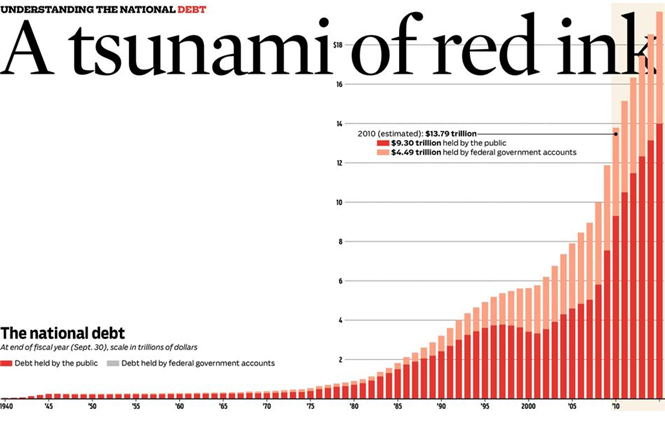
We are on a trajectory of cumulative fiscal deficits that cannot possibly be sustained. We have gone from being the world's largest creditor nation, with no foreign debt at the end of World War II, to the world's largest debtor, with roughly half of our public debt held by foreign lenders. Over the last four years, our national debt has grown by more than $5 trillion to over $16 trillion. We have to service that debt. The Federal Reserve is keeping rates historically low but here's the cost of paying interest on the debt for fiscal 2012: $359,796,008,919.49

What do you get for that? Nothing.

The greatest fiscal challenge to the U.S. government is not just its annual deficit but its total liabilities. Our federal balance sheet does not include the unfunded social insurance obligations of Medicare, Social Security, and the future retirement benefits of federal employees. Only in the small print of the financial statements do you get some idea of the enormous size of the unfunded commitments. Today the estimated unfunded total is more than $87 trillion, or 550 percent of our GDP. And the debt per household is more than 10 times the median family income.

The public doesn't know about these awesome liabilities because the totals appear only in actuarial estimates. As Chris Cox, former chairman of the Securities and Exchange Commission, and Bill Archer, former chairman of the House Ways and Means Committee, recently noted in the Wall Street Journal, the real annual accrued expense of Medicare and Social Security alone is $7 trillion. The government's balance sheet does not include any of these unfunded obligations but focuses on the current year deficits and the accumulated national debt. Cox and Archer reported that the annual budget deficit is only about one fifth of the more accurate figure.

If the American public saw our financial statements in the same way that public companies report their pension liabilities, it would clearly see the magnitude of danger represented by the future borrowings that these liabilities to an aging population imply—borrowing on a scale that would not only bankrupt the programs themselves but the entire federal government. And to a worrying extent, we are locked into continued escalation by the fact that social insurance programs, as well as other mandatory programs, carry payments that are in accordance with automatic formulas written into law and are not subject to an annual spending limit. Today, less than 40 percent of our budget is actually decided by Congress and the president, down from 62 percent 40 years ago.

If we continue in these irresponsible ways, an eventual reckoning cannot be avoided. The liabilities are so huge, and multiplying so fast, that there will be one unavoidable demand as the various bills come to their due date. Show us the money!

How will the bills be honored? Let's remember that 100 percent of the payroll taxes for Social Security and Medicare are spent in the year that they are collected, leaving no leftovers for the unfunded obligations. And this doesn't take into account other risks, hardly minimal, like the fact that the Federal Housing Authority confronts a $16.3 billion net deficit after its latest audit that may force a taxpayer bailout for the first time in its 78-year history. And just four years from now, in 2016, the Disability Insurance trust fund will be fully depleted.

Read more: http://goo.gl/620En


BREITBART
Lawmakers Leave Capitol Without a Deal
by Kerry Picket
December 30, 2012

Washington D.C. lawmakers in both chambers left the capitol on early Sunday night after negotiations to avoid the fiscal cliff fell apart in the Senate.

Senate Majority Leader Harry Reid (D – NV) said there is "still time left to reach an agreement.” In the meantime, Senate Minority Leader Mitch McConnell will continue negotiations on the phone tonight with Vice President Joe Biden.

McConnell told reporters, “There’s no single issue that remains an impossible sticking point. The sticking point appears to be the willingness and interest or frankly the courage to close the deal. I want everyone to know, I’m willing to get this done, but I need a dance partner.”

At least 50 House GOP members elected two years ago during the tea party wave are key votes to satisfy in the fiscal cliff negotiations.

Congressman Robert Andrews (D – NJ) told reporters he believes Speaker of the House John Boehner (R – OH) cannot do his job with fiscal cliff negotiations because the tea party is a “problem” for the Republican leader.

“There’s the tea party. I think it’s an aberrant strain of the Republican Party that knows what it doesn’t like; knows what it’s angry about, but doesn’t know what it wants to do,” said Andrews.

“I think [Boehner will] survive on January 3rd, sure, but on four occasions the country’s been—in these two years—the country’s been brought to the brink of real economic harm, because a small group on their side doesn’t want anything,” Andrews added.

Congressman Pat Tiberi (R – OH) shot back at Andrews remarks saying that the tea party is not giving Boehner “anymore problems than moveon.org or code pink is giving Ms. Pelosi.”

Rep. Tiberi told Breitbart News that the GOP House Conference’s rejection of Speaker Boehner’s Plan B is not hurting the caucus saying, “I think we’re a lot more united than we are divided.”

He added, “A super majority of our members supported that and there were ones that didn’t, because there were differences as to why people didn’t support it. There wasn’t one reason that united the opposition of Plan B.”

Tiberi explained further that the House GOP is putting the onus on Senator Reid:

“Here are the facts. We did our business. We passed a bill. We passed two bills. We passed one on taxes and one on sequestration. The way that School House Rock worked when I was a kid, until the health care bill that is, the House passes a bill; sends it to the Senate; the Senate either accepts it or changes it. It goes back to the House and we have a conference Committee. And the Senate refuses to do that. They’ve not taken up our bill to this minute of today. The bill that they passed is a joke.”

Congressman Tom Price (R – GA) agreed telling Breitbart News, “The Senate’s got to act. If the Senate acts, then we might be able to respond, but the Senate’s got to act.”

Price said that the conference is currently “solid” since the rejection of Plan B. “It appears the Senate can’t do anything. They can’t pass a budget—can’t pass a bill. It’s time for them to work,” he said.

The House will resume legislative business on Monday morning.

Read more: http://goo.gl/sFbJs


Wednesday, December 26, 2012

December 26, 2012


NEWSMAX
Conservative Groups to GOP Leaders: Don’t Fear Fiscal Cliff Dive
by Newsmax Wires
December 24, 2012

Republicans in Congress must be prepared to jump off the fiscal cliff if that’s what it takes to make President Barack Obama abandon his idea of ending tax cuts for the wealthy, conservative interest groups say.

House Speaker John Boehner and other GOP leaders have acted too much out of fear of the automatic spending cuts and tax increases that will begin Jan. 1 if Congress and the president don’t reach a deal before then, leaders of the groups say, according to The Hill.

Republicans have the upper hand, because if the fiscal cliff talks fail and a recession ensues, Obama will be the one to take the blame, the groups say.

“I think Obama is very mindful of his legacy and is horrified of going over the cliff,” Andy Roth, vice president of government affairs at the Club for Growth, told The Hill. “Going over the cliff might be a signal that needs to be sent to the president that he needs to play ball.”

Plenty of others agree. “I think it is certainly better to go over the fiscal cliff than to have the Republican party deny the American people to have one party that stands for lower taxes and another party that doesn’t,” Michael Needham, CEO of Heritage Action, said last week.

Meanwhile, Sen. John Barrasso, R-Wyo., said on "Fox News Sunday" that Obama actually wants to leap off the cliff for political purposes. "I think he sees a political victory at the bottom of the cliff," the chairman of the Republican Senate Policy Committee said. "He gets all this additional tax revenue for new programs; he gets to cut the military, which Democrats have been calling for for years; and he gets to blame Republicans for it."

Read more: http://goo.gl/yvfzt


TOWNHALL
The Next Taxpayer Bailout: The Federal Housing Administration
by Kevin Glass
December 25, 2012

The Federal Housing Administration (FHA), hit hard by the collapse of the housing bubble, is still making risky loans on the taxpayers' dime, and may need a bailout in 2013.
An exhaustive study of the subject by the American Enterprise Institute's Edward Pinto reveals some shocking statistics:
An estimated 40 percent of the FHA’s business consists of loans with either one or two subprime attributes—a FICO score below 660 or a debt ratio greater than or equal to 50 percent (based on loans insured during FY 2012). The FHA’s underwriting policies encourage low- and moderate-income families with low credit scores or high debt burdens to make risky financing decisions—combining a low credit score and/or a high debt ratio with a 30-year loan term and a low down payment. A substantial portion of these loans have an expected failure rate exceeding 10 percent. 
Across the country, 9,000 zip codes with a median family income below the metro area median have projected foreclosure rates equal to or greater than 10 percent.These zips have an average projected foreclosure rate of 15 percent and account for 44 percent of all FHA loans in the low- and moderate-income zips.
The full AEI study is a must-read. It's not merely that the FHA is exposing taxpayers to inordinate risk, it's that their entire model is predatory upon low- and middle-income American families:
The resulting reduced or declining home values impact FHA and non-FHA low- and moderate-income families diligently making their payments. These families may be denied the opportunity to build equity, provide security for their family, and have the down payment for their next home as their family grows. Foreclosures also result in increased blight and crime and the larger community suffers from a reduced tax base and higher costs for providing municipal services.
Writing in the Wall Street Journal, Nick Timiraos reports that the FHA will be facing a $16.3 billion shortfall at the end of September, forcing the government to direct taxpayer money to the agency. The FHA backs over $1 trillion in U.S. home loans.

The FHA has been attempting reforms recently to try to avoid succumbing to a taxpayer bailout, but it is yet to be seen if this becomes successful. Further reporting from Timiraos is that the agency will be suspending its most popular reverse-mortgage program.

The federal government itself, despite the home bubble collapse in 2008, has added fuel to the fire.
In 2009, as home values plunged, Congress boosted the maximum home value that seniors could borrow against, fueling more demand for reverse mortgages. Private offerings of reverse mortgages disappeared as the housing bust deepened.
Reforms must be made to the FHA, especially in light of the vulnerabilities that the agency has shown in the wake of 2008's massive decrease in home values. It's not just that they expose taxpayers to an inordinate amount of risk, it's that FHA policy actively harms the quality of life for middle- and lower-income Americans. Reforms are needed sooner rather than later, as the clock is ticking on the FHA's bankruptcy.

Read more: http://goo.gl/yaQDB


REAL CLEAR POLITICS
A Washington Mess
by Richard Cohen
December 26, 2012

In 1962, Casey Stengel, the longtime manager of the New York Yankees, came out of retirement to lead the New York Mets, an expansion team. That season the Mets lost an astounding 120 games -- which is within about 20 games of what Stengel used to win with the Yankees -- and prompted Stengel to ask a memorable question: "Can't anybody here play this game?" That very question can now be asked about Washington.

I found myself channeling Stengel when, incredibly, John Boehner, speaker of the House and leader of his party, last week had to abort a vote he himself had called because he lacked sufficient Republican support. This brought a rare expression of sheer wonder from a former Republican speaker of the House, Dennis Hastert. "You don't ever bring something to the floor without the votes," he told National Journal.

The vote was supposed to be on a tax bill Boehner unironically called Plan B, which, as my colleague Dana Milbank pointed out, is also the name of the morning-after pill. Maybe for that reason -- one cannot underestimate the level of stupidity in Washington -- 26 Republican members of the House said they would vote no. Boehner thereupon called off the vote and sent the House home for Christmas. Maybe he'll use the time to learn how to count.

Washington has been reveling in its own history of late. The Senate last week took time off to watch Steven Spielberg's magnificent "Lincoln." To Spielberg's credit, he depicted a president who did more than grandly free the slaves; he got an anti-slavery constitutional amendment through Congress one recalcitrant member at a time. Lincoln cajoled and arm-twisted and even, we may suppose, bought the occasional vote, not with cash but with jobs and contracts. Few politicians will sell their soul, but they will on occasion sell a vote real cheap, sometimes out of sheer affection for the president.

Abraham Lincoln is Barack Obama's hero, and the president seemed to invoke Honest Abe when he promised to do something about guns. In the movie, Lincoln says that as a wartime president, he is "clothed in immense power." Obama said he will "use whatever power this office holds to engage my fellow citizens" in preventing gun tragedies. The words, the phrasing -- all redolent of Lincoln. The outcome, the past being prologue, will not be Lincolnesque. It will be an Obama muddle.

Spielberg knows what Obama does not. His Lincoln is in incessant negotiations with Congress and the rest of the Washington power structure. He does more than make grand speeches. But Obama is a grand speech sort of guy. After his re-election he said he had won a mandate. He actually hit the road again, asserting a mandate to raise taxes on the rich. He is right to want to do that, but his mandate is chimerical, made of rhetorical filigree that evaporates in the intellectually arid atmosphere of congressional districts that voted tea-party Republican.

Some 15 Republicans won in congressional districts that Obama carried -- whose mandate is that, anyway? -- and other Republicans triumphed in districts where Obama is considered an alien creature. One of those who refused to support Boehner's Plan B was Tim Huelskamp of Kansas. He won with -- this is no typo -- 100 percent of the vote. (He had no Democratic opposition.) Try telling him about mandates.

As with Lincoln, Washington now reveres Lyndon Johnson. Much of this is due to Robert A. Caro's latest volume, "The Passage of Power," and its tales of how Johnson knew how to squeeze out every last congressional vote. Caro tells how Johnson basted the crusty Sen. Harry Byrd Sr. of Virginia, slathering him in praise and promises that Byrd knew would be redeemed. Johnson won titanic legislative victories, but he did so one vote at a time. He was a creature of Congress. Johnson left the Senate with a gaggle of friends and the experience to change history. Obama served in the Senate too. He just came and went.

Obama and Boehner are co-pilots steering us toward the fiscal cliff. Their respective jobs are beyond them. One talks over the head of Congress, the other called for a vote he couldn't win. The thing's on automatic pilot -- automatic spending cuts, automatic tax increases: automatic debacle. The stock market fell. Next, jobs will be lost. Boehner went home to Ohio and the president went to Hawaii for a vacation ... from what? Only the ghost of Casey Stengel remains in town: "Can't anybody here play this game?"

Apparently not.

Read more: http://goo.gl/AJKcF

Saturday, December 22, 2012

December 22, 2012


NEWSMAX
Gingrich to Newsmax: GOP Gave Obama Upper Hand
by Todd Beoman
December 21, 2012

Former GOP presidential candidate Newt Gingrich told Newsmax late on Thursday that he was perplexed by House Speaker John Boehner’s move to postpone the vote on his highly controversial plan that would prevent tax hikes for everyone except those making more than $1 million a year.

“I don’t understand what the strategy is of the House Republicans, so it’s hard to judge what they’re doing,” the former GOP House Speaker told Newsmax in an exclusive interview. “I don’t know what they’re trying to do.

“I’ve talked with several House members here today — and I don’t think many of them have any idea of what they’re doing. Literally have no idea,” Gingrich added. “Several members have no idea.”

Editor's Note: 5 Signs Stock Market Will Collapse in 2013

“I’m not worried about this week or next week. I’m worried about four years from now — and I don’t see the strategy in place that is going to catch up with Obama,” he said.

Gingrich was among several Capitol Hill observers asked by Newsmax to respond to Boehner’s late-evening decision. The move to call off the vote came after the Ohio Republican called a short meeting of the House Republican Conference to determine whether he had enough vote to pass the bill.

“The House did not take up the tax measure today because it did not have sufficient support from our members to pass,” Boehner said in a statement. “Now it is up to the president to work with Senator Reid on legislation to avert the fiscal cliff.

“The House has already passed legislation to stop all of the Jan. 1 tax-rate increases and replace the sequester with responsible spending cuts that will begin to address our nation's crippling debt. The Senate must now act.”

Boehner’s postponement topped a chaotic day of intense arm-twisting of members of the GOP rank and file. Several Senate Republicans, including Rob Portman of Ohio, were called on to press their House colleagues to support the Boehner plan.

Gingrich told Newsmax, however, that the negotiating process has given President Barack Obama the upper hand. “They have spent the entire time since the election negotiating — and that puts the president in the strongest position.”

He likened Obama to being the fictional Gulliver in Jonathan Swift’s classic “Gulliver’s Travels” and the GOP to being the Lilliputians. “You needed all of the Lilliputians to tie Gulliver down.

Editor's Note: 5 Signs Stock Market Will Collapse in 2013

“If every House committee and House subcommittee had hearings every day on the waste in government — if every week there was something new about government wastefulness, there would be a very different tone to these negotiations,” Gingrich said. “It would be very difficult to demand more money from the American people.”

The House move also brought praise from several conservative groups, including the Club for Growth, which earlier this week attacked the concessions Boehner made in the plan.

“We are pleased that the House Republicans did not vote to raise taxes,” spokesman Barney Keller told Newsmax late Thursday. “An anti-growth tax increase would not have solved our fiscal problems — and it would have killed jobs.

“The House needs to focus on a pro-growth, tax-reform, entitlement-reform agenda, which enjoys broad support among Americans,” he said.

Americans for Prosperity told Newsmax that it was among many organizations that emailed House members asking them not to support Plan B, said spokesman Levi Russell.

“We have been opposing and continually opposing the plan,” he said. “We just think it’s a bad plan. It does not address the fiscal cliff. It does not address our fiscal issues. It does nothing to control out-of-control spending.

“The tax increases are always real and always immediate — but the spending cuts are predicted to take place in some future Congress.

“The Senate should take the bill that the House has already passed, pass it — and the president should sign it,” Russell recommended. “And, then next year, Congress needs to begin real, substantive entitlement reform and tax reform to put this country back on the road to prosperity.”

Read more: http://goo.gl/aNuq3


TOWNHALL
10 Facts for Liberals: Why Gun Control Can't Stop Another Newtown Massacre
by John Hawkins
December 22, 2012

There are now calls from the Left for gun control legislation in response to Adam Lanza's unconscionable mass killing of innocent children at Sandy Hook Elementary. However, very few people seem to be asking the most basic question of all before getting started: What gun control legislation could have stopped Adam Lanza?

The answer is "none."

Let's consider a few alternatives:

1) The school was already a "gun free zone;" so obviously that wasn't effective. Of course, the sort of people who would respect a "gun free zone" in the first place are the very ones you wouldn't have to worry about carrying a gun; so it's an almost useless designation.

2) What about closing the supposed "gun show loophole?" Well, since Lanza killed his own mother and used her legally acquired guns for his rampage, making it harder for googly-eyed loners to acquire weapons wouldn't have changed a thing.

3) Some people are calling for a ban on automatic weapons. Setting aside the fact that the regulation of fully automatic weapons is already tighter than Spandex, Adam Lanza didn't use a fully automatic weapon.

4) Then there are calls for the "Assault Weapons Ban" to be reinstated. One problem: the semiautomatic Bushmaster .223 rifle that Lanza used wasn't covered by the bill. So, his mother could have bought that exact same gun with a sheriff looking over her shoulder while the ban was in place.

5) We could, of course, pass a newly updated "Assault Weapons Ban" that covers the semiautomatic Bushmaster .223 rifle. Then, gun manufacturers would try to create weapons that can get around the ban. They would probably be successful. Even if they weren't, it's not as if Lanza was battling Marines. When you're a coward who's attacking unarmed children, any gun will work.

6) We could also ban high-capacity ammunition magazines, but given the 3-5 second reload time, that would have been a minor inconvenience to Adam Lanza at worst. After all, it's not as if a group of small children were going to be able to scamper away or gang up on him during a four second window.

So, what now? Well, let's step into the realm of fantasy and assume that there's no such thing as a 2nd Amendment that provides the public with a Constitutional right to "keep and bear arms." that is every bit as important as the right to free speech and freedom of religion. Let's also pretend that the American public would go along with the following laws and attempts to implement them wouldn't lead to wide scale violence and unrest.

7) Congress could ban the manufacture and sale of bullets and magazines. Given the massive number of bullets and magazines already owned by the public and readily available instructions for making them, this wouldn't stop any determined killer like Adam Lanza. On the other hand, it would lead to a massive black market with tens of millions of previously law abiding Americans buying bullets by the bucketful from back rooms across the country.

8) Congress could also ban the manufacture and sale of guns. Again, that would lead to the creation of a massive black market, but it would also leave roughly 300 million guns in the hands of the American people. In other words, if Adam Lanza had decided to wait until AFTER that law was passed to go on his killing spree, it would have been the same sad story.

9) Then, there's the most extreme step of all: Congress could ban the ownership of guns. One problem: In the vast majority of cases, the government has no record of who owns guns and who doesn't. In most places, those records are kept at the gun store level and are not updated. If the gun is lost, stolen, given away or sold by the individual, there is no record of it. This is a feature, not a bug, and it's designed to prevent exactly the sort of confiscation we're discussing here. So, even if all guns were made illegal, it would be very difficult to enforce, most people wouldn't turn their weapons in and there would probably be two hundred million guns left in the hands of the American public. Would a man like Adam Lanza still be able to acquire a weapon in that situation? Come on, he KILLED HIS OWN MOTHER for a gun; so you can be sure he'd have gotten one elsewhere.

10) Let's go Steven Spielberg on this problem and assume space aliens show up and use some bizarre technology to get rid of all guns. Well, even so, fire and explosives would still exist and as Brian Palmer has noted in Slate, those can be even more effective killers than guns.

Guns aren't even the most lethal mass murder weapon. According to data compiled by Grant Duwe of the Minnesota Department of Corrections, guns killed an average of 4.92 victims per mass murder in the United States during the 20th century, just edging out knives, blunt objects, and bare hands, which killed 4.52 people per incident. Fire killed 6.82 people per mass murder, while explosives far outpaced the other options at 20.82. Of the 25 deadliest mass murders in the 20th century, only 52 percent involved guns.

If gun control advocates like Barack Obama, Michael Bloomberg and Michael Moore, all of whom have armed guards protecting their safety, succeed in making guns less available for law abiding citizens, it wouldn't stop another Newtown massacre, but ironically it would make it easier for rapists, gangs or even the next Adam Lanza to hurt innocent people.

Read more: http://goo.gl/tnm8s


THE WEEKLY STANDARD
The Greatest Conservative Generation
by William Kristol
ADVANCE EDITORIAL from the December 31, 2012 - January 7, 2013 issue.

“There were giants in the earth in those days.” The death on December 19 of Robert Bork—superb legal scholar, preeminent constitutional thinker, principled public servant—calls to mind the other giants of American conservatism who have left us in the last decade: Bill Buckley and Irving Kristol, Milton Friedman and James Q. Wilson, Richard John Neuhaus and Jeane Kirkpatrick, Ronald Reagan and Jack Kemp. They were the greatest conservative generation. They rode into the valley of liberal orthodoxies and emerged sometimes triumphant, always unbowed. When can their glory fade? They left our nation stronger and better for their efforts.

Those who knew them do their best to carry on the fight. Inspired by their example and effort, by their boldness and wisdom, remembering the uphill struggles of the early years, they do their best to keep the banner aloft and moving forward. But what of the next generation?

It’s been almost 60 years since Bill Buckley and his colleagues founded National Review, standing “athwart history, yelling Stop, at a time when no one is inclined to do so, or to have much patience with those who so urge it.” Those of us concerned with the perpetuation and success of American conservatism might consider what Abraham Lincoln said a little more than 60 years after the American Revolution, on January 27, 1838, at the Young Men’s Lyceum in Springfield, Illinois.

The whole speech is, needless to say, worth reading—and worth rereading. But for our purposes, consider one aspect of the 28-year-old Lincoln’s treatment of the question of “the perpetuation of our political institutions.” Why, he asked, “suppose danger to our political institutions? Have we not preserved them for more than fifty years? And why may we not for fifty times as long?”


One reason, Lincoln explains, is that “the scenes of the revolution .  .  . must fade upon the memory of the world, and grow more and more dim by the lapse of time. In history, we hope, they will be read of, and recounted, so long as the Bible shall be read;—but even granting that they will, their influence cannot be what it heretofore has been. Even then, they cannot be so universally known, nor so vividly felt, as they were by the generation just gone to rest.”

Lincoln suggests that, even for the generation after the Founders, these scenes were a kind of “living history.” But for Lincoln’s generation, “those histories are gone.” And “unless we, their descendants, supply their places with other pillars, hewn from the solid quarry of sober reason,” we will lack “the materials for our future support and defense.”

The materials for the future support and defense of conservatism will have to be forged by a generation that remembers not the Founders. In a way, this can be an advantage. Young men and women today, interested in the perpetuation of our political and civic liberty, will understand they can’t coast on the Founders’ efforts. They’ll also be less intimidated by the Founders’ example. They will be open to fresh thinking “hewn from the solid quarry of sober reason.” Such fresh thinking has never been more necessary.

But as they think anew, they’ll also look back to Bob Bork and his compatriots. Their work is the point of departure, a source of invaluable lessons, both substantive and strategic. Yet the generation that now ascends to center stage shouldn’t be intimidated by their daunting example.

The best revenge for Edward Kennedy’s slander about “Robert Bork’s America” would be to help advance the cause of what is truly Bob Bork’s America—a nation of constitutional liberty and self-government. Bob Bork would have enjoyed the well-deserved encomiums he is receiving. He’d be even more pleased by the young men and women coming forth to say how inspired they have been by his example.

Read more: http://goo.gl/Rd9R3

Friday, December 21, 2012

December 21, 2012


NATIONAL REVIEW
Inside the Meltdown
by Robert Costa
December 21, 2012

At a quarter to 8 p.m. on Thursday night, House Republicans gathered in the Capitol basement for an urgent, closed-door conference meeting. The scene was hushed and confused. Instead of huddling in a windowless room, members thought they’d spend the evening on the House floor, voting on “Plan B,” Speaker John Boehner’s fiscal-cliff proposal. But as they took their seats and looked at Boehner’s face, the reason for the gathering became clear: The speaker didn’t have the votes. The whipping was over. “Plan B” was dead.

Boehner’s speech to the group was short and curt: He said his plan didn’t have enough support, and that the House would adjourn until after Christmas, perhaps even later. But it was Boehner’s tone and body language that caught most Republicans off guard. The speaker looked defeated, unhappy, and exhausted after hours of wrangling. He didn’t want to fight. There was no name-calling. As a devout Roman Catholic, Boehner wanted to pray. “God grant me the serenity to accept the things I cannot change,” he told the crowd, according to attendees.

There were audible gasps of surprise, especially from freshman lawmakers who didn’t see the meltdown coming. Boehner’s friends were shocked, and voiced their disappointment so the speaker’s foes could hear. “My buddies and I said the same thing to each other,” a Boehner ally told me later. “We looked at each other, rolled our eyes, and just groaned. This is a disaster.”

Representative Mike Kelly of Pennsylvania, a burly former car dealer, stood up and urged the conference to get behind the speaker. “How the hell can you do this?” Kelly asked, according to several people inside the room. A few of Boehner’s critics told Kelly to stop lecturing, but most were silent. They had been battling against “Plan B” all week, and quite suddenly, they had crippled the leadership. Boehner sensed the tension, requested calm, and then exited the room.

Since the meeting lasted only a few minutes, several members, such as Representative Tim Huelskamp of Kansas, missed the session. As Huelskamp, a leading “Plan B” adversary, rushed to get there, he saw a stream of his colleagues exiting. They were on their phones with aides and family members, sharing the news. They’d be coming home for the holidays since the House was in a state of chaos. Some of them, however, seemed bewildered by the turn of events. They walked slowly down the basement hallway, whispering with other members. One freshman asked a senior member, “Are we really not coming back?” The senior member simply nodded. Almost everyone avoided the press. Feelings were raw. Representative Steve King of Iowa, a frequent Boehner critic, looked at me, shook his head, and said, “I have nothing to say.”

Boehner and his leadership team soon departed. Kevin McCarthy, the GOP whip, who hours earlier was meeting with on-the-fence members over Chick-fil-A sandwiches in his office, left the Capitol looking distressed. So did Eric Cantor, the majority leader, who had spent the past two days wooing backbenchers. Representative Paul Ryan of Wisconsin, the Budget Committee chairman and recent Republican vice-presidential candidate, strolled out of the Capitol with Representative Tom Price of Georgia, a popular conservative who has expressed his unhappiness with Boehner’s cliff strategy. The pair declined to discuss the drama, but they both looked tired and frustrated.

Read more: http://goo.gl/xwElu


THE CATO INSTITUTE
Behind the Smears
by Walter Olson
December 20, 2012

Here’s something you may not know about the 1987 battle that kept Robert Bork off the Supreme Court: Opponents pursued a whispering campaign against him on the grounds that he wasn’t enough of a religious believer.

Back then, many Democrats still held seats in the rural South, and the religion angle gave them an easier way to explain their stance to constituents than, We’ve been asked to oppose him as a party-line matter.

Thus Rep. John Bryant (D-Texas) warned that Bork was “an agnostic who is not a member of any church.”

And Sen. Bennett Johnston (D-La.), while disclaiming any “religious test for judges,” advised “fundamental religious people” back home to “look, in addition to what he has written, at [Bork’s] statements on morals or lack thereof — and I don’t mean to suggest he is immoral — but his lack of occupation with morals and with religion.”

“Never in memory had a judicial nomination
been fought in such language. Why?”

Sen. Howell Heflin (D-Ala.) told constituents he was “disturbed by [Bork’s] refusal to discuss his belief in God — or the lack thereof.” Heflin also alluded darkly to the nominee’s beard and “strange lifestyle” as a Yale law professor.

Judge Robert Bork died yesterday at 85, and as one of the smartest persons ever nominated to the high court — George Will called him ‘the most intellectually distinguished nominee since Felix Frankfurter’ — he was well situated to appreciate the many historical ironies.

One was that opponents like Heflin could exploit prejudice against him as a former Yale law professor and presumed Northeastern elitist. In fact his views were so far from his former colleagues’ that in later years he was to joke of seeing a bumper sticker that read, Save America. Close Yale Law School.

The religious angle adds another irony. Particularly after his defeat and retirement from the bench, Bork’s views drifted steadily rightward; in the wake of his best-selling 1997 book Slouching Toward Gomorrah, he became a favorite of “secularism is destroying America” culture warriors.

Of course the confirmation critique that makes it into every Bork obituary isn’t Heflin’s or Johnston’s. It’s Ted Kennedy’s blowhard caricature, intended for northern liberal consumption, of “Robert Bork’s America” as “a land in which women would be forced into back alley abortions, blacks would sit at segregated lunch counters, rogue police could break down citizens’ doors in midnight raids, school children could not be taught about evolution,” and so on.

Never in memory had a judicial nomination been fought in such language. Why?

As a constitutional law scholar, Bork had distinguished himself even among conservatives for his scathing critique of the Warren Court, which he accused essentially of having made up constitutional law as it went along.

To organized liberal groups, on whose behalf Kennedy was acting, this was the next thing to a declaration of war. Yet they couldn’t exactly come out and defend making up constitutional law as you went along as their own vision for the high court.

Instead, they served up a steady diet of vitriol and wild oversimplification, especially in TV ads and other messages delivered outside the confirmation hearings.

The Washington Post itself opposed Bork’s confirmation, yet nonetheless editorialized against the “intellectual vulgarization and personal savagery” to which some of his opponents had descended, “profoundly distorting the record and the nature of the man.”

Once “Borking” had been coined as a word and as a practice, it didn’t take long for nominees of both sides to pay the price. Some didn’t care to put themselves or their families through months of mudslinging.

Within a few years, presidents of both parties were taking care to pick nominees with schmoozy as opposed to prickly personalities — and willing to submit to coaching on how to give off that oh-so-important empathetic vibe without actually committing to anything.

Read more: http://goo.gl/zIGfR


AMERICAN THINKER
How to Downsize the Federal Government
by Bill Weckesser
December 21, 2012

Maybe Republicans need go back to the Gipper's playbook on the deficit. Reagan once said, "I'm not worried the deficit. It's big enough to take care of itself." He certainly had a point. Reagan was charged with massively increasing spending and borrowing on defense so that liberals would be sort of handcuffed from any big new spending programs for a while. And, arguably, for a while it may have worked.

Now the New York Times laments-in an article I found at CNBC-that instead of defense, entitlements are swallowing all the money.
Consider the president's budget, which by law must include projections of taxing and spending over the next decade. Loath to raise taxes on the middle class yet unwilling to cut deeply into the budgets for Social Security or Medicare, the president and his advisers proposed cutting the discretionary part of the budget devoted to everything except defense and other security agencies to 1.7 percent of economic output by 2022, down from 3.1 percent last year. 
This is not irrelevant spending. It accounts for every government expenditure except entitlements, security and interest. It pays subsidies for higher education and housing assistance for the poor. It finances the National Institutes of Health and the Food and Drug Administration. It pays for the Federal Emergency Management Agency and training programs for unemployed workers. Without such spending, the government becomes little more than a heavily armed pension plan with a health insurer on the side.
House Republicans are equally if not more frugal. The House budget resolution, the Republicans' last detailed proposal about taxes and spending, refers to discretionary spending except national defense, a broader category than that considered in the president's budget. They too cut it to the bone: to about 2.1 percent of economic output in 2022, from 4.3 percent last year. 
To put it in perspective, this would cut the government's civilian discretionary budget to the smallest it has been as a share of the economy at least since the Eisenhower administration -- when a quarter of the population lived under the poverty line, thousands of children still contracted polio each year and fewer than one in 12 Americans older than 25 had a college degree. According to estimates by the Congressional Budget Office, even going over the so-called fiscal cliff would not cut it as deeply.
Hey, the Eisenhower years weren't so bad. This could be a road back.

Conservatives need to turn the table on the debate. Instead of arguing that entitlements will soon swallow everything else, so let's cut them, let's work on cutting all the rest. House republicans should consider making every cut a tradeoff versus cutting Social Security/Medicare. For instance, either downsize the EPA...or cut Social Security/Medicare. Reduce the Energy department...or reduce Social Security/Medicare. Scale back the Department of Education...or trim Social Security/Medicare. The list is endless. A lot of Americans have more affection for Social Security/Medicare than any government agency. This could be a stealth way to pursue some healthy de-regulation. Would this meaningfully reduce the deficit? Of course not.

But, to paraphrase Reagan, "entitlements are a big enough problem to take care of themselves." In the meantime, maybe conservatives can win some other battles

Read more: http://goo.gl/USzE5