Showing posts with label fiscal cliff. Show all posts

Thursday, January 10, 2013

January 10, 2013


NEWSMAX
Gingrich: Use Debt Ceiling Fight to Stop Obama Gun Ban
by Todd Beamon
January 9, 2013

Former House Speaker Newt Gingrich said Republicans should use the upcoming debt-ceiling talks to craft legislation that would block Obama from doing anything that is unconstitutional in light of the administration’s suggestion they may bypass Congress to craft laws banning certain types of guns.

“Iin March, the Congress has a continuing resolution,” Gingrich told Newsmax. “The government is going to run out of money. The Congress has to pass the continuing resolution.

“They should put in a prohibition on spending to block anything that the president does that is illegal,” Gingrich said. “Congress has absolute authority to control spending. The House Republicans should craft into the continuing resolution a rule that the president is blocked from doing anything unconstitutional.”

Gingrich, who ran for the 2012 Republican nomination and lost to Mass. Gov. Mitt Romney, has been vocal in his support for Americans’ rights to bear arms.

Read more: http://goo.gl/kwva8


TOWNHALL
White House Pretends Taxes Haven't Gone Up on Middle Class After Fiscal Cliff Deal
Katie Pavlich
January 10, 2013

Despite Americans seeing a two percent jump in their Social Security taxes and less money in their bank accounts after the fiscal cliff deal was signed via auto pen on behalf of President Obama last week, the White House is pretending rates stayed the same. In an email to supporters yesterday, White House Senior Adviser David Plouffe wrote:
Hello -- 
I'll tell you what keeps driving me every day: the knowledge that people like you have our backs. 
When President Obama asked you to make your voices heard to keep taxes from going up on the middle class, people from all over the country, folks in every state spoke out. More than 130,000 of you sent in stories to the White House website. There were times these past few weeks when our Twitter feeds were positively overwhelmed by people joining the debate using the #My2k hashtag. 
So we put your stories on the front page of the White House website. We asked you to stand behind the President when he laid out his position on this debate at the White House. The President went and met with one family who had shared their story. The Vice President sat down with another for lunch. 
And people took notice. Reporters wrote stories about the way that you were adding your voices to this debate, and it became impossible to ignore your perspective.
The White House also released the following video which like Plouffe's email,  says middle class taxes haven't gone up and points out that the fiscal cliff requires "the wealthy to pay their fair share."


The stories Plouffe won't be putting on the front page of WhiteHouse.gov are those of angry voters wondering why their paychecks are less, after all, the President promised he'd take care of them by only soaking the rich. More from Twitchy:

Photobucket

On another note, notice Plouffe's use of the media to push the White House agenda, "Reporters wrote stories about the way that you were adding your voices to this debate." Still wondering how Obama got re-elected? This is one reason why. Notice how the same reporters aren't talking or writing about the latest tax increase and broken White House promise of helping the middle class.

Read more: http://goo.gl/fd6v1


HUMAN EVENTS
Walmart, Biden to discuss restricting gun rights

by Neil W. McCabe
January 9, 2013 

A spokesman for the world’s largest retailer, and the country’s largest seller of guns and ammunition said Jan. 9 the company will meet Jan. 10 with Vice-President Joseph R. Biden Jr., regarding his efforts to restrict gun rights after first declining the invitation.

“Knowing our senior leaders could not be in Washington this week, we spoke in advance with the vice president’s office to share our perspective,” said David Tovar, the vice-president for corporate communications at Walmart, based in Bentonville, Ark. That message found its way into the press.

“We underestimated the expectation to attend the meeting on Thursday in person, so we are sending an appropriate representative to participate,” he said. “Walmart, like the rest of the country, has been engaged in a national dialogue about the responsible sale and regulation of firearms.” Walmart does not report its firearms sales separately.

“We take this issue very seriously and are committed to staying engaged in this discussion as the administration and Congress work toward a consensus on the right path forward,” he said.

Biden, the author of the 1994 crime law that banned so-called assault rifles for 10 years, was tasked by President Barack Obama to fashion a response the gun violence in America that curtails gun rights now in place.

Tovar said the retail giant, whose founder Sam. M. Walton opened his first store opened in 1962 in Rogers, Ark., is also working with New York City Mayor Michael R. Bloomberg, who leads the gun control advocacy groups called Mayors Against Illegal Guns.

“We have had ongoing conversations with the administration, Congress, Mayor Bloomberg’s office, sportsmen groups, suppliers and others to listen and share our thoughts and experiences,” he said.

“Over the years we have been very purposeful about striking the right balance between serving hunters and sportsmen and ensuring that we sell firearms responsibly,” he said.

“In fact, we became a charter member of Mayor Bloomberg’s coalition against illegal guns and adopted the 10-point code established by the Responsible Firearms Retailer Partnership that goes beyond what the law requires,” the Walmart spokesman said.

Read more: http://goo.gl/ZPJZe


Wednesday, January 2, 2013

January 2, 2013


NEWSMAX
Cantor, McCarthy Join 151 Republicans Against Bill
by Stephen Feller
January 2, 2013

Majority House Leader Eric Cantor and GOP Whip Kevin McCarthy were among the 151 Republicans who voted against the fiscal cliff bill in the House Tuesday night.

Speaker John Boehner and Republican Conference chairwoman Cathy McMorris Rodgers, the number four in the party hierarchy in the House, both voted in favor of the bill that was introduced in the House by the GOP's Ways and Means Committee chairman Dave Camp.

The party was split with around two-thirds of House Republicans voting against the bill aimed at keeping a plethora of tax rates from going up this year.

It even divided one married Republican couple. Florida's Connie Mack voted against while his wife Mary Bono Mack of California voted in favor.

The biggest complaint was that the bill — which had earlier passed by an overwhelming 89-8 vote in the Senate — did not include enough spending cuts while increasing taxes on Americans who make more than $450,000 per year.

Chief Deputy Whip Peter Roskam joined the no votes, along with influential oversight committee chairman Darrell Issa.

Budget committee chairman and former vice-presidential candidate Paul Ryan voted for while former presidential candidate Ron Paul was among five GOP members who did not cast a vote.

The bill passed the house 257 to 167 as 85 Republicans and 172 Democrats voted to send the bill to the president to be signed, and 151 Republicans and 16 Democrats voted no.

Cantor "was disappointed with the bill that passed the Senate late last night," the Virginia congressman's deputy chief of staff, told Politico. "That's why you saw him working all day to find an alternative with the leadership. That's why you saw two conference meetings to deal with what all alternatives.”

Republicans also discussed the possibility of amending the bill by adding additional spending cuts to it, however the Senate would have been required to vote to approve the new version of the bill. Senate Democratic leaders already had indicated earlier in the day that they would not vote on the bill again.

Had the bill not passed the House, tax rates on all Americans were set to go up — which gave pause to many Republicans who voted against it.

"I'd like to be speaking for this bill, but I can't," said Californian Issa during the debate. "I would like to vote for this because I do vote for lower taxes. But the other day in conference, one of my colleagues pointed out that in fact you're spending the money, you're taxing our future generation."

Read more: http://goo.gl/NNJR0

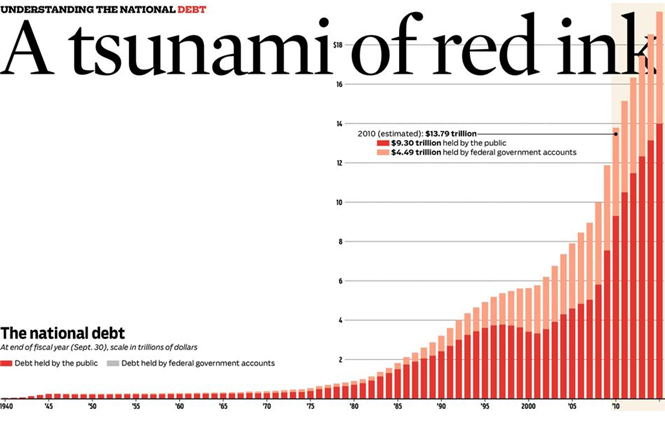
National debt

BREITBART
Sources: Enough Republicans Willing to Unseat Speaker Boehner
by Matthew Boyle
January 1, 2013

American Majority Action spokesman Ron Meyer told Breitbart News late Tuesday that enough House Republicans have banded together in an effort to unseat House Speaker John Boehner from his position--they just need a leader to take up the mantle.

“At least 20 House Republican members have gotten together, discussed this and want to unseat Speaker Boehner--and are willing to do what it takes to do it,” Meyer said. “That’s more than enough to get the job done, but the one problem these guys face is they need a leader to coalesce behind.”

Meyer said the conservatives have considered House Majority Leader Eric Cantor (R-VA) to take the helm after Boehner is knocked out. His opposition from the right to the Senate fiscal cliff deal that Vice President Joe Biden cut with Senate Minority Leader Mitch McConnell is a sign Cantor may try for the job.

AMA is hardly the only conservative entity aware of the rekindled effort afoot to unseat Boehner. Another conservative with inside knowledge of the effort told Breitbart News that the movement has "new focus and juice," and if enough members go to Boehner telling him they won’t support his re-election, that Americans should “watch for him to resign gracefully.”

The vote for Boehner’s re-election as Speaker happens on Thursday, two days after Boehner’s decision to support the Senate "fiscal cliff" deal Vice President Joe Biden cut with Senate Minority Leader Mitch McConnell on New Year’s Eve.

Read more: http://goo.gl/Lq3ZD


CVN EDITORIAL
Beware of Rinos Drinking Tea
by Conservative Sue
January 2, 2012

Well, the votes have been counted, and it appears the Democrats and Republicans have now passed a 'fiscal cliff' deal that represents a big tax increase with no significant long term spending cuts.  Outspoken critics of this deal include Senators Mike Lee, Rand Paul, and other Tea Party favorites,

What Speaker John Boehner has managed to accomplish with his adept political deal-making skill is to get the GOP blamed for the biggest tax increase in the last two decades while simultaneously increasing the deficit and kicking the spending cuts down the road for 'another day' that, most agree, will never come.  And, to add insult to injury, the mainstream media is in full propaganda mode blaming the teaparty for obstructionism and a 'bad deal' even though the teaparty has been pretty much united against this proposal from the start.

What does the GOP stand for?  Limited government?  Low taxes? Controlling spending? Balanced budgets? Fiscal responsibility? State sovereignty? Liberty?  From seeing the legislation written and passed by the GOP over the last 20 years, I see very little coming out of the leadership of this Republican Party that bears any resemblance to the current GOP party platform or the Reagan-style conservatism that built conservative majorities in the 80's.

Interestingly, House Majority Leader Eric Cantor voted no on this deal, which initially puzzled me (considering he's been brokering this deal with Speaker John Boehner and Senate Majority Leader Mitch McConnell all along), but I've had an epiphany this morning and believe I may have discovered the motive behind Cantor's vote....

The balance has tipped in the GOP controlled house, and the vote for this particular bill has made that clear. The majority of Republicans in the House voted against this bill, meaning that the establishment-wing of the GOP (led by Boehner and others) is now in the minority. The 'leash' the establishment had placed on the teaparty coalition has been removed, and 'going along' with GOP leadership is no longer a foregone conclusion.  Cantor is very much an establishment Republican .. so why did he join the teaparty coalition in this vote?  

Simple, Boehner is facing a vote on Thursday by GOP House Republicans on whether or not he will remain as Speaker of the House. The establishment needs to have a viable alternative to put forth if it becomes clear they will not have the votes to keep Boehner in the job .. so along comes the mysterious Cantor 'pro-teaparty' vote just in time to give them that establishment alternative to Boehner. Does anyone really believe Cantor is a teaparty Republican?  I certainly don't.

Beware of Rinos drinking tea. These politicians will sell their souls for power. If the House GOP wants to throw out Boehner for being too liberal on taxes and spending, they had better look elsewhere for an alternative. Replacing Boehner with Cantor is like replacing Charlie Sheen with Lindsay Lohan.  Both Boehner and Cantor are bad news for fiscal conservatives, and neither have any desire to get this out-of-control deficit spending under control.

Tuesday, January 1, 2013

January 1, 2013


TOWNHALL
Senate Passes Bill to Avoid Fiscal Cliff
by Leah Barkoukis 
January 1, 2013

The Senate voted early Tuesday morning 89-8 in favor of the scaled-down bipartisan package that would halt historic tax hikes for many Americans and postpone automatic spending cuts for two months. The bill will now go to the House, which is expected to be back in session at noon today.

The outlines of the deal Mr. McConnell and Mr. Biden worked out included raising tax rates for individuals making more than $400,000 and families with incomes more than $450,000, and extended unemployment benefits for the long-term jobless. It also continued a number of programs from Mr. Obama’s 2009 stimulus law, including tax credits for college tuition and for green-energy programs.

The deal included no net spending cuts, however, which left conservative Republicans complaining. Meanwhile, liberal Democrats balked at not holding firm on tax increases for families making more than $250,000 — a stance on which Mr. Obama campaigned.

Regardless of their income, all taxpayers will still see at least some tax increases with the expiration of the payroll tax holiday, which was worth about $1,000 to the average family in 2012. […]

The deal on the table late Monday included a patch to prevent millions of taxpayers from being hit by the Alternative Minimum Tax, and also included an extension of full payments to doctors treating Medicare patients.

The tax rate agreement would see the top marginal rate rise from 35 percent to 39.6 percent — the rate during the Clinton years — for individuals with incomes more than $400,000 and for households with incomes more than $450,000.

The bill is a far cry from ideal. Earlier in the day, Sen. Mike Lee said that what needs to be kept in mind is that even if a deal happens “we will be leaving intact 99 percent of a dysfunctional system – 99 percent of a tax code that’s unstable - that produces an inconsistent revenue stream and that’s gotten us $16 trillion in debt and has been producing trillion dollar annual deficits.” Lee voted against the bill, as did Republican Sens. Rand Paul, Richard Shelby, Chuck Grassley and Marco Rubio.

The question now is whether the bill can pass the House. Breitbart points out that the deal reached “cuts only $15 billion in spending while increasing tax revenues by $620 billion—a 41:1 ratio of tax increases to spending cuts,” according to the CBO. Commenting on the lopsided ratio, one House Republican said, “I can’t imagine a ratio such as that warming our fiscal hearts.”

Remember this?

Photobucket

Read more: http://goo.gl/Varpk

BREITBART
Boehner Can't Get Majority of GOP to Back Deal
by Matthew Boyle
December 31, 2012

American Majority Action, the conservative group that’s leading the charge against House Speaker John Boehner continuing in his current position, said Monday evening that Boehner doesn’t have at least 50 percent of his House GOP members’ support for the fiscal cliff deal that Senate leaders and the White House have reportedly cut.

The deal, between Senate Minority Leader Mitch McConnell and Vice President Joe Biden, reportedly raises spending and hikes taxes on all Americans making more than $450,000. According to AMA, it raises spending by delaying sequester budget cuts.

In an email to reporters late Monday, AMA spokesman Ron Meyer said he’s “heard directly from senior GOP conservative members in the House that Speaker Boehner does not have a majority of support from the GOP caucus--not even close.”

“These sources tell me Boehner has indicated he won't bring up a plan without 50% GOP support,” Meyer said. “The McConnell-Biden compromise does not meet that threshold.”

AMA was out in front in accurately predicting the failure of Boehner’s fiscal cliff “Plan B” before Christmas – even when House GOP leaders like Majority Leader Eric Cantor and Boehner himself claimed they had the votes to pass it. Boehner ultimately cancelled the scheduled floor vote before the plan would have failed because his own caucus didn’t support his effort.

Citing an anonymous “Democratic source,” Politico reports that the Biden-McConnell deal “includes a two-month delay of the sequester, which had been scheduled to begin on Jan. 2.”

“President Barack Obama spoke with Senate Majority Leader Harry Reid and House Minority Leader Nancy Pelosi about the agreement and both leaders have signed off on it, according to the source,” Politico added.

The Senate could vote late Monday on the deal, after--according to the Washington Post--Biden tries to sell it to the Senate Democrats this evening.

If the House is to vote on the deal, it would likely do so on Tuesday--New Year’s Day--meaning the country would technically fly over the fiscal cliff before congressional and White House leaders undid the move before any of the damage set in.

Read more: http://goo.gl/718xm


THE DAILY CALLER
Rand Paul accuses Democrats of raising taxes just to ‘stick it to those rich people’
by Alex Pappas
December 31, 2012

WASHINGTON — In a passionate Monday speech on the Senate floor, Kentucky Sen. Rand Paul railed against the notion of raising taxes on the wealthy, and expressed doubts that doing so in a “fiscal cliff” deal would actually help pay off the debt at all.

“You may not get any more revenue,” the Kentucky Republican said. “You may not get any more economic growth. But you can say, ‘I stuck it to the rich people.’”

In his floor speech, Paul suggested Democrats are insisting on raising taxes on the wealthy because they “campaigned against rich people” in 2012 and “got enough envy whipped up in the country.”

The lawmaker made the comments on Monday — just hours before the country goes off the so-called fiscal cliff at the end of the year and automatic hikes for all taxpayers are implemented.

All eyes are on the U.S. Senate, where talks have broken down between the leaders of both parties. Republican minority leader Mitch McConnell is now negotiating directly with Vice President Joe Biden, who is leading the talks for the Democrats.

It’s assumed any deal between those two would include extending tax cuts for everyone except a certain percentage of the wealthy. On Monday, Paul said he rejects allowing tax rates to rise on some. (MATT LEWIS: Rand Paul has a point about email snooping)

“We the Republican Party, the party of limited government and low taxation, should have no part in this,” he said. “We should have no finger prints on this and we should in no way support anything that raises taxes because it’s bad economic policy.”

Paul argued that not only is it possible the government will get less revenue by taxing the rich, doing so could also hurt middle-class workers.

“Anybody work for rich people?” Paul asked. “Anybody know somebody who works at a car lot selling expensive cars but that person only makes $40,000 a year but he sells cars that are purchased by rich people?”

He went on to give an anecdote about “the yacht tax” where Congress implemented a “special tax on yachts.”

“Guess who lost their jobs?” he asked. “The working guy making $50 and $60,000 a year making the yachts. Because rich people went to the Bahamas to buy their yachts.”

“This isn’t about getting rich people,” he said. “This is about what it’ll do to the economy, what it’s going to do the average middle-class person who works for a rich person.”


Read more: http://goo.gl/a9yNp

Monday, December 31, 2012

December 31. 2012


NEWSMAX
Over the Fiscal Cliff: Soft or Hard Landing?
by the Associated Press
December 30, 2012

Efforts to save the nation from going over a year-end "fiscal cliff" were still in disarray as lawmakers returned to the Capitol to confront the tax-and-spend crisis. A tone-setting quotation was Democratic Sen. Harry Reid's assertion that the House under Republican Speaker John Boehner had been "operating with a dictatorship."

President Barack Obama flew back to Washington from Hawaii after telephoning congressional leaders from his Christmas vacation perch. Once back, he set up a meeting with leaders of both parties at the White House late Friday to make a fresh attempt to find a solution before Monday night's deadline.

A look at why it's so hard for Republicans and Democrats to compromise on urgent matters of taxes and spending, and what happens if they fail to meet their deadline:

Partly by fate, partly by design, some scary fiscal forces come together at the start of 2013 unless Congress and Obama act to stop them. They include:
Some $536 billion in tax increases, touching nearly all Americans, because various federal tax cuts and breaks expire at year's end.

About $110 billion in spending cuts divided equally between the military and most other federal departments. That's about 8 percent of their annual budgets, 9 percent for the Pentagon.
Hitting the national economy with that double whammy of tax increases and spending cuts is what's called going over the "fiscal cliff." If allowed to unfold over 2013, it would lead to recession, a big jump in unemployment and financial market turmoil, economists predict.

If New Year's Day arrives without a deal, the nation shouldn't plunge onto the shoals of recession immediately. There still might be time to engineer a soft landing.

So long as lawmakers and the president appear to be working toward agreement, the tax hikes and spending cuts could mostly be held at bay for a few weeks. Then they could be repealed retroactively once a deal was reached.

The big wild card is the stock market and the nation's financial confidence: Would traders start to panic if Washington appeared unable to reach accord? Would worried consumers and businesses sharply reduce their spending? In what could be a preview, stock prices in the U.S. and Europe dropped Friday on waning hopes that Obama and key lawmakers would reach an 11th-hour compromise.

Federal Reserve Chairman Ben Bernanke has warned lawmakers that the economy is already suffering from the uncertainty and they shouldn't risk making it worse by blowing past their deadline.

If negotiations between Obama and Congress collapse completely, 2013 looks like a rocky year.

Taxes would jump $2,400 on average for families with incomes of $50,000 to $75,000, according to a study by the nonpartisan Tax Policy Center. Because consumers would get less of their paychecks to spend, businesses and jobs would suffer.

At the same time, Americans would feel cuts in government services; some federal workers would be furloughed or laid off and companies would lose government business. The nation would lose up to 3.4 million jobs, the Congressional Budget Office predicts.

"The consequences of that would be felt by everybody," Bernanke says.

Read more: http://goo.gl/C3KRt


U.S. NEWS & WORLD REPORT
Brace For an Avalanche of Unfunded Debt - The fiscal cliff isn't as scary as the looming deficit and debt crisis about to swamp the country
by Mort Zuckerman
December 28, 2012

All eyes have been on the clear and present danger of the fiscal cliff—understandably—but there's a sound in the mountain range that's even scarier than the cliff. It's the sound made by an avalanche, the trillions of dollars of debt that's heading our way, gathering speed and mass. For most people, it's out of earshot now, and that's the way our government prefers to play it in its financial statements. Liabilities are not set out there in accordance with the well-established norms of the private sector, where this overhang of liabilities would set off alarm bells in the markets, with boards of directors in emergency sessions.

We'll come to why that's not happening, but let's consider first why we should regard our predicaments as gravely as any private company does on the path to bankruptcy.

We are on a trajectory of cumulative fiscal deficits that cannot possibly be sustained. We have gone from being the world's largest creditor nation, with no foreign debt at the end of World War II, to the world's largest debtor, with roughly half of our public debt held by foreign lenders. Over the last four years, our national debt has grown by more than $5 trillion to over $16 trillion. We have to service that debt. The Federal Reserve is keeping rates historically low but here's the cost of paying interest on the debt for fiscal 2012: $359,796,008,919.49

What do you get for that? Nothing.

The greatest fiscal challenge to the U.S. government is not just its annual deficit but its total liabilities. Our federal balance sheet does not include the unfunded social insurance obligations of Medicare, Social Security, and the future retirement benefits of federal employees. Only in the small print of the financial statements do you get some idea of the enormous size of the unfunded commitments. Today the estimated unfunded total is more than $87 trillion, or 550 percent of our GDP. And the debt per household is more than 10 times the median family income.

The public doesn't know about these awesome liabilities because the totals appear only in actuarial estimates. As Chris Cox, former chairman of the Securities and Exchange Commission, and Bill Archer, former chairman of the House Ways and Means Committee, recently noted in the Wall Street Journal, the real annual accrued expense of Medicare and Social Security alone is $7 trillion. The government's balance sheet does not include any of these unfunded obligations but focuses on the current year deficits and the accumulated national debt. Cox and Archer reported that the annual budget deficit is only about one fifth of the more accurate figure.

If the American public saw our financial statements in the same way that public companies report their pension liabilities, it would clearly see the magnitude of danger represented by the future borrowings that these liabilities to an aging population imply—borrowing on a scale that would not only bankrupt the programs themselves but the entire federal government. And to a worrying extent, we are locked into continued escalation by the fact that social insurance programs, as well as other mandatory programs, carry payments that are in accordance with automatic formulas written into law and are not subject to an annual spending limit. Today, less than 40 percent of our budget is actually decided by Congress and the president, down from 62 percent 40 years ago.

If we continue in these irresponsible ways, an eventual reckoning cannot be avoided. The liabilities are so huge, and multiplying so fast, that there will be one unavoidable demand as the various bills come to their due date. Show us the money!

How will the bills be honored? Let's remember that 100 percent of the payroll taxes for Social Security and Medicare are spent in the year that they are collected, leaving no leftovers for the unfunded obligations. And this doesn't take into account other risks, hardly minimal, like the fact that the Federal Housing Authority confronts a $16.3 billion net deficit after its latest audit that may force a taxpayer bailout for the first time in its 78-year history. And just four years from now, in 2016, the Disability Insurance trust fund will be fully depleted.

Read more: http://goo.gl/620En


BREITBART
Lawmakers Leave Capitol Without a Deal
by Kerry Picket
December 30, 2012

Washington D.C. lawmakers in both chambers left the capitol on early Sunday night after negotiations to avoid the fiscal cliff fell apart in the Senate.

Senate Majority Leader Harry Reid (D – NV) said there is "still time left to reach an agreement.” In the meantime, Senate Minority Leader Mitch McConnell will continue negotiations on the phone tonight with Vice President Joe Biden.

McConnell told reporters, “There’s no single issue that remains an impossible sticking point. The sticking point appears to be the willingness and interest or frankly the courage to close the deal. I want everyone to know, I’m willing to get this done, but I need a dance partner.”

At least 50 House GOP members elected two years ago during the tea party wave are key votes to satisfy in the fiscal cliff negotiations.

Congressman Robert Andrews (D – NJ) told reporters he believes Speaker of the House John Boehner (R – OH) cannot do his job with fiscal cliff negotiations because the tea party is a “problem” for the Republican leader.

“There’s the tea party. I think it’s an aberrant strain of the Republican Party that knows what it doesn’t like; knows what it’s angry about, but doesn’t know what it wants to do,” said Andrews.

“I think [Boehner will] survive on January 3rd, sure, but on four occasions the country’s been—in these two years—the country’s been brought to the brink of real economic harm, because a small group on their side doesn’t want anything,” Andrews added.

Congressman Pat Tiberi (R – OH) shot back at Andrews remarks saying that the tea party is not giving Boehner “anymore problems than moveon.org or code pink is giving Ms. Pelosi.”

Rep. Tiberi told Breitbart News that the GOP House Conference’s rejection of Speaker Boehner’s Plan B is not hurting the caucus saying, “I think we’re a lot more united than we are divided.”

He added, “A super majority of our members supported that and there were ones that didn’t, because there were differences as to why people didn’t support it. There wasn’t one reason that united the opposition of Plan B.”

Tiberi explained further that the House GOP is putting the onus on Senator Reid:

“Here are the facts. We did our business. We passed a bill. We passed two bills. We passed one on taxes and one on sequestration. The way that School House Rock worked when I was a kid, until the health care bill that is, the House passes a bill; sends it to the Senate; the Senate either accepts it or changes it. It goes back to the House and we have a conference Committee. And the Senate refuses to do that. They’ve not taken up our bill to this minute of today. The bill that they passed is a joke.”

Congressman Tom Price (R – GA) agreed telling Breitbart News, “The Senate’s got to act. If the Senate acts, then we might be able to respond, but the Senate’s got to act.”

Price said that the conference is currently “solid” since the rejection of Plan B. “It appears the Senate can’t do anything. They can’t pass a budget—can’t pass a bill. It’s time for them to work,” he said.

The House will resume legislative business on Monday morning.

Read more: http://goo.gl/sFbJs


Sunday, December 30, 2012

December 30, 2012


BREITBART
Hobby Lobby Defies Obama Administration with Civil Disobedience for Religious Liberty
by Ken Klukowski
December 28, 2012

“We must obey God rather than men!”—Acts 5:29.

Now that Supreme Court Justice Sonia Sotomayor has denied Hobby Lobby’s application for an emergency injunction protecting them from Obamacare’s HHS Mandate on abortion and birth control, Hobby Lobby has decided to defy the federal government to remain true to their religious beliefs, at enormous risk and financial cost.

Hobby Lobby is wholly owned and controlled by the Green family, who are evangelical Christians. The Greens are committed to running their business in accordance with their Christian faith, believing that God wants them to conduct their professional business in accordance with the family’s understanding of the Bible. Hobby Lobby’s mission statement includes, “Honoring the Lord in all we do by operating the company … consistent with Biblical principles.”

The HHS Mandate goes into effect for Hobby Lobby on Jan. 1, 2013. The Greens correctly understand that some of the drugs the HHS Mandate requires them to cover at no cost in their healthcare plans cause abortions.

Today Hobby Lobby announced that they will not comply with this mandate to become complicit in abortion, which the Greens believe ends an innocent human life. Given Hobby Lobby’s size (it has 572 stores employing more than 13,000 people), by violating the HHS Mandate, it will be subject to over $1.3 million in fines per day. That means over $40 million in fines in January alone. If their case takes another ten months to get before the Supreme Court—which would be the earliest it could get there under the normal order of business—the company would incur almost a half-billion dollars in fines. And then of course the Supreme Court would have to write an opinion in what would likely be a split decision with dissenters, which could easily take four or six months and include hundreds of millions of dollars in additional penalties.

This is civil disobedience, consistent with America’s highest traditions when moral issues are at stake. The Greens are a law-abiding family. They have no desire to defy their own government. But as the Founders launched the American Revolution because they believed the British government was violating their rights, the Greens believe that President Barack Obama and Secretary Kathleen Sebelius are commanding the Greens to sin against God, and that no government has the lawful authority to do so.

The Christian tradition of defying government commands to do something wrong goes back to the very birth of Christianity. When the apostles were ordered not to share the gospel of Jesus Christ with anyone, the Book of Acts records: “Peter and the other apostles replied: ‘We must obey God rather than men! The God of our fathers raised Jesus from the dead—whom you had killed by hanging him on a tree.’”

Eleven of the twelve apostles—including Peter—would lose their lives for the sake of spreading the gospel of Jesus Christ; only the apostle John died of old age. They were determined to obey God’s will at all costs.

This issue of civil disobedience is never to be undertaken lightly. The Bible teaches Christians to submit to all legitimate governmental authority (e.g., Romans 13:1), and so a person can only disobey the government when there is no other way to obey God.

But here in America, the Constitution is the Supreme Law of the Land, and in its First Amendment it protects against a government establishment of an official religion and separately protects the free exercise of religion. On top of that, Congress passed the Religious Freedom Restoration Act of 1993 (RFRA) to specifically add an additional layer of protection against government actions that violate a person’s religious beliefs.

The HHS Mandate is a gross violation of the religious beliefs of the Green family. The issue before the courts here is whether the Greens religious-liberty rights include running their secular, for-profit business consistent with their religious beliefs. In other words, is religious liberty just what you do in church on a Sunday morning, or does it include what you do during the week at your job?

The Greens are now putting their fortunes on the line to do what they believe is right. The courts should side with them, affirming a broad scope of religious liberty under the Constitution and RFRA. And the Supreme Court should resolve this matter with dispatch in their favor.

Millions of Christians across the country feel exactly the same way as the Greens. The Obama administration has issued a statist command that is a declaration of war on people of faith who object to abortion, and civil disobedience could break out all over the country unless the courts set this matter right—and quickly.

Read more: http://goo.gl/d86N3


THE BLAZE
‘We Have Passed That Point of No Return’: Ron Paul Explains What’s Missing in The ‘Fiscal Cliff’ Talks
by Becket Adams
December 29, 2012

Even if Congress manages to come up with a solution to avert the “fiscal cliff,” a combination of year-end tax increases and spending cuts, it won’t be worth anything because it’ll probably only deal with tax rates and ignore the problem of runaway government spending, or so say Texas Congressman and former presidential candidate Ron Paul.

“I think we have passed that point of no return where we can actually get our house in order,” Rep. Paul said Friday on CNBC. “I believe there is too much bipartisanship on the spending. Nobody is talking about cutting any spending.”

“Republicans and Democrats,” he continued, “they pretend they’re fighting up there, but they really aren’t. They’re arguing over power, spin, and who looks good, and who looks bad, but they’re all trying to preserve this system where they can spend what they want, take care of their friends, and let the Fed print money when they need it.”

However, that’s not to say Rep. Paul doesn’t believe U.S. lawmakers will come up with temporary solutions to things like the “cliff.”

“[It’ll be] sort of like — how many times have they had a ‘solution’ for the Greece crisis? About ten or 15 times?” the congressman asked, referring to the eurozone’s most unstable and financially broken member.

“There’s no admission that they [U.S. lawmakers] have a crisis. They have no admission that the country is bankrupt. There’s no admission that our government is spending way too much and it’s way beyond our means and there’s not a single bit of effort to cut anything,” the congressman continued.

“They are so they so far removed from admitting the seriousness of this crisis and if they don’t admit it, they can’t solve the problem. They’re like a bunch of drug addicts that just want another fix. That’s what they are looking for,” he concluded:


Read more: http://goo.gl/SNSSP

TOWNHALL
Putting the Spending Genie Back in the Bottle
Bob Beauprez 
December 30, 2012

As the following chart from Investor's Business Daily demonstrates, The Bush Tax Cuts didn't starve the federal treasury – revenue flooded in as the economy expanded from the pro-growth policies implemented in 2003 and continued until the sub-prime mortgage market collapse.

Even with the anemic Obama economic recovery, revenues are again nearly equal to the level required to fund the government had spending over the last fifteen years increased at the rate of population plus inflation growth.  But, that has not been the case.

The pox on Bush and the Republican majorities is that while revenues soared following implementation of the 2003 tax cuts, spending did as well.  To be fair, much of that increased spending was related to the war on terror following the September 11, 2001 attacks.

Also, the rate of GOP spending increases pale in comparison to what happened when Democrats took control of Congress beginning in 2007 and further accelerated when Obama moved into the White House in 2009.


Federal revenue rose from $1.7 trillion to $2.4 trillion from FY 1998 to 2012 as indicated.  "Revenue growth averaged 2.9% annually, despite two recessions, bear markets, - and tax cuts," as David Hogberg explained in the feature article accompanying the IBD graphic.

However, federal spending rose nearly twice as fast – 5.7% per year – surging from $1.6 trillion to $3.5 trillion over the same period, notes Hogberg.

Further, the chart shows that if spending had increased over the period at the same rate as population and inflation, revenue would have trended upward about the same even allowing for the effects of the recessions.  But, current spending levels are nearly $1 trillion beyond what population-plus-inflation growth increases would have dictated.

Hogberg calculates that had spending from FY1998-2012 increased consistent with population-plus-inflation growth, revenues would have exceeded spending by $177 billion – a net budget surplus!  Instead, because of the dramatic increase in spending, the federal government racked up an additional $6.7 trillion of new debt.

Every objective observer knows that the elephant in the room is the out of control rate of spending increases over the last many years.  True to form, however, Washington – and particularly Barack Obama - is laser focused on who they can raise tax rates on and by how much.  Their efforts would be better directed at putting the Spending Genie back in the bottle.

Read more: http://goo.gl/ALHXq

Friday, December 28, 2012

December 28, 2012


MONEYNEWS
Wilbur Ross Sees Recession, Warns of 'Greek' Situation
by Forrest Jones and Kathleen Walter
December 27, 2012

The U.S. economy faces a recession if the nation goes off the fiscal cliff and key tax cuts fully expire at the end of this year, said Wilbur Ross, chairman and CEO of WL Ross and Co.

And, in the wake of news the U.S. will hit its debt limit earlier than expected, the billionaire financier warned that the United States could soon face its own “Greek” style debt situation.

Failure to stop automatic tax increases set for Jan. 1 “would obviously have a big negative effect on disposable income and consequently, I believe would put us back into the recession when coupled with the spending cuts that are also part of it," Ross told Newsmax TV in an exclusive interview Thursday.


Ross says that even a compromise deal that stops tax increases for many still may not save the U.S. economy.

"I think that if we don't go over the full fiscal cliff, because we will go over some sort of a cliff even if you only raise the rates on the high-bracket people, and even if you cut back on the sequester, there still will be jolts to the economy," Ross said.

"So the question isn't whether or not we go over a cliff, it's just how steep is the cliff."


Ross scoffed at the idea that a deal that includes tax increases on the wealthy could avert disaster.

"It's less damaging than if everybody goes over the cliff, but it still is damaging," Ross said of keeping tax breaks in play for everyone except top earners.

"Worse than that is that it really doesn't solve the problem. The problem we have is not so much too little tax, the problem is too much spending," Ross said.

Republicans have proposed a compromise plan that calls for income tax increases for top U.S. earners coupled with spending cuts.

Republicans in the U.S. House of Representatives canceled recent plans to vote on a proposal put forth by House Speaker John Boehner — widely known as Plan B — that called for tax hikes on incomes over $1 million, well above a White House plan that would hike taxes on incomes topping $400,000. Plan B also included future spending cuts on entitlement programs like Medicare and Social Security.

But Ross believes such proposed spending cuts are not real.

"The other thing that I think people don't focus on is, nobody is talking about, cutting the actual, total amount of spending. All they are really talking about is reducing the rate of increase in spending. And that's what makes it so dangerous," Ross said.

Read more: http://goo.gl/QVsq4


THE BLAZE
Rampage Rick: You Have to Watch CNBC’s Santelli’s Epic Anti-Fed, Anti-Washington, Anti-Easy Money Rant
by Becket Adams
December 27, 2012

CNBC’s Rick Santelli (i.e. the original “Tea Partier”) has long been a critic of the Federal Reserve’s monetary policy and is a staunch opponent of runaway government spending. So it shouldn’t come as a surprise that he gets really, awfully, terribly upset when people talk about the U.S.’ economic future and fail to factor in Fed policy.

“Why do we look at the Dow Jones industrial average to handicap if this country’s going to go down the sewer in a couple of days?” Santelli shouted at trader Jim Iuorio during a discussion on the impending “fiscal cliff.” “We can’t afford our bills anymore!”

“The stock market is an immediate gratification for investors to make money. I don’t have a problem with it, but it doesn’t give you a glimpse into our future, or our kids’ future,” he added.

Santelli continued, turning his attention to the Fed’s inability to spend within its means.

“The fact that we have $100 trillion dollars of underfunded liability, it isn’t a question whether that’s going to work!” Santelli said.

“If you can tease out the fact that the Fed has by throwing in all of this money over the last several of years and that’s a difficult thing to do,” Iuorio said.

“The Fed doesn’t have a clue! Neither does the president and neither does Congress!” Santelli shot back.

“The stock market takes all the news stories and filters them for us,” Iuorio added.

Santelli went on to accuse U.S. Treasury Secretary Timothy Geithner of being less-than-honest with the American people about the current state of the nation’s finances.

“[Geithner] gives a speech about hitting the debt ceiling? I’d like to see if he can even count to a million much less $16.4 trillion!” the fiery analyst shouted, referring to the national debt.


Read more: http://goo.gl/ZVYmH

BREITBART
Stormin' Norman, Warrior at Peace
by Joel B. Pollak
December 27, 2012

Not since General Douglas MacArthur had Americans celebrated a general as we did "Stormin' Norman" Schwarzkopf, who cut a figure of strength on the world stage as he decimated Saddam Hussein's military--which was then thought to be the world's fourth most powerful--and restored our confidence in our armed forces.

In the Gulf War of 1991, Gen. Schwarzkopf not only liberated a small nation, Kuwait, from an aggressive invader, but also liberated the U.S. from the timidity and apprehension that had hovered over our military since the end of the Vietnam War. What President Ronald Reagan made possible with his investment in military technology and hardware in the 1980s, Gen. Schwarzkopf brought to fruition in Iraq, shocking even our European allies with the degree to which our military had leapt generations ahead of friend and foe alike.

It is almost difficult to imagine today, but Schwarzkopf led a broad coalition of armies that included every significant Arab military power, with the exception of Jordan. The coalition's crushing victory set the stage for American military, economic, and cultural dominance in the post-Cold War era, enabling President George H. W. Bush to embark on building both the "kinder, gentler" nation and the "new world order" he had promised.

In that victory, there were seeds of future conflict. Coalition forces--obeying United Nations Security Council mandates--left Saddam Hussein in power, enabling him to quash an uprising with appalling brutality. And the presence of foreign forces in Saudi Arabia inspired Osama bin Laden to embark on his terrorist war against America. The recession that followed the war caused Americans to turn inward, replacing Bush with President Bill Clinton, who oversaw military reductions and arguably neglected to stop the rising Islamist threat.

But none of that was Schwarzkopf's fault. He left policy to the diplomats and politicians, and focused on victory, which he secured with honor. He left the national spotlight as a hero, and departs this world beloved by the men and women who fought under his command, well remembered by the people for whom he fought.

Read more: http://goo.gl/iZbr7

In this April 22, 1991, file photo, Gen. H. Norman Schwarzkopf waves to the crowd after a military band played a song in his honour at welcome home ceremonies at MacDill Air Force Base in Tampa, Fla.
"Leadership is a combination of character and strategy. 
If you must be without one, be without the strategy" 
- Norman Schwarzkopf

Thursday, December 27, 2012

December 27, 2012


WALL STREET JOURNAL
The Biggest Cliff of All
by Daniel Henninger 
December 26, 2012

If you're looking for optimism as the world turns toward 2013, stay up late watching paid-for television explaining how to turn wrinkles into miracles. Past that, my own reservoir of uplift is a bit dry this year.

A famous and successful American optimist, Ronald Reagan, put his finger closer to the problem when he suggested there was little limit to what people could accomplish if government would get out of the way. As Barack Obama flies from Hawaii's beaches to Washington's cliff, there may be four or five liberals who've come to agree with the Gipper.

Indeed, a reality has become too obvious for the world's dazed inhabitants not to notice: The greatest threat to the upward arc of human progress is the collapse of public policy making. That is the biggest cliff of all.

Governments are giving government a bad name.

Japan's once-thriving economy has been in the dumpster for years. California, said to be the world's sixth-largest economy, is joining Japan in decline. The euro crisis, now in its third year, is less a crisis than a chronic condition of policy failure across Western Europe. As to America's fiscal cliff, no comment.

Then came the Newtown massacre. A few days after this event, a familiar American policy-making consensus called for federal gun-control laws. More precisely, they want Congress to re-pass the ban on big, dramatic-looking assault-type weapons that existed from 1994 until the law sun-setted in 2004.

Government, for the past 80 years or so, has seen its purpose as mainly to "respond" to society's failures the moment they occur or whenever they are imagined. Adam Lanza killed with guns, so modern policy-making logic posits that government must pass a law. Whether that law will accomplish its goal is . . . irrelevant.

Policy making has become an activity that supports the genetic and financial needs of policy makers and their follower tribes. The community's role, we've lately learned, is to provide revenue. Medicaid, for example, is medical care for the poor. As administered by the policy professionals, it has been allowed to become awful.

The experience with guns is hardly better. In November 2011, the National Institute of Justice convened its Firearms and Violence Research Working Group to examine what the best research reveals about reducing gun-related violence. In 2005 the National Research Council produced a 250-page study of this subject. Both concluded that the quality of data about gun violence and prevention programs is poor, and that it is possible to reach very few policy conclusions about what works or not.

Programs and laws abound already. For years the U.S. Bureau of Alcohol, Tobacco, Firearms and Explosives has run the National Tracing Center that operates the firearms eTrace system. Every new U.S. firearm goes into the eTrace system from point of manufacture to first retail sale. But past first sale, tracing guns or bullets has proved impossible.

A real-world look at where killers and other career criminals get guns emerged in October when the New York Police Department put on display 154 guns—most of them bizarre-looking handguns—that it obtained in a high-risk sting operation in Brooklyn. Incidentally, these police antigun efforts are about the only program that research has identified as effective.

Buying or possessing a gun legally in New York City is so difficult that it is a non-subject for most New Yorkers. So where did the NYPD get these guns? A Mr. Kerwin "Trini" Gobin allegedly sold undercover cops 87 of the weapons, including a Sten machine gun able to fire 550 rounds per minute. Machine guns have been illegal since the 1930s. But not in Trini Gobin's world. The illicit firearms market is global. Canada, Australia and New Zealand are all wrestling with how to control black-market gun traffic after recent outbreaks of firearm violence, much of it gang-related.

A consensus has formed around the unacceptability of young people being killed by guns—as bystanders in the inner cities or as mass-murder victims in the suburbs and on campuses. Policy making today ordains that we pass laws no matter how little we know and ignore what we've already learned.

After Newtown happened, mental-health experts pointed out the hardly disputed linkage between violent behavior and some untreated or poorly medicated patients who have a severe mental illness. But legislation to monitor or mandate effective treatment for individuals already identified as dangerous is frequently voted down by various civil libertarians. Public programs that exist are often poorly administered.

Government's problem for a great many people around the world today is that its advocates are enacting policies that do damage or don't work. The public record of national governments—America's and others'—as we approach the new year calls to mind the minimalist optimism of a prescient book title from the 1960s: "Been Down So Long It Looks Like Up to Me."

Read more: http://goo.gl/ejRqA


HUMAN EVENTS
Geithner: Treasury runs out of cash Monday
by Neil W. McCabe
December 26, 2012

The 75th man to hold the office of Treasury Secretary informed congressional leaders from both parties by a letter dated today that the U. S. Treasury would hit its debt limit Dec. 31.

As of Dec. 24, the national debt stood at $16,337,556,561,533.65.

The current debt ceiling is: $16,394 trillion.

“Under normal circumstances, that amount of headroom would last approximately two months.  However, given the significant uncertainty that now exists with regard to unresolved tax and spending policies for 2013, it is not possible to predict the effective duration of these measures,” wrote Timothy F. Geithner, who served as the president of the Federal Reserve Bank of New York prior to his current posting.

Geithner said the reason for the short notice and the short leeway is the confusion caused by the failure of President Barack Obama and the Congress to resolve tax and spending issues regarding what has become known as the “fiscal cliff,” the mandatory spending cuts and tax increases written into the Budget Control Act passed in August 2011.

800px-US_Public_Debt_Ceiling_1981-2010

“If left unresolved, the expiring tax provisions and automatic spending cuts, as well as the attendant delays in filing of tax returns, would have the effect of adding some additional time to the duration of the extraordinary measures,” Geithner said.

Speaker John A. Boehner (R.-Ohio) released a joint statement today, before the Geithner debt ceiling letter was released, with the other members of the GOP House leadership team: Rep. Eric I. Cantor (R.-Va), the House Majority Leader, Rep. Kevin O. McCarthy (R.-Calif.), the House Majority Whip and Rep. Catherine McMorris Rogers (R.-Wash.) stating his case for resolving the fiscal cliff.

The House Republicans have already acted to meet the crisis, he said.

“The House has acted on two bills which collectively would avert the entire fiscal cliff if enacted.  Those bills await action by the Senate,” he said.

“If the Senate will not approve and send them to the president to be signed into law in their current form, they must be amended and returned to the House,” he said.

The House will act, but the Senate, controlled by Democrats, must act first, the Speaker said.

Boehner said he and the House GOP will continue to communicate, but they are convinced the problem that the governement spends too much, not that the people are taxed too little.

Geithner sent his letter to all Capitol Hill leaders,  including Boehner, House Minoity Leader Nancy P. Pelosi (D.-Calif.), Senate Minority Leader A. Mitchell McConnell Jr. (R.-Ky.), Rep. Sander M. Levin (D.-Mich.), the ranking member on the House Ways and Means committee; Sen. Max S.Baucus (D.-Mont.), the chairman of the Senate Finance Committee and Sen. Orrin G. Hatch (R.-Utah), the ranking member on the Senate Finance Committee, recieved the same letter as well as individual members of the outgoing 112th Congress. The 112th Congress expires Jan. 3.

The text of the letter sent to Sen. Harry Reid (D.-Nev.), the senate majority leader is below:

December 26, 2012
The Honorable Harry Reid
Majority Leader
United States Senate
Washington, DC 20510
 
Dear Mr. Leader:
I am writing to inform you that the statutory debt limit will be reached on December 31, 2012, and to notify you that the Treasury Department will shortly begin taking certain extraordinary measures authorized by law to temporarily postpone the date that the United States would otherwise default on its legal obligations.
These extraordinary measures, which are explained in detail in an appendix​ to this letter, can create approximately $200 billion in headroom under the debt limit. Under normal circumstances, that amount of headroom would last approximately two months. However, given the significant uncertainty that now exists with regard to unresolved tax and spending policies for 2013, it is not possible to predict the effective duration of these measures. At this time, the extent to which the upcoming tax filing season will be delayed as a result of these unresolved policy questions is also uncertain. If left unresolved, the expiring tax provisions and automatic spending cuts, as well as the attendant delays in filing of tax returns, would have the effect of adding some additional time to the duration of the extraordinary measures. Treasury will provide more guidance regarding the expected duration of these measures when the policy outlook becomes clearer.
Sincerely, 
Timothy F. Geithner
Read more:  http://goo.gl/Aoz67

Wednesday, December 26, 2012

December 26, 2012


NEWSMAX
Conservative Groups to GOP Leaders: Don’t Fear Fiscal Cliff Dive
by Newsmax Wires
December 24, 2012

Republicans in Congress must be prepared to jump off the fiscal cliff if that’s what it takes to make President Barack Obama abandon his idea of ending tax cuts for the wealthy, conservative interest groups say.

House Speaker John Boehner and other GOP leaders have acted too much out of fear of the automatic spending cuts and tax increases that will begin Jan. 1 if Congress and the president don’t reach a deal before then, leaders of the groups say, according to The Hill.

Republicans have the upper hand, because if the fiscal cliff talks fail and a recession ensues, Obama will be the one to take the blame, the groups say.

“I think Obama is very mindful of his legacy and is horrified of going over the cliff,” Andy Roth, vice president of government affairs at the Club for Growth, told The Hill. “Going over the cliff might be a signal that needs to be sent to the president that he needs to play ball.”

Plenty of others agree. “I think it is certainly better to go over the fiscal cliff than to have the Republican party deny the American people to have one party that stands for lower taxes and another party that doesn’t,” Michael Needham, CEO of Heritage Action, said last week.

Meanwhile, Sen. John Barrasso, R-Wyo., said on "Fox News Sunday" that Obama actually wants to leap off the cliff for political purposes. "I think he sees a political victory at the bottom of the cliff," the chairman of the Republican Senate Policy Committee said. "He gets all this additional tax revenue for new programs; he gets to cut the military, which Democrats have been calling for for years; and he gets to blame Republicans for it."

Read more: http://goo.gl/yvfzt


TOWNHALL
The Next Taxpayer Bailout: The Federal Housing Administration
by Kevin Glass
December 25, 2012

The Federal Housing Administration (FHA), hit hard by the collapse of the housing bubble, is still making risky loans on the taxpayers' dime, and may need a bailout in 2013.
An exhaustive study of the subject by the American Enterprise Institute's Edward Pinto reveals some shocking statistics:
An estimated 40 percent of the FHA’s business consists of loans with either one or two subprime attributes—a FICO score below 660 or a debt ratio greater than or equal to 50 percent (based on loans insured during FY 2012). The FHA’s underwriting policies encourage low- and moderate-income families with low credit scores or high debt burdens to make risky financing decisions—combining a low credit score and/or a high debt ratio with a 30-year loan term and a low down payment. A substantial portion of these loans have an expected failure rate exceeding 10 percent. 
Across the country, 9,000 zip codes with a median family income below the metro area median have projected foreclosure rates equal to or greater than 10 percent.These zips have an average projected foreclosure rate of 15 percent and account for 44 percent of all FHA loans in the low- and moderate-income zips.
The full AEI study is a must-read. It's not merely that the FHA is exposing taxpayers to inordinate risk, it's that their entire model is predatory upon low- and middle-income American families:
The resulting reduced or declining home values impact FHA and non-FHA low- and moderate-income families diligently making their payments. These families may be denied the opportunity to build equity, provide security for their family, and have the down payment for their next home as their family grows. Foreclosures also result in increased blight and crime and the larger community suffers from a reduced tax base and higher costs for providing municipal services.
Writing in the Wall Street Journal, Nick Timiraos reports that the FHA will be facing a $16.3 billion shortfall at the end of September, forcing the government to direct taxpayer money to the agency. The FHA backs over $1 trillion in U.S. home loans.

The FHA has been attempting reforms recently to try to avoid succumbing to a taxpayer bailout, but it is yet to be seen if this becomes successful. Further reporting from Timiraos is that the agency will be suspending its most popular reverse-mortgage program.

The federal government itself, despite the home bubble collapse in 2008, has added fuel to the fire.
In 2009, as home values plunged, Congress boosted the maximum home value that seniors could borrow against, fueling more demand for reverse mortgages. Private offerings of reverse mortgages disappeared as the housing bust deepened.
Reforms must be made to the FHA, especially in light of the vulnerabilities that the agency has shown in the wake of 2008's massive decrease in home values. It's not just that they expose taxpayers to an inordinate amount of risk, it's that FHA policy actively harms the quality of life for middle- and lower-income Americans. Reforms are needed sooner rather than later, as the clock is ticking on the FHA's bankruptcy.

Read more: http://goo.gl/yaQDB


REAL CLEAR POLITICS
A Washington Mess
by Richard Cohen
December 26, 2012

In 1962, Casey Stengel, the longtime manager of the New York Yankees, came out of retirement to lead the New York Mets, an expansion team. That season the Mets lost an astounding 120 games -- which is within about 20 games of what Stengel used to win with the Yankees -- and prompted Stengel to ask a memorable question: "Can't anybody here play this game?" That very question can now be asked about Washington.

I found myself channeling Stengel when, incredibly, John Boehner, speaker of the House and leader of his party, last week had to abort a vote he himself had called because he lacked sufficient Republican support. This brought a rare expression of sheer wonder from a former Republican speaker of the House, Dennis Hastert. "You don't ever bring something to the floor without the votes," he told National Journal.

The vote was supposed to be on a tax bill Boehner unironically called Plan B, which, as my colleague Dana Milbank pointed out, is also the name of the morning-after pill. Maybe for that reason -- one cannot underestimate the level of stupidity in Washington -- 26 Republican members of the House said they would vote no. Boehner thereupon called off the vote and sent the House home for Christmas. Maybe he'll use the time to learn how to count.

Washington has been reveling in its own history of late. The Senate last week took time off to watch Steven Spielberg's magnificent "Lincoln." To Spielberg's credit, he depicted a president who did more than grandly free the slaves; he got an anti-slavery constitutional amendment through Congress one recalcitrant member at a time. Lincoln cajoled and arm-twisted and even, we may suppose, bought the occasional vote, not with cash but with jobs and contracts. Few politicians will sell their soul, but they will on occasion sell a vote real cheap, sometimes out of sheer affection for the president.

Abraham Lincoln is Barack Obama's hero, and the president seemed to invoke Honest Abe when he promised to do something about guns. In the movie, Lincoln says that as a wartime president, he is "clothed in immense power." Obama said he will "use whatever power this office holds to engage my fellow citizens" in preventing gun tragedies. The words, the phrasing -- all redolent of Lincoln. The outcome, the past being prologue, will not be Lincolnesque. It will be an Obama muddle.

Spielberg knows what Obama does not. His Lincoln is in incessant negotiations with Congress and the rest of the Washington power structure. He does more than make grand speeches. But Obama is a grand speech sort of guy. After his re-election he said he had won a mandate. He actually hit the road again, asserting a mandate to raise taxes on the rich. He is right to want to do that, but his mandate is chimerical, made of rhetorical filigree that evaporates in the intellectually arid atmosphere of congressional districts that voted tea-party Republican.

Some 15 Republicans won in congressional districts that Obama carried -- whose mandate is that, anyway? -- and other Republicans triumphed in districts where Obama is considered an alien creature. One of those who refused to support Boehner's Plan B was Tim Huelskamp of Kansas. He won with -- this is no typo -- 100 percent of the vote. (He had no Democratic opposition.) Try telling him about mandates.

As with Lincoln, Washington now reveres Lyndon Johnson. Much of this is due to Robert A. Caro's latest volume, "The Passage of Power," and its tales of how Johnson knew how to squeeze out every last congressional vote. Caro tells how Johnson basted the crusty Sen. Harry Byrd Sr. of Virginia, slathering him in praise and promises that Byrd knew would be redeemed. Johnson won titanic legislative victories, but he did so one vote at a time. He was a creature of Congress. Johnson left the Senate with a gaggle of friends and the experience to change history. Obama served in the Senate too. He just came and went.

Obama and Boehner are co-pilots steering us toward the fiscal cliff. Their respective jobs are beyond them. One talks over the head of Congress, the other called for a vote he couldn't win. The thing's on automatic pilot -- automatic spending cuts, automatic tax increases: automatic debacle. The stock market fell. Next, jobs will be lost. Boehner went home to Ohio and the president went to Hawaii for a vacation ... from what? Only the ghost of Casey Stengel remains in town: "Can't anybody here play this game?"

Apparently not.

Read more: http://goo.gl/AJKcF

Friday, December 21, 2012

December 21, 2012


NATIONAL REVIEW
Inside the Meltdown
by Robert Costa
December 21, 2012

At a quarter to 8 p.m. on Thursday night, House Republicans gathered in the Capitol basement for an urgent, closed-door conference meeting. The scene was hushed and confused. Instead of huddling in a windowless room, members thought they’d spend the evening on the House floor, voting on “Plan B,” Speaker John Boehner’s fiscal-cliff proposal. But as they took their seats and looked at Boehner’s face, the reason for the gathering became clear: The speaker didn’t have the votes. The whipping was over. “Plan B” was dead.

Boehner’s speech to the group was short and curt: He said his plan didn’t have enough support, and that the House would adjourn until after Christmas, perhaps even later. But it was Boehner’s tone and body language that caught most Republicans off guard. The speaker looked defeated, unhappy, and exhausted after hours of wrangling. He didn’t want to fight. There was no name-calling. As a devout Roman Catholic, Boehner wanted to pray. “God grant me the serenity to accept the things I cannot change,” he told the crowd, according to attendees.

There were audible gasps of surprise, especially from freshman lawmakers who didn’t see the meltdown coming. Boehner’s friends were shocked, and voiced their disappointment so the speaker’s foes could hear. “My buddies and I said the same thing to each other,” a Boehner ally told me later. “We looked at each other, rolled our eyes, and just groaned. This is a disaster.”

Representative Mike Kelly of Pennsylvania, a burly former car dealer, stood up and urged the conference to get behind the speaker. “How the hell can you do this?” Kelly asked, according to several people inside the room. A few of Boehner’s critics told Kelly to stop lecturing, but most were silent. They had been battling against “Plan B” all week, and quite suddenly, they had crippled the leadership. Boehner sensed the tension, requested calm, and then exited the room.

Since the meeting lasted only a few minutes, several members, such as Representative Tim Huelskamp of Kansas, missed the session. As Huelskamp, a leading “Plan B” adversary, rushed to get there, he saw a stream of his colleagues exiting. They were on their phones with aides and family members, sharing the news. They’d be coming home for the holidays since the House was in a state of chaos. Some of them, however, seemed bewildered by the turn of events. They walked slowly down the basement hallway, whispering with other members. One freshman asked a senior member, “Are we really not coming back?” The senior member simply nodded. Almost everyone avoided the press. Feelings were raw. Representative Steve King of Iowa, a frequent Boehner critic, looked at me, shook his head, and said, “I have nothing to say.”

Boehner and his leadership team soon departed. Kevin McCarthy, the GOP whip, who hours earlier was meeting with on-the-fence members over Chick-fil-A sandwiches in his office, left the Capitol looking distressed. So did Eric Cantor, the majority leader, who had spent the past two days wooing backbenchers. Representative Paul Ryan of Wisconsin, the Budget Committee chairman and recent Republican vice-presidential candidate, strolled out of the Capitol with Representative Tom Price of Georgia, a popular conservative who has expressed his unhappiness with Boehner’s cliff strategy. The pair declined to discuss the drama, but they both looked tired and frustrated.

Read more: http://goo.gl/xwElu


THE CATO INSTITUTE
Behind the Smears
by Walter Olson
December 20, 2012

Here’s something you may not know about the 1987 battle that kept Robert Bork off the Supreme Court: Opponents pursued a whispering campaign against him on the grounds that he wasn’t enough of a religious believer.

Back then, many Democrats still held seats in the rural South, and the religion angle gave them an easier way to explain their stance to constituents than, We’ve been asked to oppose him as a party-line matter.

Thus Rep. John Bryant (D-Texas) warned that Bork was “an agnostic who is not a member of any church.”

And Sen. Bennett Johnston (D-La.), while disclaiming any “religious test for judges,” advised “fundamental religious people” back home to “look, in addition to what he has written, at [Bork’s] statements on morals or lack thereof — and I don’t mean to suggest he is immoral — but his lack of occupation with morals and with religion.”

“Never in memory had a judicial nomination
been fought in such language. Why?”

Sen. Howell Heflin (D-Ala.) told constituents he was “disturbed by [Bork’s] refusal to discuss his belief in God — or the lack thereof.” Heflin also alluded darkly to the nominee’s beard and “strange lifestyle” as a Yale law professor.

Judge Robert Bork died yesterday at 85, and as one of the smartest persons ever nominated to the high court — George Will called him ‘the most intellectually distinguished nominee since Felix Frankfurter’ — he was well situated to appreciate the many historical ironies.

One was that opponents like Heflin could exploit prejudice against him as a former Yale law professor and presumed Northeastern elitist. In fact his views were so far from his former colleagues’ that in later years he was to joke of seeing a bumper sticker that read, Save America. Close Yale Law School.

The religious angle adds another irony. Particularly after his defeat and retirement from the bench, Bork’s views drifted steadily rightward; in the wake of his best-selling 1997 book Slouching Toward Gomorrah, he became a favorite of “secularism is destroying America” culture warriors.

Of course the confirmation critique that makes it into every Bork obituary isn’t Heflin’s or Johnston’s. It’s Ted Kennedy’s blowhard caricature, intended for northern liberal consumption, of “Robert Bork’s America” as “a land in which women would be forced into back alley abortions, blacks would sit at segregated lunch counters, rogue police could break down citizens’ doors in midnight raids, school children could not be taught about evolution,” and so on.

Never in memory had a judicial nomination been fought in such language. Why?

As a constitutional law scholar, Bork had distinguished himself even among conservatives for his scathing critique of the Warren Court, which he accused essentially of having made up constitutional law as it went along.

To organized liberal groups, on whose behalf Kennedy was acting, this was the next thing to a declaration of war. Yet they couldn’t exactly come out and defend making up constitutional law as you went along as their own vision for the high court.

Instead, they served up a steady diet of vitriol and wild oversimplification, especially in TV ads and other messages delivered outside the confirmation hearings.

The Washington Post itself opposed Bork’s confirmation, yet nonetheless editorialized against the “intellectual vulgarization and personal savagery” to which some of his opponents had descended, “profoundly distorting the record and the nature of the man.”

Once “Borking” had been coined as a word and as a practice, it didn’t take long for nominees of both sides to pay the price. Some didn’t care to put themselves or their families through months of mudslinging.

Within a few years, presidents of both parties were taking care to pick nominees with schmoozy as opposed to prickly personalities — and willing to submit to coaching on how to give off that oh-so-important empathetic vibe without actually committing to anything.

Read more: http://goo.gl/zIGfR


AMERICAN THINKER
How to Downsize the Federal Government
by Bill Weckesser
December 21, 2012

Maybe Republicans need go back to the Gipper's playbook on the deficit. Reagan once said, "I'm not worried the deficit. It's big enough to take care of itself." He certainly had a point. Reagan was charged with massively increasing spending and borrowing on defense so that liberals would be sort of handcuffed from any big new spending programs for a while. And, arguably, for a while it may have worked.

Now the New York Times laments-in an article I found at CNBC-that instead of defense, entitlements are swallowing all the money.
Consider the president's budget, which by law must include projections of taxing and spending over the next decade. Loath to raise taxes on the middle class yet unwilling to cut deeply into the budgets for Social Security or Medicare, the president and his advisers proposed cutting the discretionary part of the budget devoted to everything except defense and other security agencies to 1.7 percent of economic output by 2022, down from 3.1 percent last year. 
This is not irrelevant spending. It accounts for every government expenditure except entitlements, security and interest. It pays subsidies for higher education and housing assistance for the poor. It finances the National Institutes of Health and the Food and Drug Administration. It pays for the Federal Emergency Management Agency and training programs for unemployed workers. Without such spending, the government becomes little more than a heavily armed pension plan with a health insurer on the side.
House Republicans are equally if not more frugal. The House budget resolution, the Republicans' last detailed proposal about taxes and spending, refers to discretionary spending except national defense, a broader category than that considered in the president's budget. They too cut it to the bone: to about 2.1 percent of economic output in 2022, from 4.3 percent last year. 
To put it in perspective, this would cut the government's civilian discretionary budget to the smallest it has been as a share of the economy at least since the Eisenhower administration -- when a quarter of the population lived under the poverty line, thousands of children still contracted polio each year and fewer than one in 12 Americans older than 25 had a college degree. According to estimates by the Congressional Budget Office, even going over the so-called fiscal cliff would not cut it as deeply.
Hey, the Eisenhower years weren't so bad. This could be a road back.

Conservatives need to turn the table on the debate. Instead of arguing that entitlements will soon swallow everything else, so let's cut them, let's work on cutting all the rest. House republicans should consider making every cut a tradeoff versus cutting Social Security/Medicare. For instance, either downsize the EPA...or cut Social Security/Medicare. Reduce the Energy department...or reduce Social Security/Medicare. Scale back the Department of Education...or trim Social Security/Medicare. The list is endless. A lot of Americans have more affection for Social Security/Medicare than any government agency. This could be a stealth way to pursue some healthy de-regulation. Would this meaningfully reduce the deficit? Of course not.

But, to paraphrase Reagan, "entitlements are a big enough problem to take care of themselves." In the meantime, maybe conservatives can win some other battles

Read more: http://goo.gl/USzE5